

A parental duty of feeding the offspring can be very expensive in terms of energy expenditure and sometimes risks of predation. Many animals avoid that onerous parental duty altogether. They just turn their hatchings or newborns loose, to forage for themselves (in some cases with parental guidance or protection). Lots of fishes and marine invertebrates are in this category.
But here is a sample of how others feed their kids, in an interesting variety of ways. There are some species that collect food from the environment and bring it to the young ones. Predatory mammals such as wolves, foxes, cougars may bring prey items whole, in pieces, partly chewed, or regurgitated. Some spiders do too. Adult bees provision larvae in their nests with pollen and nectar; wasps provision larvae with paralyzed prey to feast on.
Still other critters make food for their offspring. Some produce extra eggs, called trophic or nurse eggs, filled with nutrition and usually unfertilized; trophic eggs have been reported from an African catfish, a giant frog of the Caribbean area, a nematode (round worm), some ants and a cricket, and a web-building spider, for example. In Peru, there’s a frog in which the male reportedly calls the female to bring a trophic egg to tadpoles. Other species (e.g. some snails) produce extra early embryos that also serve as initial food for viable young ones. Sibling cannibalism is known from a variety of fishes, often induced by famine or simply size differentials within the group (larger ones eating smaller ones).
Female mammals feed their little ones on milk — rich in protein, fats, sugars, vitamins and minerals; the precise composition varies among species. A surprising variety of other species also make a form of milk on which the young feed. The offspring of a jumping spider may lap up milky drops deposited by the female, but they also drink the milk directly from the mother’s egg-laying vent. A nematode that makes nutritious trophic eggs also secretes “milk” that’s eaten by the young; that milk is derived from yolk that is destroyed (along with all the female’s internal organs) in the process of making the milk.

A Siphonops annulatus. (By Andreas Schlüter/CC BY-SA 2.5)
Some offspring feed on their parent’s skin: A Panamanian tree-frog raises tadpoles in tree cavities, and tadpoles feed on the skin of the attentive male parent. Interesting critters called caecilians feed their young not only on “milk” but also on the parent’s skin. Caecilians are small, limbless, nearly blind, carnivorous, burrowing amphibians that are mostly tropical. One species has been studied in some detail, the ringed caecilian (Siphonops annulatus) of South America. Females lay up to 16 eggs and brood them in nests that are often placed at the bases of big trees with roots that make walls beside the nests. When the young hatch, they have specialized teeth that they use to scrape the skin of the mother; in preparation for this, the mother has developed unusually thick layers of skin, providing protein and fat. All the young ones feed at once, stripping off the outside layers of the mother’s skin, and then they all rest for a few days while mother grows a new layer of skin. This goes on for two or three months, when they become independent.
However, skin-eating every few days seems to be insufficient to account for the rapid growth of the young ones. The offspring also obtain “milk” secreted from the female’s cloaca. They gather at the opening, press against it, stick their heads inside, and take turns drinking, doing this several times a day. The milk contains lipids and sugars and is produced by glands on the epithelium of the oviduct. If the young get separated from the mother, they make little click noises and seek her out again.
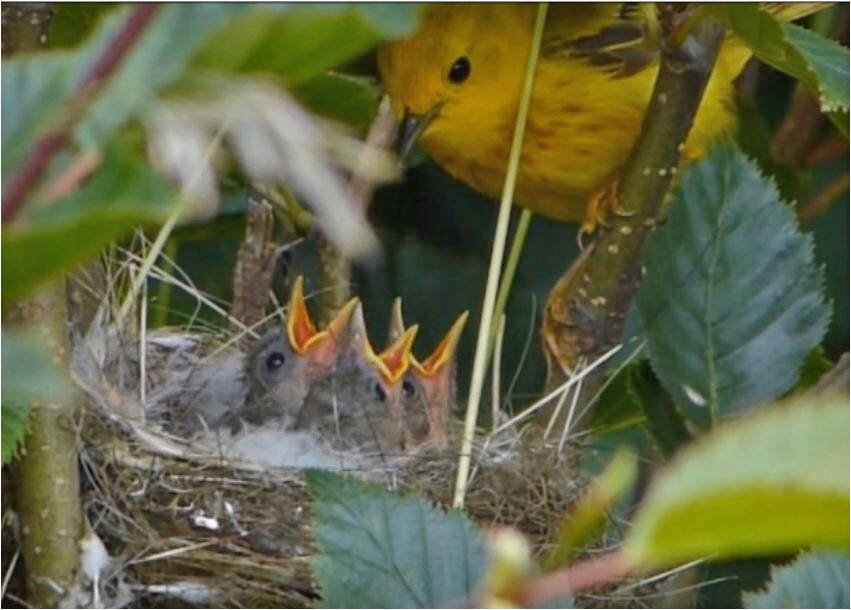
Hungry yellow warbler chicks beg for food with open mouths. (Photo by Bob Armstrong)
And then there are species in which the female makes the ultimate sacrifice, giving her offspring the opportunity to feed on her body until it’s used up. This intriguing habit is known as matriphagy, a fancy way of saying mother-eating. Here are some examples. The little telephone-pole beetle has a very complex reproductive pattern, and in one variety of that complexity the male larvae feed on their mother’s body. Earwig females are attentive mothers; in some species, females may bring food to their larvae and those larvae may also consume her body before they leave the nest. In times of famine, the females of a pseudoscorpion allow their offspring to take fluid from their leg joints and eat their bodies. When stressed, females of a certain nematode can retain her fertilized eggs and let the larvae hatch inside her body, where they eat her from the inside. An Australian crab spider makes trophic eggs and demolishes them inside the female’s body; nutrients from those eggs passes into the female’s body fluids and the larvae drink it from her leg joints; those larvae eventually eat the whole body of the mother. Females of the black-lace spider seem to invite the kids to feed; they come and poison her, suck her dry, and ultimately consume her body. Certain Old-World desert spider mothers (planning ahead, so to speak) liquefy their insides, putting all that nutrition into vacuoles, and their larvae puncture the bodies and drain all the fluid out. Matriphagy is an expensive way to feed the kids, but it works — the kids can be shown to survive well.
This essay is aimed at noting the great variety of ways to feed offspring. I’ve not attempted to explain even some of the factors that account for the evolution of that variety. Lots to wonder about!
• Mary F. Willson is a retired professor of ecology. “On the Trails” appears every Wednesday in the Juneau Empire.
