
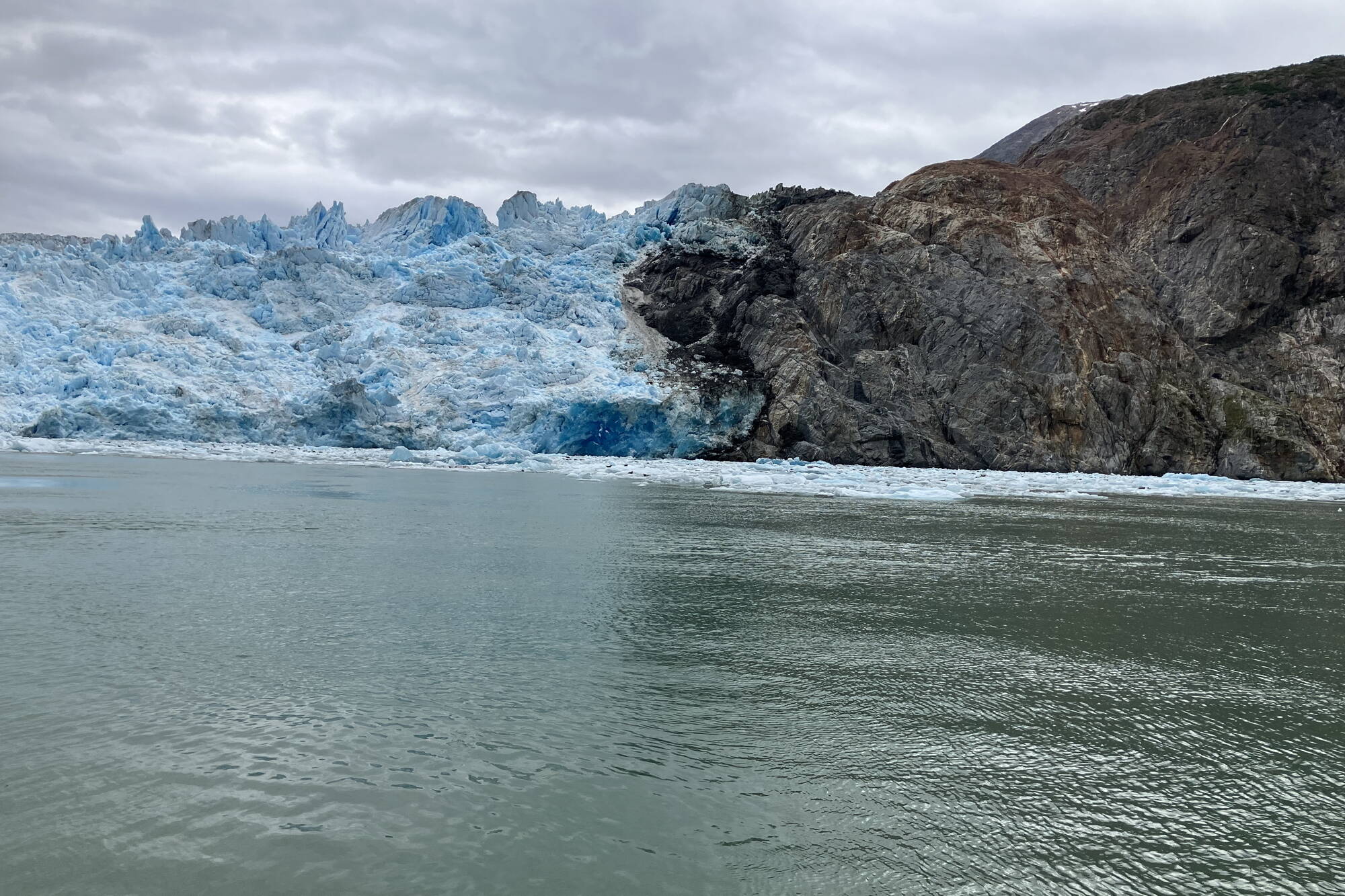
In late August I went on a day cruise to Tracy Arm. The weather was good for observing: gray, overcast skies to reduce the glare and no rain (except a little on the way home). Amazingly, the tour boat was not totally jam-packed with sightseers, so we could all move around fairly comfortably.
We saw several humpback whales cruising to and fro just under the surface and exhaling a misty spout at intervals. Each one eventually dove deep, showing a deep bend ahead of the tail and lifting the flukes as it disappeared.
The South Sawyer glacier has retreated a lot since my previous visit and now the fjord offers a nice long ride through the spectacular canyon. Spruce trees had colonized crevices and gullies in the lower part of the fjord, and as we passed up-bay, of course they got shorter and shorter and eventually vanished, leaving shrubs and lichens and more bare rock. I wish I knew some geology to enhance the viewing pleasure.
Near the face of the glacier lay a broad raft of many icebergs. Every comfortable berg had a resting harbor seal; there must have been about 200 of them, seldom moving more than raising a flipper or a head. A few immature gulls explored along the base of the ice wall, presumably hoping for fish. While we were there, the glacier dropped off a few more small calves, setting the berg-raft into gentle rocking motion.
We saw no bears, but we startled a flock of what I think were black scoters that took off in displeasure. And someone’s sharp eyes spotted a mountain goat partway up a steep slope, making use of a horizontal vegetated ledge. As we watched, second goat occasionally came out of that shrubbery to join the other one for a little while, before retreating back into cover. A pretty good trip!
In early September, a friend and I went out to the Amalga salt chuck in hopes of seeing the swans that had been reported there. No luck. But on the way, we saw a glossy young buck just getting his antlers, grazing peacefully on the roadside. We stopped to watch, as had an oncoming vehicle; eventually the little fellow bounded up into the woods. At the outflow of the salt chuck, we saw two female mergansers followed by a bunch of well-grown youngsters; apparently the mamas had merged their broods for a time. Across the outflow, disturbances in a little pool at the edge of the flowing water yielded two mink that then scrambled up along the shore into the brush. Whales spouted in the distance.
Then we decided to try the Horse Tram Trail from the Eagle Valley Center. The big clumps of comfrey near the trailhead were blooming well. At a couple of places along the trail to the cove that past the cabin, we found tiny toadlets pretending to be pebbles or hopping around. One was an unusual dark copper color, with paler copper-colored stripes, quite unlike the usual brown. All of them had already resorbed their tadpole tails. A porcupine had used the bridge, leaving pellets of its digested dinner. There was a chattering mixed-species flock of chickadees and some warblers (at least one was a Townsend’s) and a solitary wren. That was more small songbirds than I had seen in recent days.
A few days later, I went with another friend on the Boy Scout Camp/Crow Point trails. Remarkably, we had lovely sunshine. The trail by the river was notable for the aroma of rotting fish. Dried bits and pieces of fish littered the trail, the remnants of predators’ feasts. Out on the river and in the trees, eagles were too numerous for us to count. There were lots of juveniles in various stages of plumage maturation. Gulls picked at fish carcasses on the sandy flats exposed at low tide. Out on the delta, throngs of crows joined the gangs of gulls.
The flowering season was almost over. Fireweed had shed most of its seeds to the breezes. A few foam flowers and yarrows still showed us their fading white flowers but the queens of the white flowers were those of strawberries, still fresh-looking. A little blue-flowered herb, known by its generic name of Swertia, was flowering well but obviously was not in the mountainside meadow habitat where we usually see it. A nice treat was waiting for us near the south end of the beach: in the meadow not far from the iconic cottonwood tree was an isolated prickly rose bush. It bore a number of open flowers and even some optimistic buds (their chances of fulfilling their mission by making a fruit must be low…). Several highbush cranberry shrubs bore good crops of scarlet berries.
A flock of geese flew over the big meadow, talking among themselves, and landed. After a few minutes, some of them lifted off and went on their own way. And so did we.
The next day I walked the dike trail, grumbling because I had carried my heavy binoculars and the place was almost without visible vertebrate activity — two sparrows, an eagle, a cone-harvesting squirrel; no geese, no ducks, no shorebirds, not even a harrier cruising over the meadows. However, I did see a nice woolly-bear caterpillar crossing the trail. On the way back from visiting the roses at the end of the trail, I happened to perch for a moment at the little bench and looked out over the lagoons. Still nothing! Ah, but wait a minute. There were three dark lumps on the far side of a lagoon, and yes, they moved. So I paid attention; those binoculars were useful after all. The lumps were swimming, apparently foraging in a small channel over there. But not ducks; mammals. Two seemed to be a wee bit smaller than the third and often swam over to make light contact. Hmm, that was a hint. Then, when they occasionally climbed out of the water to walk over the sand, I could see some key physical features. That clinched it! A family of otters!
Thanks to Koren Bosworth for helpful consultation about Swertia.
• Mary F. Willson is a retired professor of ecology. “On The Trails” appears every Wednesday in the Juneau Empire.
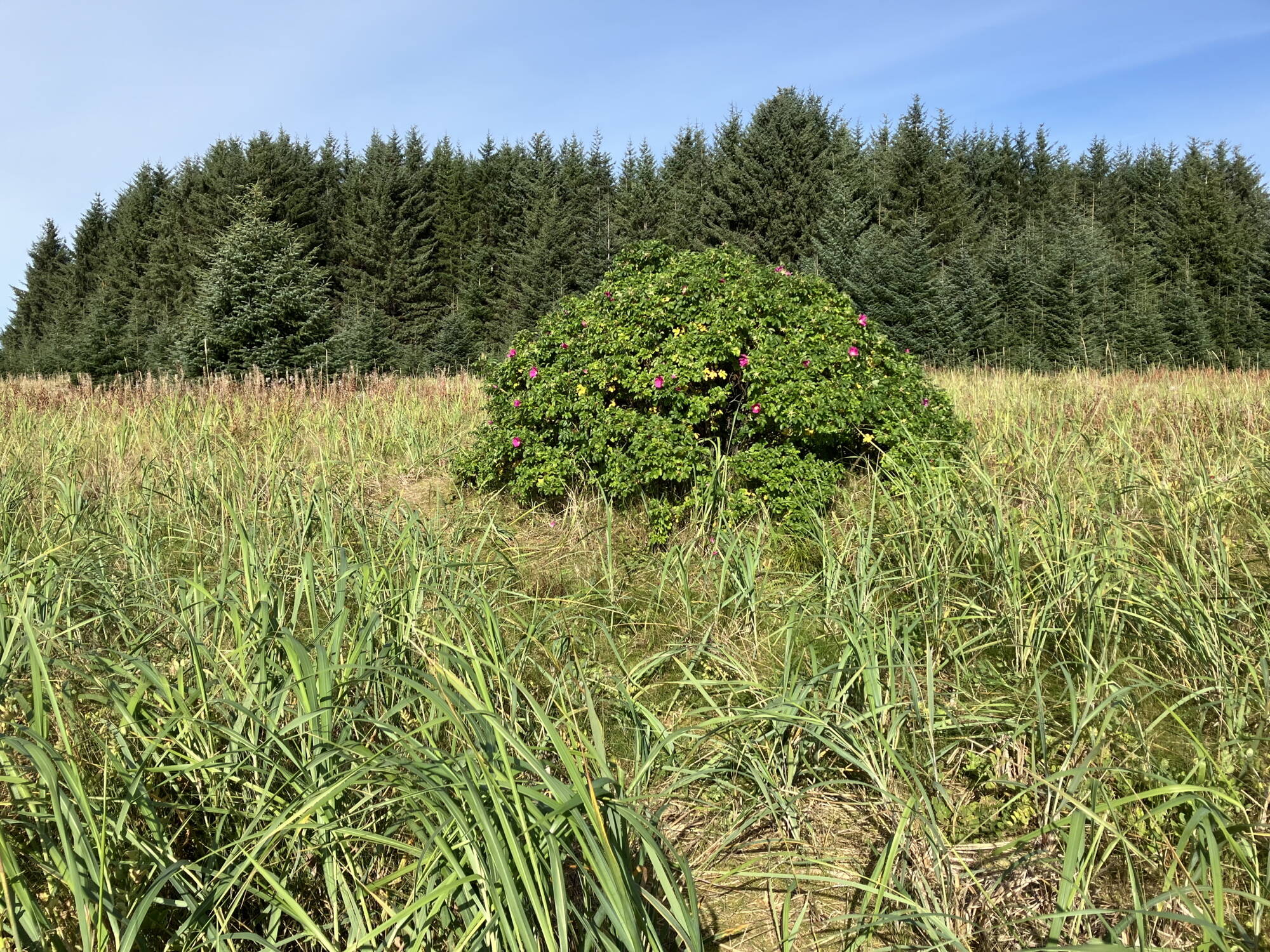
A shapely rose bush still bore flowers and buds. (Photo by Mary F. Willson)
