
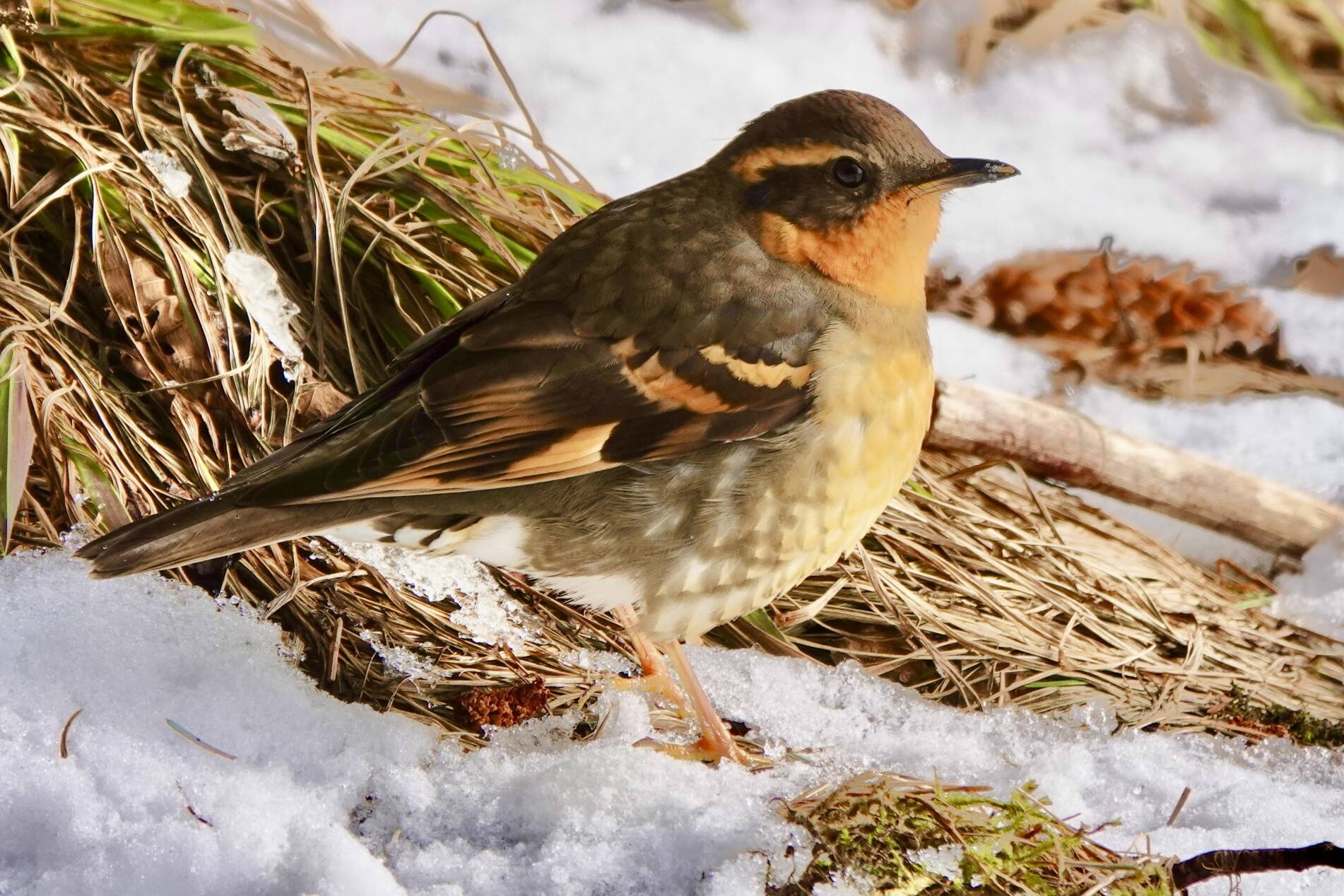
A female varied thrush pauses to look around during her foraging bout. (Photo by Helen Unruh)

A female varied thrush pauses to look around during her foraging bout. (Photo by Helen Unruh)

On the Trails: Early signs of spring

The ground is heavily blanketed with snow. The snow berms in my driveway (and, dangerously, at some street intersections too) are still over six feet high. Skiers streak by, over in the campground. And the flocks of redpolls are still here, cleaning out a quart of seed in a couple of hours.

But the days are perceptibly longer and the critters know it. We see pairs of eagles sitting companionably together on a branch; one pair was bringing small sticks to an old nest that needed refurbishment. Two pairs of mallards have been visiting my still-ice-covered pond, hanging out in the bit of open water by the little dam. They venture out onto the ice to feed on fallen bird seed.

All winter long, I’ve had one squirrel visiting my feeders, stealing peanut butter from the birds and scavenging fallen sunflower seeds. She (I think it’s a she) made tunnels through the heaps of snow under my deck, perhaps to get protected access to seeds on the ground.

Now I’ve started to see not one but two – or even three! —squirrels in my yard, usually engaging in long chases. It’s that time of year for them too. The strict territorial defenses weaken, borders are ignored, and the chases are on. If they work things out well, a litter may be born in five or six weeks later.

Plants are showing visible seasonal responses too; the leaf buds of cottonwood and alder are noticeably fatter than their winter slim-ness and a bit of green peeps out of a few leaf buds. In a few places, alder catkins are no longer stiff and almost upright but hanging down, tightly closed but getting ready to open up and release pollen. And on the tall blueberry shrubs, there are a few stems showing red with green buds.

Out on the Dike Trail, in addition to some ducks, we initially saw numerous small groups of geese, scattered all over the meadow. Later, however, most of those groups had coalesced into a mob of maybe three hundred or so, all grubbing into the upper soil, perhaps seeking sedge roots. Suddenly, some of that mob took flight, circling widely before landing. We noticed that the only geese that took to the air were the ones directly below the flight path of an eagle. All the foragers to the sides of that flight path stayed put and the disturbed part of the flock quickly returned to their feeding sites. This was the first time this year that I have seen such large numbers of geese out there, suggesting that the migration season has begun for them.

A few days later, still in mid-February, as I set out with another friend to walk the dike trail, my sharp-eared friend heard a junco singing from the top of a tree near the edge of the wetlands. Juncos typically stay here all winter, foraging on whatever seeds they can find, including those offered at seed feeders. They are among the first songbirds to try out their voices as spring approaches. So this was a real treat.

Those annual harbingers of spring, the Varied Thrushes, have been here at least since the time when the big snows fell this winter, and some of them may have stayed here all winter, as they are known to do sometimes. They are beginning to appear in several places now, indicating that more of them may be arriving. But no reports yet of singing. So start listening for them…they may be a bit subdued at first, before revving up to full song.

Is it just possible that I’m a bit impatient for springtime’s fun and so I’m seeking signs that it will really happen?

• Mary F. Willson is a retired professor of ecology. “On The Trails” appears every Wednesday in the Juneau Empire.
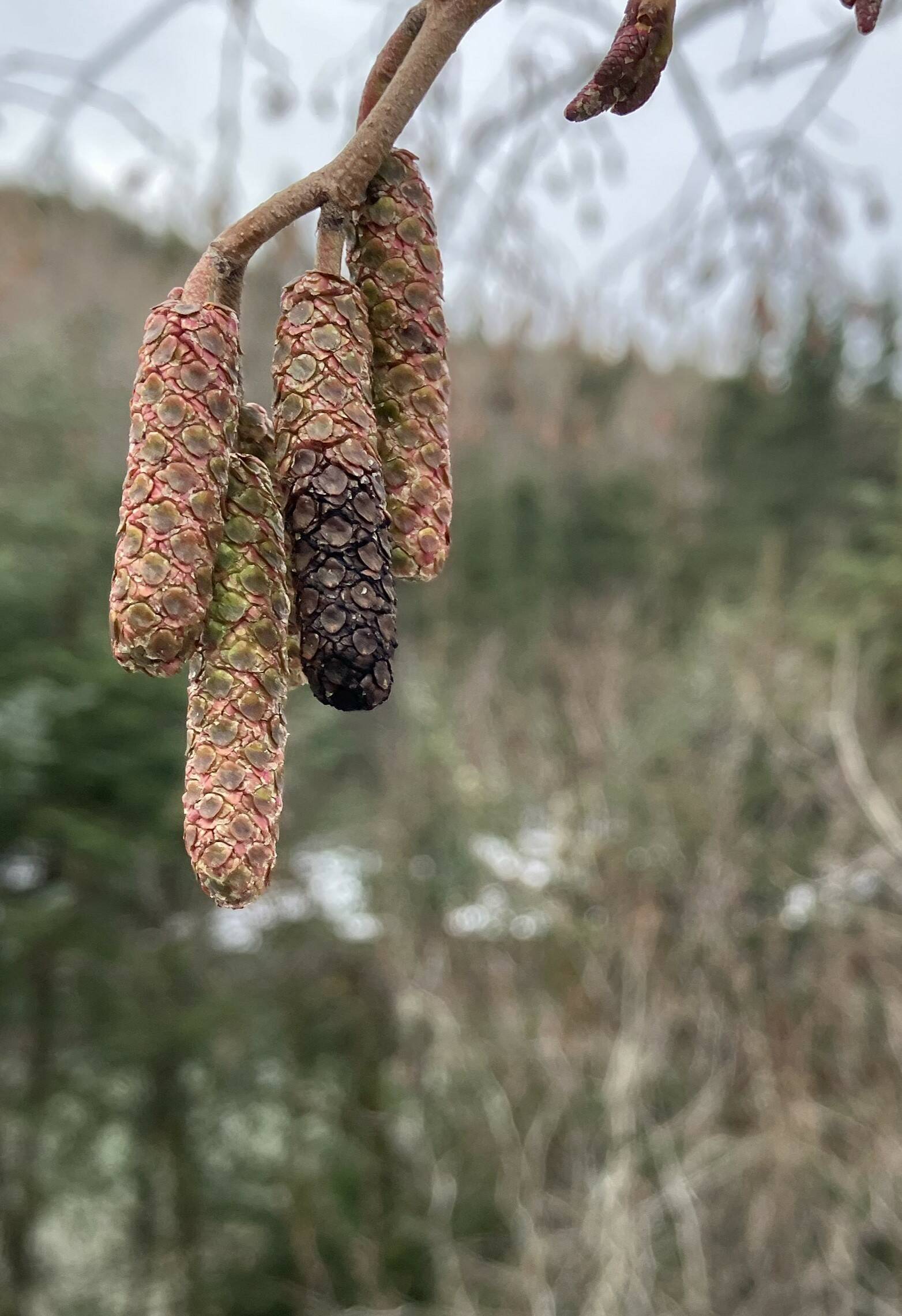
Alder catkins are still tightly closed but now hang downward; they will open to release pollen to the breezes. (Photo by Mary F. Willson)

Alder catkins are still tightly closed but now hang downward; they will open to release pollen to the breezes. (Photo by Mary F. Willson)

More in Sports

Senior Juneau-Douglas High School: Yadaa.at Kalé hockey players were recognized at the Treadwell Arena on Friday, Jan. 23, 2026 before the Crimson Bears faced the Homer High School Mariners. Head coach Matt Boline and assistant coaches Mike Bovitz, Luke Adams, Jason Kohlase and Dave Kovach honored 11 seniors. (Chloe Anderson / Juneau Empire)
JDHS celebrates hockey team’s senior night with sweeping victory over Homer

The Crimson Bears saw an 8-2 victory over the Mariners Friday night.

Photo by Ned Rozell
Golds and greens of aspens and birches adorn a hillside above the Angel Creek drainage east of Fairbanks.
Alaska Science Forum: The season of senescence is upon us

Trees and other plants are simply shedding what no longer suits them

Things you won’t find camping in Southeast Alaska. (Jeff Lund/Juneau Empire)
I Went to the Woods: Sodium and serenity

The terrain of interior Alaska is captivating in a way that Southeast isn’t

An albacore tuna is hooked on a bait pole on Oct. 9, 2012, in waters off Oregon. Tuna are normally found along the U.S. West Coast but occasionally stray into Alaska waters if temperatures are high enough. Sport anglers catch them with gear similar to that used to hook salmon. (Photo provided by the National Oceanic and Atmospheric Administration/West Coast Fisheries Management and Marine Life Protection)
Brief tuna bounty in Southeast Alaska spurs excitement about new fishing opportunity

Waters off Sitka were warm enough to lure fish from the south, and local anglers took advantage of conditions to harvest species that make rare appearances in Alaska

Isaac Updike breaks the tape at the Portland Track Festival. (Photo by Amanda Gehrich/pdxtrack)
Updike concludes historic season in steeplechase heats at World Championships

Representing Team USA, the 33-year-old from Ketchikan raced commendably in his second world championships

A whale breaches near Point Retreat on July 19. (Chloe Anderson/Juneau Empire)
Weekly Wonder: The whys of whale breaching

Why whales do the things they do remain largely a mystery to us land-bound mammals

Renee Boozer, Carlos Boozer Jr. and Carlos Boozer Sr. attend the enshrinement ceremony at the Naismith Basketball Hall of Fame in Sprinfield, Massachusetts, on Saturday, Sept. 6, 2025. As a member of the 2008 U.S. men's Olympic team, Boozer Jr. is a member of the 2025 class. (Photo provided by Carlos Boozer Sr.)
Boozer Jr. inducted into Naismith Hall of Fame with ‘Redeem Team’

Boozer Jr. is a 1999 graduate of Juneau-Douglas: Yadaa.at Kale

Photo by Martin Truffer
The 18,008-foot Mount St. Elias rises above Malaspina Glacier and Sitkagi Lagoon (water body center left) in 2021.
Alaska Science Forum: The long fade of Alaska’s largest glacier

SITKAGI BLUFFS — While paddling a glacial lake complete with icebergs and… Continue reading

Photo by Jeff Lund/Juneau Empire
The point of fishing is to catch fish, but there are other things to see and do while out on a trip.
I Went to the Woods: Fish of the summer

I was amped to be out on the polished ocean and was game for the necessary work of jigging

A female brown bear and her cub are pictured near Pack Creek on Admiralty Island on July 19, 2024. (Chloe Anderson for the Juneau Empire)
Bears: Beloved fuzzy Juneau residents — Part 2

Humor me for a moment and picture yourself next to a brown bear

Isaac Updike of Ketchikan finished 16th at the World Championships track and field meet in Budapest, Hungary, on Tuesday. (Alaska Sports Report)
Ketchikan steeplechaser makes Team USA for worlds

Worlds are from Sept. 13 to 21, with steeplechase prelims starting on the first day

Old growth habitat is as impressive as it is spectacular. (Photo by Jeff Lund/Juneau Empire)
I Went to the Woods: The right investments

Engaged participation in restoration and meaningful investment in recreation can make the future of Southeast special