
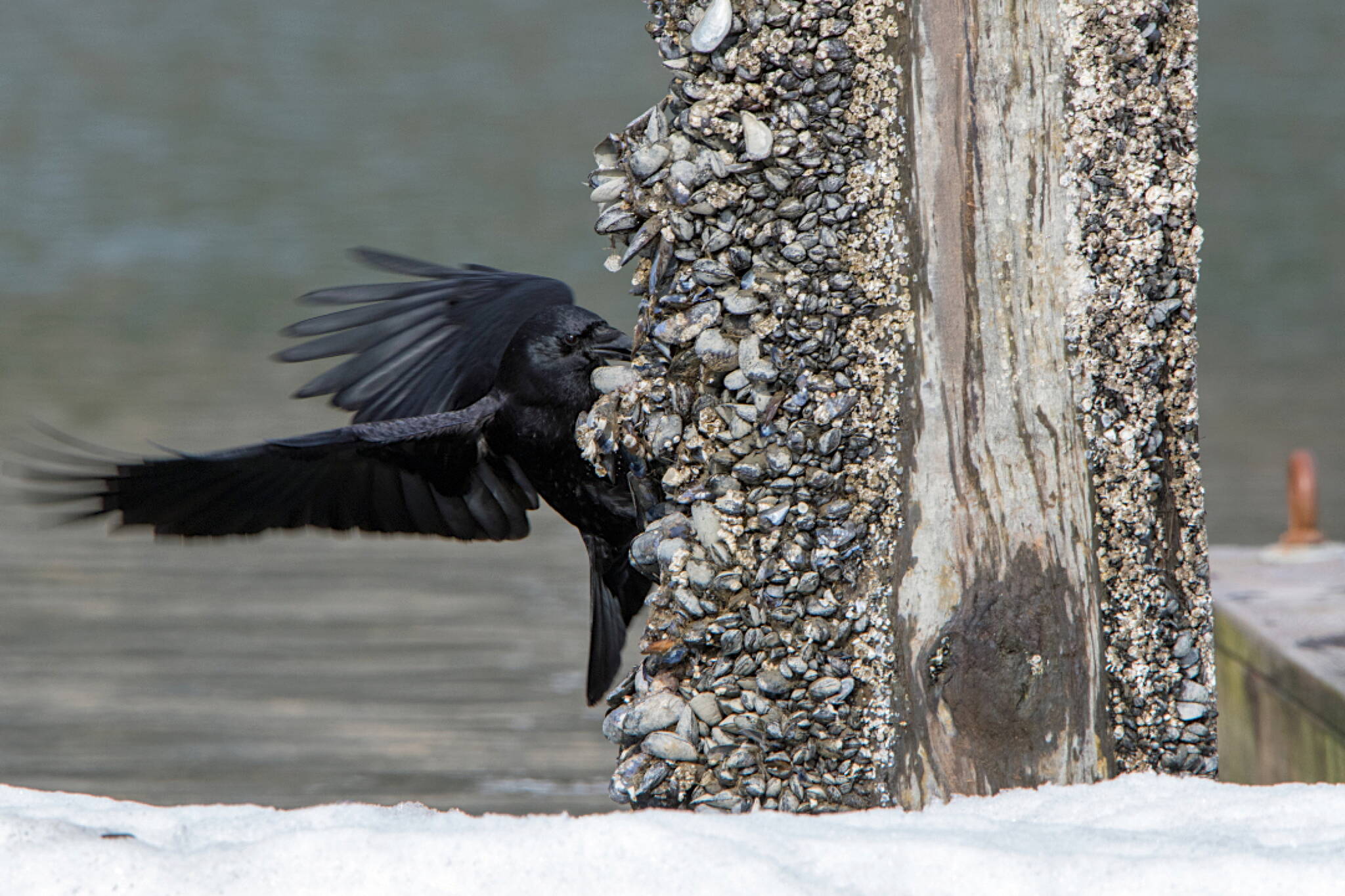
Crows, jays, ravens, magpies and their various other relatives (nutcrackers, choughs, jackdaws, etc.) belong to the taxonomic family Corvidae. It’s a sizeable family of about 130 species — a smaller assemblage than that of thrushes (over 300 species) or flycatchers (over 400 species), but with more species than most other kinds of songbirds. Corvids probably originated in Australia, then spread and diversified around the world, nesting on every continent except Antarctica.
Yes, corvids are indeed classified as songbirds, although they don’t typically fill the air with melodic springtime songs of territory defense and mate attraction. We’re more familiar with their croaks, rasps, caws, and squawks, but in fact many of them can make very musical passages, usually in a more intimate setting. The family interests me in many ways, including some fascinating contrasts.
Corvid plumages feature mainly black, grays, white, and blue, sometimes brown — no yellow throats or red crests or orange breasts. There are exceptions to that generalization:
1) The green jay of Central America and Mexico and its very close relative (sometimes classified as the same species) in the Andes of South America. These birds, with their green body plumage, are exceptions even in their own genus (Cyanocorax), most of which do not have green feathers.
2) The green magpies of Southeast Asia, with reddish flight feathers, red legs and bill, and green backs — one of them even has a bright yellow breast. How did it happen that these birds evolved plumage so different from their relatives? Many corvids have flashy plumage in contrasting black and white and blue, but the green jays and green magpies stand out for their colorful plumage.
Most corvids make open-cup nests of some sort, bowl-shaped and lined with soft material. But not our magpies or the several other species in the genus Pica, which live in North America and Eurasia. They make substantial nests with a sturdy dome of sticks over the cup. Why put a dome on a nest?? Clearly, a cover on a nest provides some sort of protection…the nest contents are less visible and they are shielded from weather extremes, such as hot sun and rain. Descriptions of the nesting habitats of these magpies generally mention “open” areas with scattered trees or shrubs. So protection from hot sun might have encouraged the evolution of these domed nests. That idea gets some support from the observation that two species in the genus thought to be most closely related to Pica occasionally put domes on their nests: one may sometimes make just a loose one and another one does so conditionally — only when the nest is placed in shrubbery that is not dense. Alternatively, are there predators in these habitats that are deterred by a covered nest?
Corvids are generally omnivores, eating all kinds of things. Within that generalization are several interesting ecological relationships. Several kinds of corvid cache food items, to be retrieved later. Other birds cache things too, but the corvids typically cache their prizes in the ground. When they store seeds, that kind of location is a likely place for forgotten seeds to germinate, so the corvids are part of a mutualism with the seed-bearing plants. For instance, the nutcrackers of North America and Eurasia specialize on various kinds of pine seeds, storing them in a pouch under the tongue and caching thousands of them each fall. They can disperse those seeds many kilometers from the parent trees and, because not all caches are retrieved, they are reported to be important in re-establishing pine forest in burned or cleared areas. The birds can remember their cache sites for several months, allowing them to store seeds in the fall and feed them to their chicks in spring.
Here’s another example. Pinyon jays of southwestern U. S are highly social, flocking and nesting in groups. They specialize on the seeds of pinyon pines, caching them and remembering those locations.
Both the jays and the pines have adaptations that contribute to this co-evolved mutualism. The pines retain their seeds in the cone, not releasing them as most pines do, and the jays can just pick them up off the cone scales if the cone is open or, if the cone is still closed, hack open the cone with their strong bills. The cones are upright and easy to access, presenting their seeds to the jays. Dark-colored seeds are good, ready for dispersal, and the jays favor those over pale seeds. The jays can carry dozens of seeds at a time in an expandable esophagus. The jays have no feathers near their nostrils, so they don’t get pine resin stuck on their faces when they hack open cones, and a specialized jaw articulation that absorbs the impact of hammering the seeds.
Many kinds of birds use tools of various types, gaining access to food by probing, prying, or cutting. The corvids do so, and some even make their tools. For instance, the palm cockatoo makes drumsticks used to enhance its social displays. But perhaps the most famous avian tool-maker is the New Caledonian crow, which can even put together two separate items to make a tool.
• Mary F. Willson is a retired professor of ecology. “On The Trails” appears every Wednesday in the Juneau Empire.
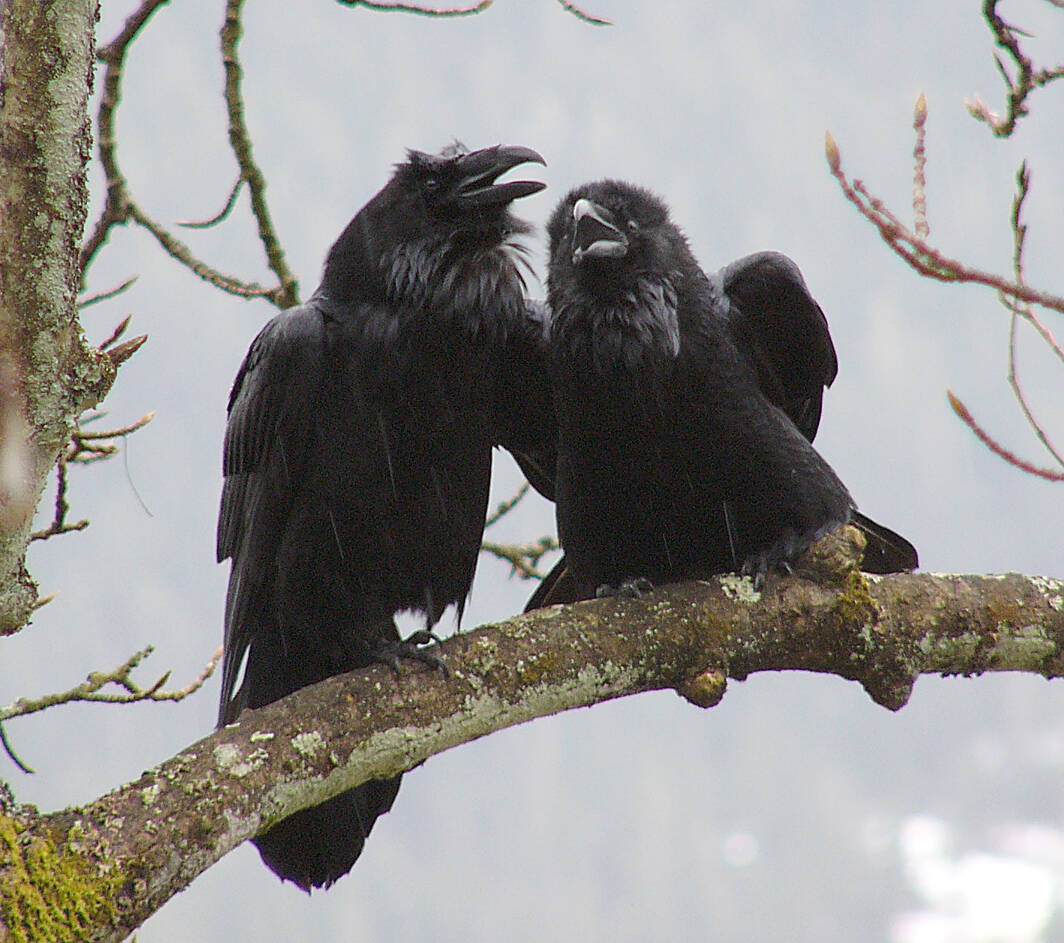
A pair of ravens converse quietly. (Photo by Bob Armstrong)
