
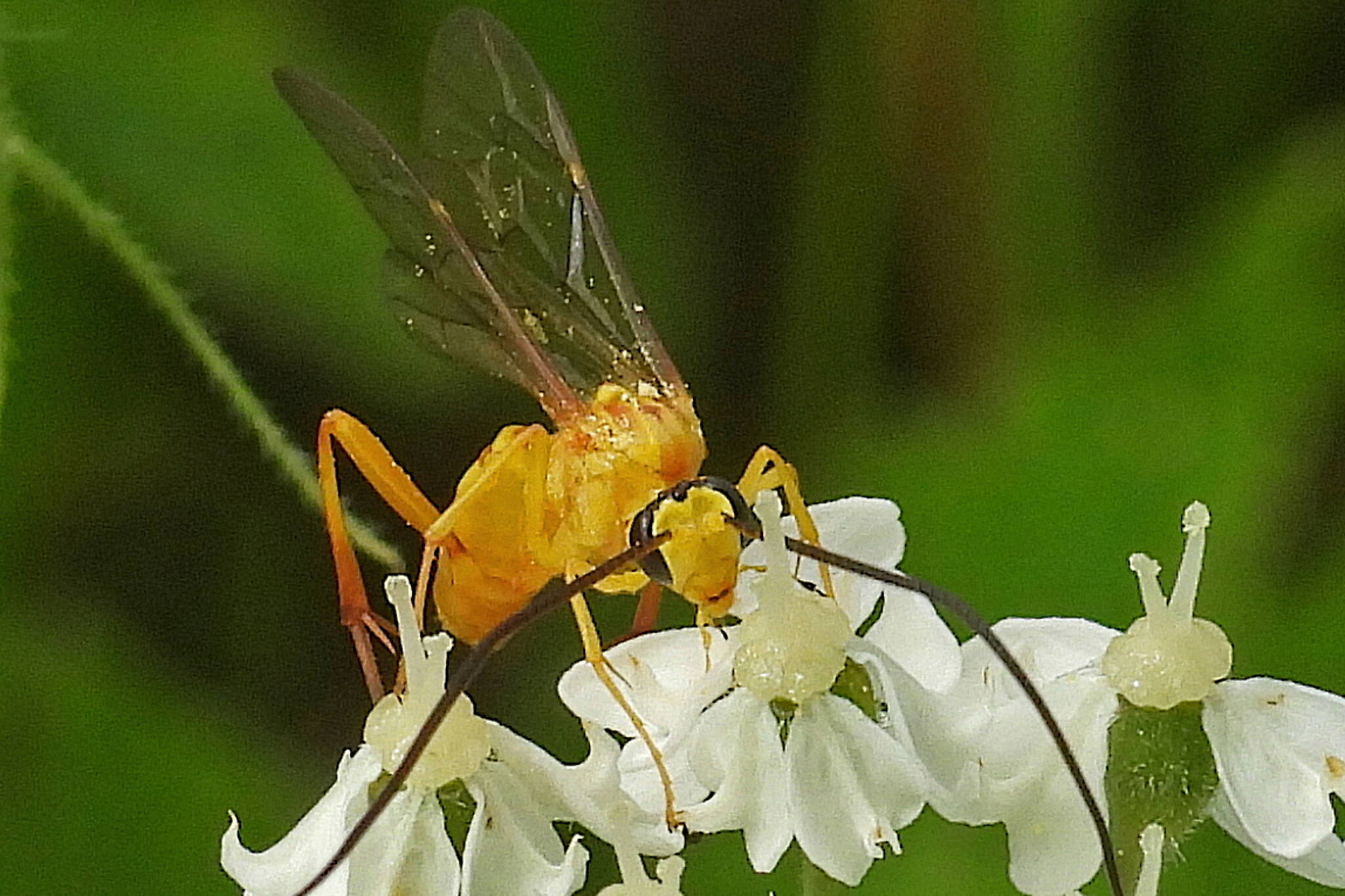
A common aerial wasp forages on cow parsnip flowers. (Photo by Bob Armstrong)

A common aerial wasp forages on cow parsnip flowers. (Photo by Bob Armstrong)

On the Trails: Cow parsnip flowers

Cow parsnip is known in our field guides as Heracleum lanatum, although it sometimes has other names. The flowers are typically displayed in big, flattish inflorescences called “umbels,” each umbel comprised of several small “umbelets.” On each umbelet, the outer ring of flowers has larger petals than the others. The literature says that some flowers are strictly male, while others are hermaphroditic. Those outer flowers seem to mature ahead of the others and often lose their stamens, so they appear to be female, but really they were both male and female. Most flowers are small, only a few millimeters across, but they offer pollen and nectar to insect visitors.

At times, nothing seems to be happening on those big inflorescences, but at other times it is possible to watch the insects as they visit the flowers. I recently strolled with a friend up along Montana Creek and things were happening on cow parsnip inflorescences (which flowered later here than in other places, where the plant is already producing fruits). Some on the inflorescences were covered with dozens of flies of various sizes, from vanishingly small to the size of house flies. I have no idea who they were (except for a few hoverflies) and some of them were orange rather than blackish. We also saw a few tiny beetles, small brown moths, and a small black and white moth. Most of those visitors were sipping nectar, and maybe eating pollen, moving from flower to flower. At least some of those insects are surely pollinators, as they are for closely related plants.

Five bumblebees rest and forage on cow parsnip flowers. (Photo by Pam Bergeson)

Five bumblebees rest and forage on cow parsnip flowers. (Photo by Pam Bergeson)

Of special interest were several inflorescences with bumblebees (also potential pollinators); one inflorescence had five of those bees. The bees were very quiet, hardly moving, but they weren’t dead. Looking closely, we could usually see antennae waving or mouthparts extending to obtain nectar. A few bees were so quiet that we wondered if they were alive, but a gentle touch with a grass stem elicited a response; they were just resting. There weren’t many other kinds of open flowers along the roadway, aside from buttercups (which show no insect activity), and I wondered if these bees were driven to find some food on the tiny flowers of cow parsnip.

We looked carefully at the aggregations of insects to see if they interacted in some way. In the past, we have sometimes seen predatory wasps acting (deceitfully) like nectar foragers but, instead, sidling up to an unsuspecting fly and pouncing on it. But that we did not see on this particular day. However, sometimes wasps (with or without predatory intentions) do forage for nectar. For another time, it would be interesting to look at the inflorescences at night, to see who visits then.

Cow parsnip and many of its relatives produce powerful chemical substances as protection. The best known are furanocoumarins, which seem to defend the plant against fungi and perhaps other consumers. Despite the chemical defenses, bears and grazing mammals are reported to eat the plant. The amount and concentration of furanocoumarins depends in part on light and nutrients, and in some cases they are induced by herbivore attacks. Some insects have evolved the means of coping with the defensive substances and use cow parsnip as host plants for their larvae; that is so for some swallowtail butterflies and a number of types of moth, including the parsnip webworm and a stem borer.

As local hikers may know or at least learn about quickly, the sap of cow parsnip can raise big itchy, sore patches if it get on the skin and is exposed to sunlight. The defensive chemicals are phototoxic, so walkers are advised to avoid getting the sap on their exposed skin.

• Mary F. Willson is a retired professor of ecology. “On The Trails” appears every Wednesday in the Juneau Empire.

More in Sports

Senior Juneau-Douglas High School: Yadaa.at Kalé hockey players were recognized at the Treadwell Arena on Friday, Jan. 23, 2026 before the Crimson Bears faced the Homer High School Mariners. Head coach Matt Boline and assistant coaches Mike Bovitz, Luke Adams, Jason Kohlase and Dave Kovach honored 11 seniors. (Chloe Anderson / Juneau Empire)
JDHS celebrates hockey team’s senior night with sweeping victory over Homer

The Crimson Bears saw an 8-2 victory over the Mariners Friday night.

Photo by Ned Rozell
Golds and greens of aspens and birches adorn a hillside above the Angel Creek drainage east of Fairbanks.
Alaska Science Forum: The season of senescence is upon us

Trees and other plants are simply shedding what no longer suits them

Things you won’t find camping in Southeast Alaska. (Jeff Lund/Juneau Empire)
I Went to the Woods: Sodium and serenity

The terrain of interior Alaska is captivating in a way that Southeast isn’t

An albacore tuna is hooked on a bait pole on Oct. 9, 2012, in waters off Oregon. Tuna are normally found along the U.S. West Coast but occasionally stray into Alaska waters if temperatures are high enough. Sport anglers catch them with gear similar to that used to hook salmon. (Photo provided by the National Oceanic and Atmospheric Administration/West Coast Fisheries Management and Marine Life Protection)
Brief tuna bounty in Southeast Alaska spurs excitement about new fishing opportunity

Waters off Sitka were warm enough to lure fish from the south, and local anglers took advantage of conditions to harvest species that make rare appearances in Alaska

Isaac Updike breaks the tape at the Portland Track Festival. (Photo by Amanda Gehrich/pdxtrack)
Updike concludes historic season in steeplechase heats at World Championships

Representing Team USA, the 33-year-old from Ketchikan raced commendably in his second world championships

A whale breaches near Point Retreat on July 19. (Chloe Anderson/Juneau Empire)
Weekly Wonder: The whys of whale breaching

Why whales do the things they do remain largely a mystery to us land-bound mammals

Renee Boozer, Carlos Boozer Jr. and Carlos Boozer Sr. attend the enshrinement ceremony at the Naismith Basketball Hall of Fame in Sprinfield, Massachusetts, on Saturday, Sept. 6, 2025. As a member of the 2008 U.S. men's Olympic team, Boozer Jr. is a member of the 2025 class. (Photo provided by Carlos Boozer Sr.)
Boozer Jr. inducted into Naismith Hall of Fame with ‘Redeem Team’

Boozer Jr. is a 1999 graduate of Juneau-Douglas: Yadaa.at Kale

Photo by Martin Truffer
The 18,008-foot Mount St. Elias rises above Malaspina Glacier and Sitkagi Lagoon (water body center left) in 2021.
Alaska Science Forum: The long fade of Alaska’s largest glacier

SITKAGI BLUFFS — While paddling a glacial lake complete with icebergs and… Continue reading

Photo by Jeff Lund/Juneau Empire
The point of fishing is to catch fish, but there are other things to see and do while out on a trip.
I Went to the Woods: Fish of the summer

I was amped to be out on the polished ocean and was game for the necessary work of jigging

A female brown bear and her cub are pictured near Pack Creek on Admiralty Island on July 19, 2024. (Chloe Anderson for the Juneau Empire)
Bears: Beloved fuzzy Juneau residents — Part 2

Humor me for a moment and picture yourself next to a brown bear

Isaac Updike of Ketchikan finished 16th at the World Championships track and field meet in Budapest, Hungary, on Tuesday. (Alaska Sports Report)
Ketchikan steeplechaser makes Team USA for worlds

Worlds are from Sept. 13 to 21, with steeplechase prelims starting on the first day

Old growth habitat is as impressive as it is spectacular. (Photo by Jeff Lund/Juneau Empire)
I Went to the Woods: The right investments

Engaged participation in restoration and meaningful investment in recreation can make the future of Southeast special