
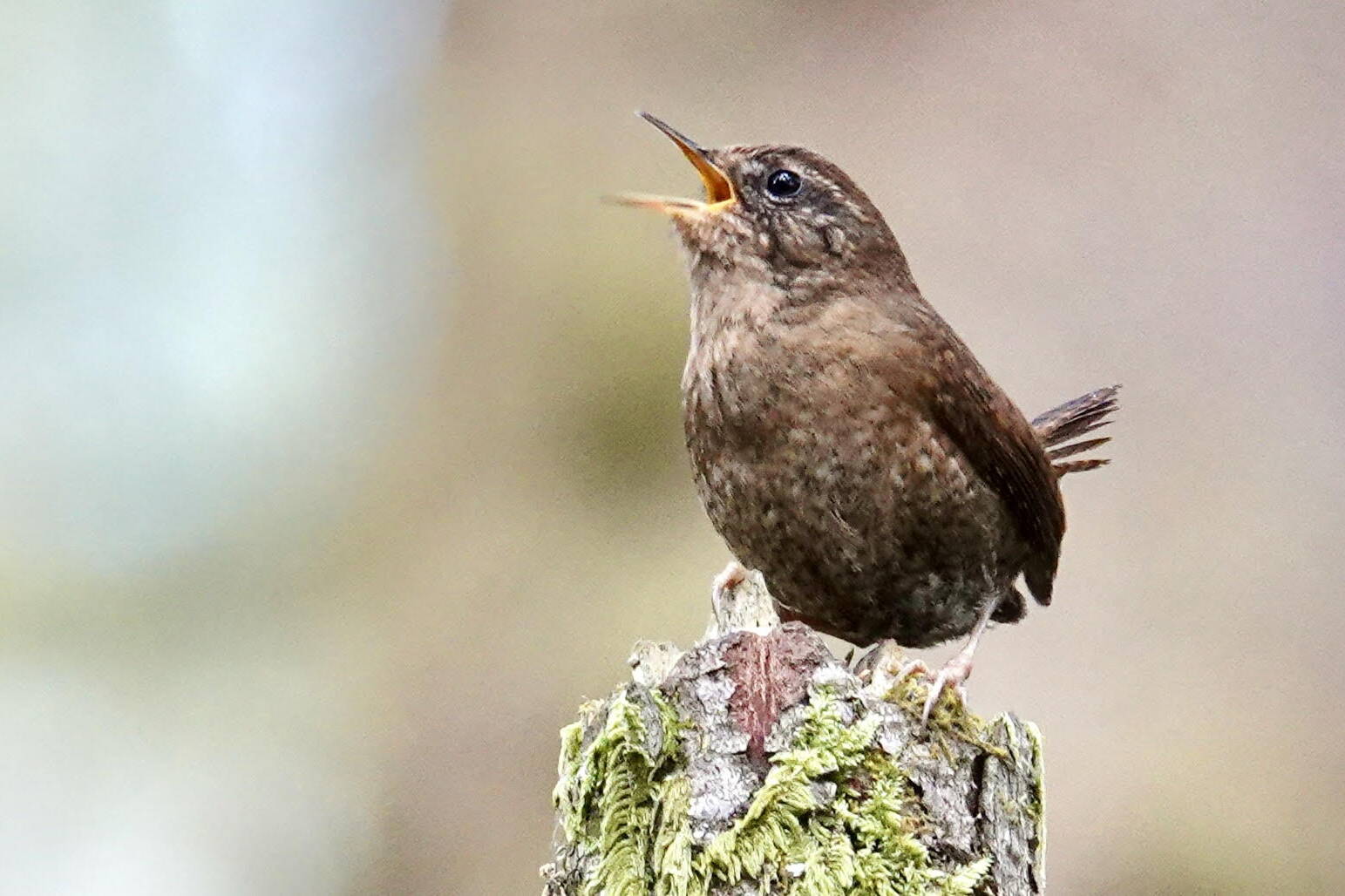
A Pacific wren sings in the understory. (Photo by Helen Uhruh)

A Pacific wren sings in the understory. (Photo by Helen Uhruh)

On the Trails: April jaunts

A walk at Fish Creek was productive, as it usually is. The marine side of the point was full of ducks: widgeon, green-wing teal, mallards, and even a few pintails. Along the way, a friend and I found shooting stars and chocolate lilies just coming up. Out on the point, we gently turned over a few rocks, finding several pseudoscorpions and some equally miniature spiders (still to be identified). I’d love to be able to watch these tiny predators hunt and eat their tiny prey.

Over a sandbar across one of the outlet channels of the creek, we saw an adult eagle with a captured duck dangling from its talons. The eagle landed on the bar, then subdued and ate most of its prey. Ever-observant juvenile eagles circled overhead, watching closely, with “me-too,” “me-too” attitudes. A few juveniles landed close to the successful adults — they apparently made nuisances of themselves, distracting the adult sufficiently that a different adult swooped in and grabbed the remnants of the duck. The thief made off with the carcass, going to a nearby dense stand of conifers where it was greeted by lots of noisy chattering, as if another bird was hoping to share the prize. Back on the sandbar there stood a bereft adult and several disappointed juveniles.

A few days later, another friend and I drove to North Douglas. On the way there, in the bay we saw hundreds of surf scoters in a long sinuous line extending from near the short way out into the bay. An odd distribution, as if they were maybe responding to nuances of tidal currents, and I wondered why. Later, on our way home, we saw that they were all gathered together more gregariously.

On the Outer Point trail, we were accompanied by the songs of wrens, varied thrushes, and ruby-crowned kinglets. We found a little group of wintergreens called “shy maiden” or “single delight” with well-formed buds soon to open. A big pleasure was finding some fern-leaf goldthread flowers all ready for action. We laughingly recalled that, on a Parks and Rec hike years ago when we hardly knew each other’s names, our very first conversation was about this species.

Fern-leaf goldthread is an interesting species. It can change its gender expression from year to year, something not all that common in the plant world. At any particular time, some plants bear wispy male flowers while others, slightly bulkier, are hermaphrodite. These may mature their male parts ahead of the female parts (protandry) or vice versa (protogyny). Years ago, a botanist friend and I transplanted some of these plants to a common garden and watched them in subsequent years. We observed that a plant that flowered as a male in one year might be either male or hermaphrodite the next year. But if a hermaphrodite plant bore fruit, it was likely to flower as a male the following year, suggesting that perhaps the cost of making fruit could make the plant decide it didn’t have the resources for doing it two years in a row.

A little stroll with a friend to Point Louisa one morning revealed the usual harlequins, goldeneyes, and scoters, and BINGO! — also a black oystercatcher, probing steadily into a pile of mussels. I have not seen them very often in recent years. We also saw two marbled murrelets drifting quietly offshore. A raven was making a ruckus — circling repeatedly over a perched eagle and making a call unfamiliar to me. Did that eagle have something special??

Later that sunny day, I went out on wetlands. There I struck it rich: arctic terns calling, swooping, and diving, white-fronted geese being lazy in the lagoon near the trailhead, and a yellow-rumped warbler foraging in the shrubs at the edge of the meadow. A good day!!

• Mary F. Willson is a retired professor of ecology. “On The Trails” appears every Wednesday in the Juneau Empire.
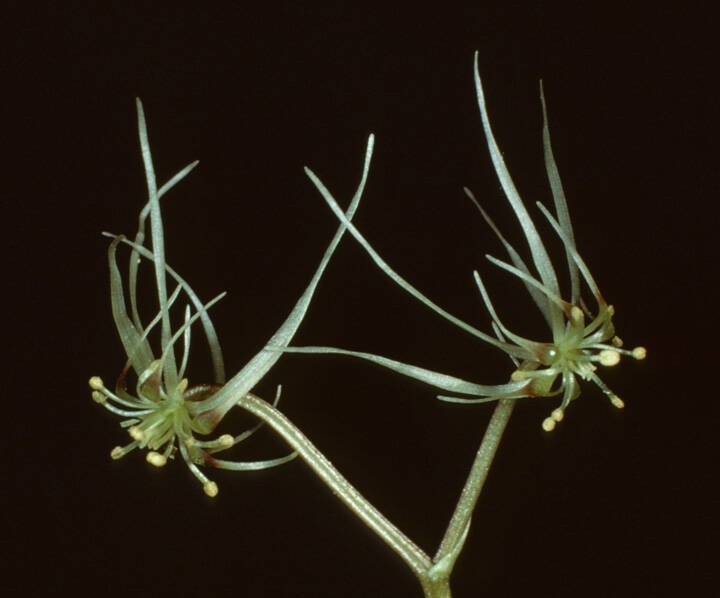
Male flowers of fern-leaf goldthread present their pollen to visiting insects. (Photo by Bob Armstrong)

Male flowers of fern-leaf goldthread present their pollen to visiting insects. (Photo by Bob Armstrong)

More in Sports

The Juneau-Douglas High School: Yadaa.at Kalé Crimson Bears won fourth place during the Division II Hockey State championships in Palmer last weekend. Photo courtesy of Rapi Sotoa
Juneau takes home fourth place during high school state hockey tournament

The Crimson Bears also received the Sportsmanship Award last weekend.

Senior Juneau-Douglas High School: Yadaa.at Kalé hockey players were recognized at the Treadwell Arena on Friday, Jan. 23, 2026 before the Crimson Bears faced the Homer High School Mariners. Head coach Matt Boline and assistant coaches Mike Bovitz, Luke Adams, Jason Kohlase and Dave Kovach honored 11 seniors. (Chloe Anderson / Juneau Empire)
JDHS celebrates hockey team’s senior night with sweeping victory over Homer

The Crimson Bears saw an 8-2 victory over the Mariners Friday night.

Photo by Ned Rozell
Golds and greens of aspens and birches adorn a hillside above the Angel Creek drainage east of Fairbanks.
Alaska Science Forum: The season of senescence is upon us

Trees and other plants are simply shedding what no longer suits them

Things you won’t find camping in Southeast Alaska. (Jeff Lund/Juneau Empire)
I Went to the Woods: Sodium and serenity

The terrain of interior Alaska is captivating in a way that Southeast isn’t

An albacore tuna is hooked on a bait pole on Oct. 9, 2012, in waters off Oregon. Tuna are normally found along the U.S. West Coast but occasionally stray into Alaska waters if temperatures are high enough. Sport anglers catch them with gear similar to that used to hook salmon. (Photo provided by the National Oceanic and Atmospheric Administration/West Coast Fisheries Management and Marine Life Protection)
Brief tuna bounty in Southeast Alaska spurs excitement about new fishing opportunity

Waters off Sitka were warm enough to lure fish from the south, and local anglers took advantage of conditions to harvest species that make rare appearances in Alaska

Isaac Updike breaks the tape at the Portland Track Festival. (Photo by Amanda Gehrich/pdxtrack)
Updike concludes historic season in steeplechase heats at World Championships

Representing Team USA, the 33-year-old from Ketchikan raced commendably in his second world championships

A whale breaches near Point Retreat on July 19. (Chloe Anderson/Juneau Empire)
Weekly Wonder: The whys of whale breaching

Why whales do the things they do remain largely a mystery to us land-bound mammals

Renee Boozer, Carlos Boozer Jr. and Carlos Boozer Sr. attend the enshrinement ceremony at the Naismith Basketball Hall of Fame in Sprinfield, Massachusetts, on Saturday, Sept. 6, 2025. As a member of the 2008 U.S. men's Olympic team, Boozer Jr. is a member of the 2025 class. (Photo provided by Carlos Boozer Sr.)
Boozer Jr. inducted into Naismith Hall of Fame with ‘Redeem Team’

Boozer Jr. is a 1999 graduate of Juneau-Douglas: Yadaa.at Kale

Photo by Martin Truffer
The 18,008-foot Mount St. Elias rises above Malaspina Glacier and Sitkagi Lagoon (water body center left) in 2021.
Alaska Science Forum: The long fade of Alaska’s largest glacier

SITKAGI BLUFFS — While paddling a glacial lake complete with icebergs and… Continue reading

Photo by Jeff Lund/Juneau Empire
The point of fishing is to catch fish, but there are other things to see and do while out on a trip.
I Went to the Woods: Fish of the summer

I was amped to be out on the polished ocean and was game for the necessary work of jigging

A female brown bear and her cub are pictured near Pack Creek on Admiralty Island on July 19, 2024. (Chloe Anderson for the Juneau Empire)
Bears: Beloved fuzzy Juneau residents — Part 2

Humor me for a moment and picture yourself next to a brown bear

Isaac Updike of Ketchikan finished 16th at the World Championships track and field meet in Budapest, Hungary, on Tuesday. (Alaska Sports Report)
Ketchikan steeplechaser makes Team USA for worlds

Worlds are from Sept. 13 to 21, with steeplechase prelims starting on the first day