

I recently made a quick trip to Gustavus to visit friends and ride the dayboat up Glacier Bay. A most satisfactory change of scene and — as a bonus — a wonderful change in weather: after many weeks of rain and drizzle, in mid-June there came two consecutive days of fabulous sunshine!
Wildlife sightings on the boat trip were excellent. Right at the start, there were dozens of sea otters drifting around in big rafts. There were more of them later on, too; some females with pups riding on their bellies. Usually the pups ride with their heads near that of the mother, but one pup did it the other way around.
Humpback whales were common, cruising just below the surface and spouting; only one showed its flukes as it dove. Sea lions of all sizes, including some very small ones, loafed on the rocks of South Marble Island. Some of the big fellows must have been basking there for a while — their fur was pale and looked very dry. Way up-bay, we saw a few harbor seals. Mountain goats showed themselves on clifftops and ledges at Gloomy Knob. When a marmot was spotted, there was an intense discussion over whether it was a marmot or a wolverine; the more knowledgeable observers clarified the issue.
Partway up-bay, we saw a brown bear on a small island, moseying around near the beach. Eventually it walked into the water and calmly swam to the mainland. Later on, we saw two brown bears foraging above the tideline — probably a courting couple, as it is that season for bears. The male was big, very dark brown, a little thin and worn; the female was smaller, lighter colored, and in good condition. The male reared up and ate catkins(?) from a willow and also dug persistently in the beach for edibles.
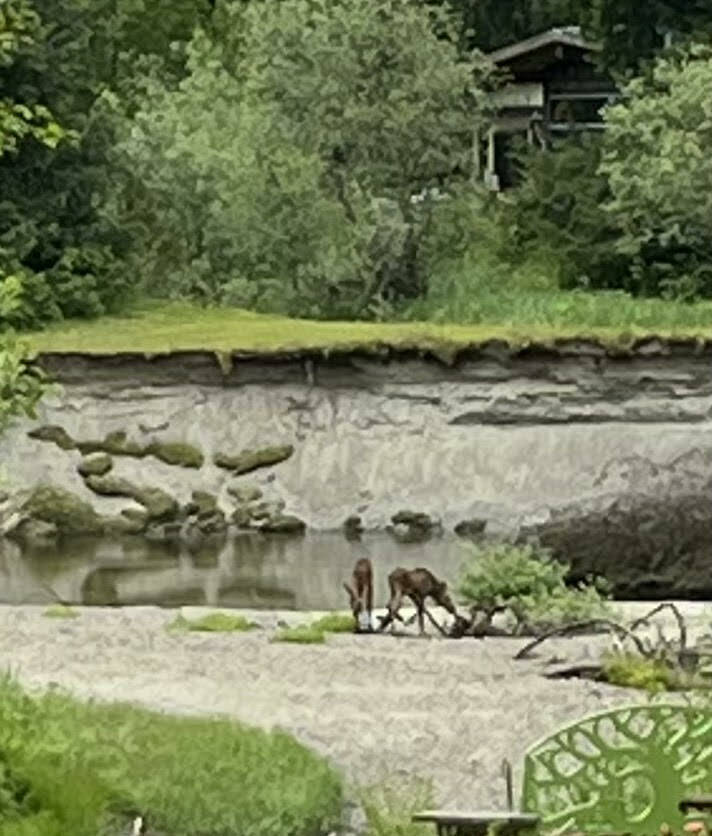
Moose calves gambol on the sand in Gustavus. (Photo by KM Hocker)
The bird show was good too. Here are some highlights. Lots of tufted puffins and a pair of horned puffins. Numerous pelagic cormorants, both breeding adults with their white flank patches and non-breeders perched on cliff ledges, flew about in small groups, and sometimes swam. Black-legged kittiwakes nested on rocky ledges. Oystercatchers perched on a few rocky reefs. There were several eagles, two of which got into a fight. Way up the bay, we saw Arctic terns sitting on the ice. On South Marble Island, relatively far from the mainland, song sparrows and fox sparrows were singing.
On land again, we walked the beach meadows, where we saw millions of strawberry flowers and little white sandwort flowers, along with lots of nagoon flowers.
We visited the little lake near the airport known locally as Lake Gustavus. Here we found many small toad tadpoles in the shallows. There were three or four broods of mallards with about 17 chicks, and a lazy male canvasback. A kingfisher appeared and disappeared. In the soft sand of the roadbed, we saw a remarkably huge bear footprint. Crossbills foraged in the conifers. Yellow-rumped warblers hawked insects in mid-air and sang. Distant sandhill cranes called. We found (both here and on the Forest Loop Trail at Bartlett Cove) lots of recently emerged damselflies (still to be identified) that had not yet acquired their full adult colors. They rested on the walkway in danger of being stepped on, so we carefully lifted some of them up to a higher perch.
At my friends’ house, we spent some very pleasant hours at a big window, watching a pair of tree swallows go in and out of a nest box and surveying a bend in the Salmon River, where mergansers rested on a sand bar. In the eroded river bank, bank swallows had dug several nest burrows just below the grassy turf line, and the swallows swooped through the air. In the bank below the swallow nests were three larger holes. A pair of kingfishers kept going in and out of one of them, occasionally scuffing out a bit of sand. They copulated on a pile of dead branches in the river. That seems very late to be thinking of starting a family; perhaps they failed on their first try.
Then, among the willows lining the river, we saw a large brown animal, very close to a willow tree. Binoculars revealed it to be a moose reaching up to feed on leaves, a cow moose with two ear tags and a collar. Her two calves, maybe about a month old, gamboled about on the beach, dashing into the water and back up to the brush where mama foraged and back down to the water’s edge. They cavorted around over there for some time, before trailing after mama back into the brush. What fun!
• Mary F. Willson is a retired professor of ecology. “On The Trails” appears every Wednesday in the Juneau Empire.
