
Alaska Science Forum: The secret life of red squirrels

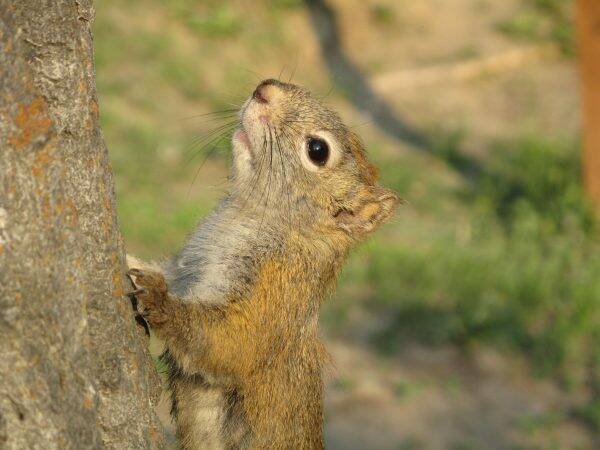
A red squirrel pauses on a tree on the University of Alaska Fairbanks campus. (Photo by Ned Rozell)

A red squirrel pauses on a tree on the University of Alaska Fairbanks campus. (Photo by Ned Rozell)

Stan Boutin has climbed more than 5,000 spruce trees in the last 30 years.

He has often returned to the forest floor knowing if a ball of twigs and moss within the tree contained newborn red squirrel pups.

Over the years, those squirrels have taught Boutin and his colleagues many things, including an apparent ability to predict the future.

Boutin, of the University of Alberta in Edmonton, was in Fairbanks once to give a lecture on one of the easiest-to-find animals in the boreal forest. The square-jawed biologist is perhaps the world’s foremost expert on red squirrels.

By marking squirrel pups with ear tags over the years, he and his helpers have gotten to know the entire red squirrel population of a square kilometer of boreal forest between Haines Junction and Kluane Lake in the Yukon.
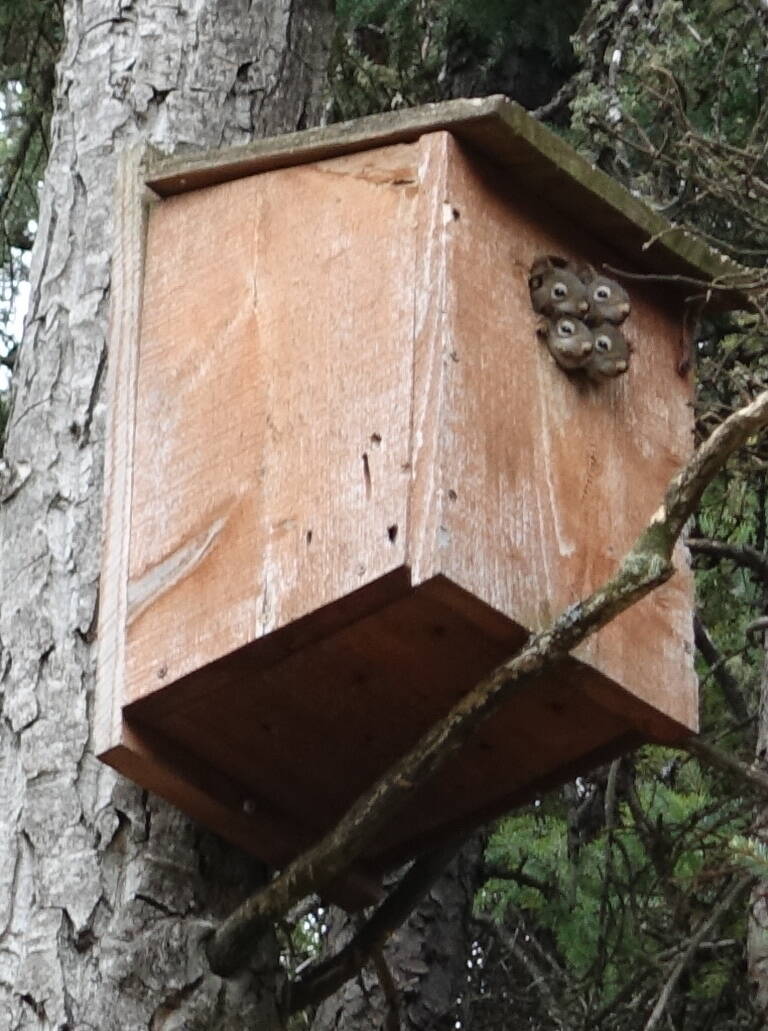
Four red squirrels poke their heads from a boreal owl box in May 2024. (Photo by Ned Rozell)

Four red squirrels poke their heads from a boreal owl box in May 2024. (Photo by Ned Rozell)

Here are some insights from three decades of observations of more than 10,000 red squirrels:

Though one squirrel on Boutin’s plot lived to be nine years old, few live past four. Most don’t survive their first year.

Squirrels spend their entire lives in a small patch of forest surrounding a midden, a pile of spruce cones with tunnels and chambers throughout.

When squirrels rattle off their call, they are signaling their possession of a small territory centered on a midden.

Squirrels are loners except for the day a female is in estrus during the breeding season. On all other days, it’s one squirrel to a territory.

“It’s a hell of a battle going on out there,” Boutin said. “If you’re on that spot, you have it until you die, or leave.”

Mother squirrels sometimes bequeath their territory to a pup and move one or two territories over where there is a vacancy.

Sibling squirrels sometimes share nests on cold nights, then go back to their own territories when temperatures warm.

Squirrels eat a lot of things — including nestling songbirds and snowshoe hare babies — but the largest part of their diet by far is white spruce seeds.

White spruce trees produce great pulses of cones every two to six years. Other years, trees grow no cones. Boutin figures the trees create so many cones suddenly to “swamp” predators like the red squirrel, ensuring that some seeds remain to germinate into trees.

Canadian scientists have discovered intriguing behavior characteristics of the red squirrel. (Photo by T. Karels)

Canadian scientists have discovered intriguing behavior characteristics of the red squirrel. (Photo by T. Karels)

These “mast years” of high cone production should give spruce trees the element of surprise. Squirrels should react with a delay, having many babies the year after many cones pop up. But female squirrels seem to be outsmarting the trees.

“All hell breaks loose in a mast year,” Boutin said. “Reproduction absolutely explodes.”

In a normal year, squirrels have one litter of pups and don’t try again. When spruce cones are abundant, females will have two litters and sometimes breed until the end of summer, even though new cones don’t mature until September.

“These buggers are cranking out reproduction when it’s ahead of masting reproduction,” Boutin said.

How can female squirrels predict a good food supply before it exists? Boutin is not sure. Spruce trees produce buds in May that squirrels eat. Perhaps there is some chemical signal within the buds that triggers what Boutin calls “adaptive anticipation” within the orange lords of the boreal forest.

• Since the late 1970s, the University of Alaska Fairbanks’ Geophysical Institute has provided this column free in cooperation with the UAF research community. Ned Rozell ned.rozell@alaska.edu is a science writer for the Geophysical Institute. A version of this story appeared in 2017.

More in Sports

Senior Juneau-Douglas High School: Yadaa.at Kalé hockey players were recognized at the Treadwell Arena on Friday, Jan. 23, 2026 before the Crimson Bears faced the Homer High School Mariners. Head coach Matt Boline and assistant coaches Mike Bovitz, Luke Adams, Jason Kohlase and Dave Kovach honored 11 seniors. (Chloe Anderson / Juneau Empire)
JDHS celebrates hockey team’s senior night with sweeping victory over Homer

The Crimson Bears saw an 8-2 victory over the Mariners Friday night.

Photo by Ned Rozell
Golds and greens of aspens and birches adorn a hillside above the Angel Creek drainage east of Fairbanks.
Alaska Science Forum: The season of senescence is upon us

Trees and other plants are simply shedding what no longer suits them

Things you won’t find camping in Southeast Alaska. (Jeff Lund/Juneau Empire)
I Went to the Woods: Sodium and serenity

The terrain of interior Alaska is captivating in a way that Southeast isn’t

An albacore tuna is hooked on a bait pole on Oct. 9, 2012, in waters off Oregon. Tuna are normally found along the U.S. West Coast but occasionally stray into Alaska waters if temperatures are high enough. Sport anglers catch them with gear similar to that used to hook salmon. (Photo provided by the National Oceanic and Atmospheric Administration/West Coast Fisheries Management and Marine Life Protection)
Brief tuna bounty in Southeast Alaska spurs excitement about new fishing opportunity

Waters off Sitka were warm enough to lure fish from the south, and local anglers took advantage of conditions to harvest species that make rare appearances in Alaska

Isaac Updike breaks the tape at the Portland Track Festival. (Photo by Amanda Gehrich/pdxtrack)
Updike concludes historic season in steeplechase heats at World Championships

Representing Team USA, the 33-year-old from Ketchikan raced commendably in his second world championships

A whale breaches near Point Retreat on July 19. (Chloe Anderson/Juneau Empire)
Weekly Wonder: The whys of whale breaching

Why whales do the things they do remain largely a mystery to us land-bound mammals

Renee Boozer, Carlos Boozer Jr. and Carlos Boozer Sr. attend the enshrinement ceremony at the Naismith Basketball Hall of Fame in Sprinfield, Massachusetts, on Saturday, Sept. 6, 2025. As a member of the 2008 U.S. men's Olympic team, Boozer Jr. is a member of the 2025 class. (Photo provided by Carlos Boozer Sr.)
Boozer Jr. inducted into Naismith Hall of Fame with ‘Redeem Team’

Boozer Jr. is a 1999 graduate of Juneau-Douglas: Yadaa.at Kale

Photo by Martin Truffer
The 18,008-foot Mount St. Elias rises above Malaspina Glacier and Sitkagi Lagoon (water body center left) in 2021.
Alaska Science Forum: The long fade of Alaska’s largest glacier

SITKAGI BLUFFS — While paddling a glacial lake complete with icebergs and… Continue reading

Photo by Jeff Lund/Juneau Empire
The point of fishing is to catch fish, but there are other things to see and do while out on a trip.
I Went to the Woods: Fish of the summer

I was amped to be out on the polished ocean and was game for the necessary work of jigging

A female brown bear and her cub are pictured near Pack Creek on Admiralty Island on July 19, 2024. (Chloe Anderson for the Juneau Empire)
Bears: Beloved fuzzy Juneau residents — Part 2

Humor me for a moment and picture yourself next to a brown bear

Isaac Updike of Ketchikan finished 16th at the World Championships track and field meet in Budapest, Hungary, on Tuesday. (Alaska Sports Report)
Ketchikan steeplechaser makes Team USA for worlds

Worlds are from Sept. 13 to 21, with steeplechase prelims starting on the first day

Old growth habitat is as impressive as it is spectacular. (Photo by Jeff Lund/Juneau Empire)
I Went to the Woods: The right investments

Engaged participation in restoration and meaningful investment in recreation can make the future of Southeast special