
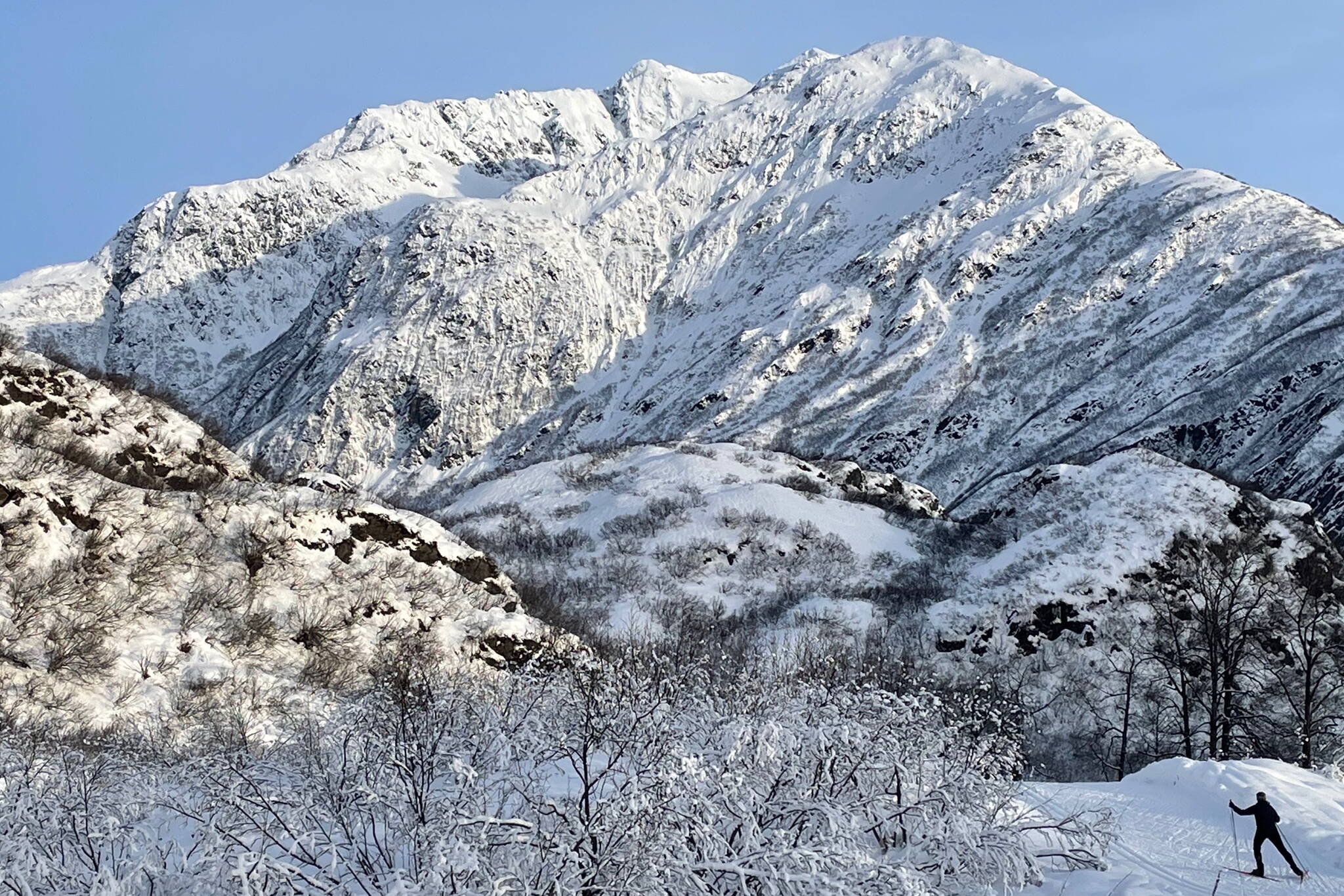
Kristen Rozell skate skis in Valdez in January 2023. (Photo by Ned Rozell)

Kristen Rozell skate skis in Valdez in January 2023. (Photo by Ned Rozell)

Alaska Science Forum: Surfing in winter on cross-country skis

With mild temperatures and ample snow, much of Alaska is now primed for cross-country skiing. It’s a sport for all ages, made possible by friction.

According to Samuel Colbeck, a retired geophysicist with the Cold Regions Research and Engineering Laboratory in Hanover, New Hampshire, gliding on skis is like surfing on a microscopic layer of water. The rubbing of ski on snow makes it possible.

Though friction is one of the major forces interfering with glide, it also allows a skier to move efficiently because it creates heat. As a skier slides over snow, weight and friction combine to melt the surface of the ski trail, a process that’s easier to understand close up.

The waxed bottom of a ski and a well-packed trail both look flat, but on a microscopic level they both feature tiny peaks and valleys.
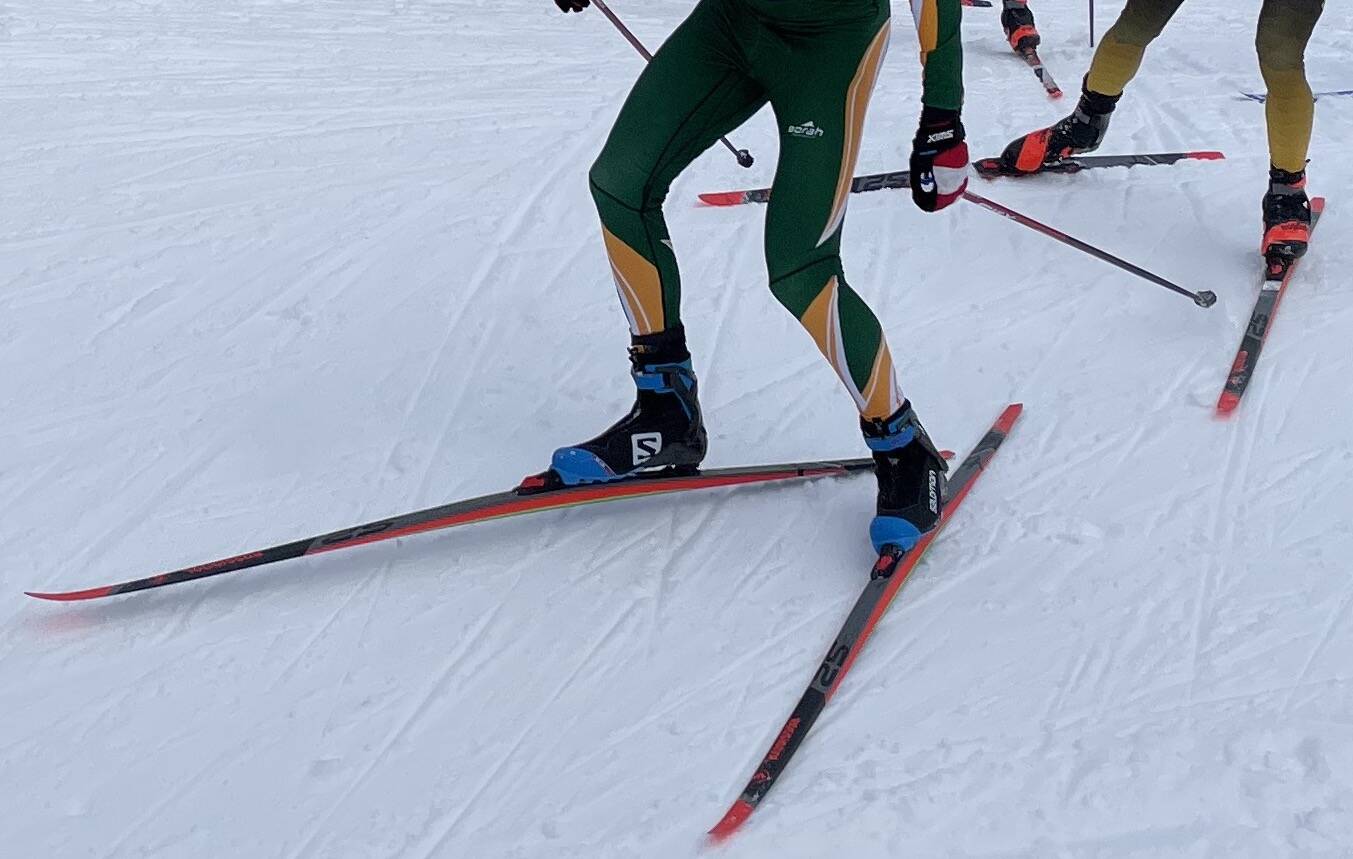
Skate skiers glide along a hilltop in Anchorage’s Kincaid Park in February 2023. (Photo by Ned Rozell)

Skate skiers glide along a hilltop in Anchorage’s Kincaid Park in February 2023. (Photo by Ned Rozell)

When a wax-coated polyethylene ski base rubs the tops of snow crystals, a tiny portion at the tip of each snow crystal melts. The ski base glides on a film of water about one micron (one-millionth of a meter) thick.

Just a small percentage of a ski base is in contact with the snow at any time. In dry snow at 15 degrees F, for example, researchers found that only one percent of the ski-base area was in contact with the snow surface.

Fresh snow also has a finer grain structure, which makes for more friction-producing contact points. In older snow, the crystals fuse together over time, forming a course-grained snowpack that causes less friction and allows skiers to go faster.

Colbeck said an average skier generates about 200 watts of heat on each ski while gliding. He likened that to the heat given off by two old-school 100-watt light bulbs, spread out over the area where the ski base touches the snow.

An experienced ski racer on a college team has even more melting power, generating about 300 watts per ski. Evidence of a skier’s work is often seen as shiny ski tracks, the collective reflection of polished snow crystals.

Skiing in really frigid temperatures reduces the release of heat, and any chance for decent glide.

Extreme cold reduces the production of meltwater because of the heat lost to a cold ski base, as well as snow crystals and the air. As the temperature drops, a skier works harder, paying a higher energy price for the same glide that seemed effortless near the freezing point.

Though a water film still forms at an air temperature of 10 below zero F, that film is too thin to be an effective lubricant. Tests performed on ski glide on snow at 10 below zero confirmed that skiing on sand would be just as fast.

• Since the late 1970s, the University of Alaska Fairbanks’ Geophysical Institute has provided this column free in cooperation with the UAF research community. Ned Rozell is a science writer for the Geophysical Institute. A version of this column appeared in 1994.

More in Sports

Senior Juneau-Douglas High School: Yadaa.at Kalé hockey players were recognized at the Treadwell Arena on Friday, Jan. 23, 2026 before the Crimson Bears faced the Homer High School Mariners. Head coach Matt Boline and assistant coaches Mike Bovitz, Luke Adams, Jason Kohlase and Dave Kovach honored 11 seniors. (Chloe Anderson / Juneau Empire)
JDHS celebrates hockey team’s senior night with sweeping victory over Homer

The Crimson Bears saw an 8-2 victory over the Mariners Friday night.

Photo by Ned Rozell
Golds and greens of aspens and birches adorn a hillside above the Angel Creek drainage east of Fairbanks.
Alaska Science Forum: The season of senescence is upon us

Trees and other plants are simply shedding what no longer suits them

Things you won’t find camping in Southeast Alaska. (Jeff Lund/Juneau Empire)
I Went to the Woods: Sodium and serenity

The terrain of interior Alaska is captivating in a way that Southeast isn’t

An albacore tuna is hooked on a bait pole on Oct. 9, 2012, in waters off Oregon. Tuna are normally found along the U.S. West Coast but occasionally stray into Alaska waters if temperatures are high enough. Sport anglers catch them with gear similar to that used to hook salmon. (Photo provided by the National Oceanic and Atmospheric Administration/West Coast Fisheries Management and Marine Life Protection)
Brief tuna bounty in Southeast Alaska spurs excitement about new fishing opportunity

Waters off Sitka were warm enough to lure fish from the south, and local anglers took advantage of conditions to harvest species that make rare appearances in Alaska

Isaac Updike breaks the tape at the Portland Track Festival. (Photo by Amanda Gehrich/pdxtrack)
Updike concludes historic season in steeplechase heats at World Championships

Representing Team USA, the 33-year-old from Ketchikan raced commendably in his second world championships

A whale breaches near Point Retreat on July 19. (Chloe Anderson/Juneau Empire)
Weekly Wonder: The whys of whale breaching

Why whales do the things they do remain largely a mystery to us land-bound mammals

Renee Boozer, Carlos Boozer Jr. and Carlos Boozer Sr. attend the enshrinement ceremony at the Naismith Basketball Hall of Fame in Sprinfield, Massachusetts, on Saturday, Sept. 6, 2025. As a member of the 2008 U.S. men's Olympic team, Boozer Jr. is a member of the 2025 class. (Photo provided by Carlos Boozer Sr.)
Boozer Jr. inducted into Naismith Hall of Fame with ‘Redeem Team’

Boozer Jr. is a 1999 graduate of Juneau-Douglas: Yadaa.at Kale

Photo by Martin Truffer
The 18,008-foot Mount St. Elias rises above Malaspina Glacier and Sitkagi Lagoon (water body center left) in 2021.
Alaska Science Forum: The long fade of Alaska’s largest glacier

SITKAGI BLUFFS — While paddling a glacial lake complete with icebergs and… Continue reading

Photo by Jeff Lund/Juneau Empire
The point of fishing is to catch fish, but there are other things to see and do while out on a trip.
I Went to the Woods: Fish of the summer

I was amped to be out on the polished ocean and was game for the necessary work of jigging

A female brown bear and her cub are pictured near Pack Creek on Admiralty Island on July 19, 2024. (Chloe Anderson for the Juneau Empire)
Bears: Beloved fuzzy Juneau residents — Part 2

Humor me for a moment and picture yourself next to a brown bear

Isaac Updike of Ketchikan finished 16th at the World Championships track and field meet in Budapest, Hungary, on Tuesday. (Alaska Sports Report)
Ketchikan steeplechaser makes Team USA for worlds

Worlds are from Sept. 13 to 21, with steeplechase prelims starting on the first day

Old growth habitat is as impressive as it is spectacular. (Photo by Jeff Lund/Juneau Empire)
I Went to the Woods: The right investments

Engaged participation in restoration and meaningful investment in recreation can make the future of Southeast special