
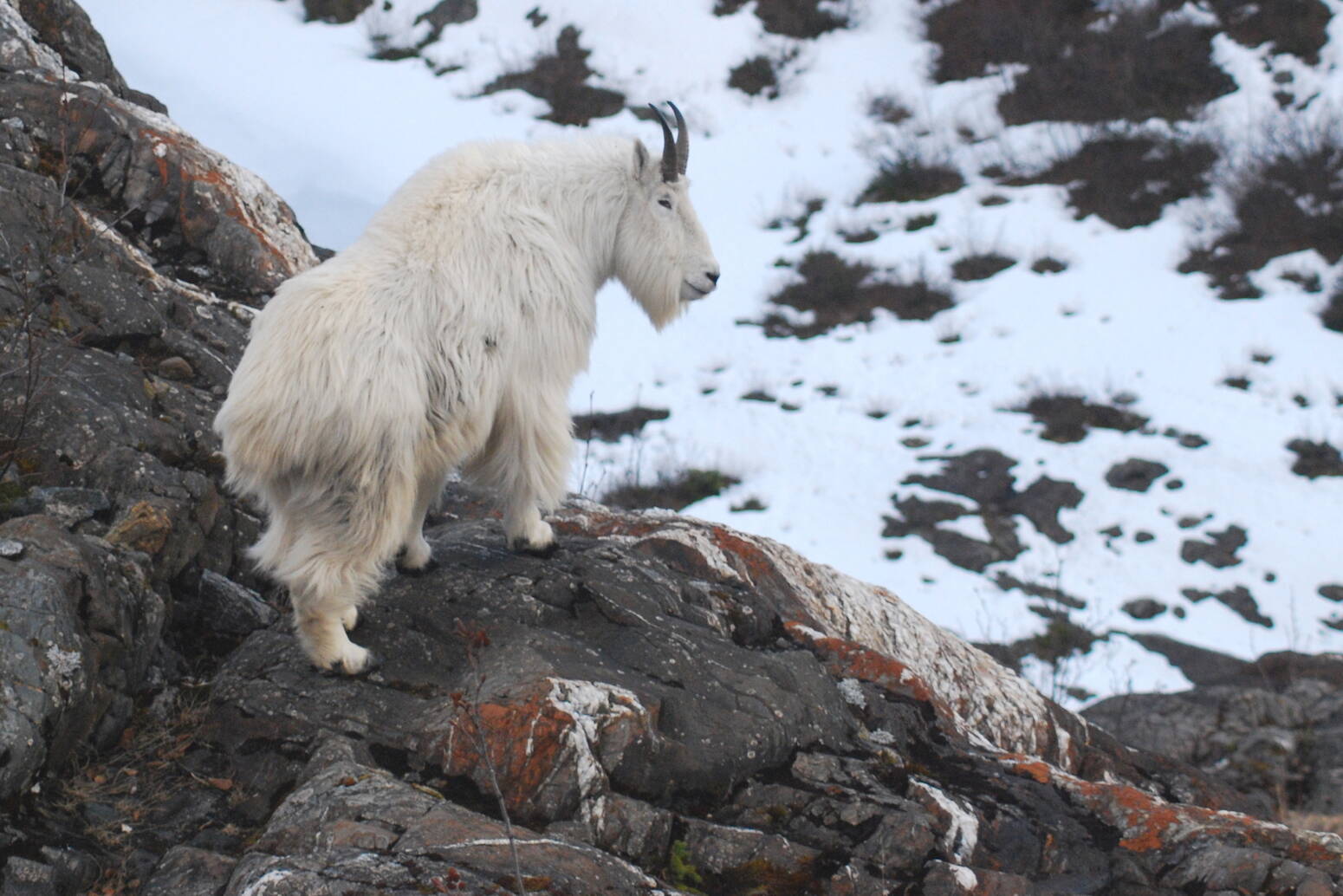
Kevin White has placed his hands on the long, white fur of more than 400 Alaska mountain goats during the past 20 years.
His diligence in studying this Ice Age wanderer of high, steep, country has led to a new understanding — a surprising number of the creatures die by snow avalanche.
White works out of Haines with the University of Alaska Southeast and is writing his PhD thesis on mountain goats for the University of Victoria in British Columbia. During his former employment for the Alaska Department of Fish and Game, White captured 421 goats in Southeast Alaska, mostly around Haines, Juneau and Baranof Island.
He, along with colleagues Eran Hood, Gabe Wolken and others, just authored a paper in which they wrote that snow avalanches killed from 23 to 65 percent of all the collared animals that had died during the 17 years biologists had followed them.
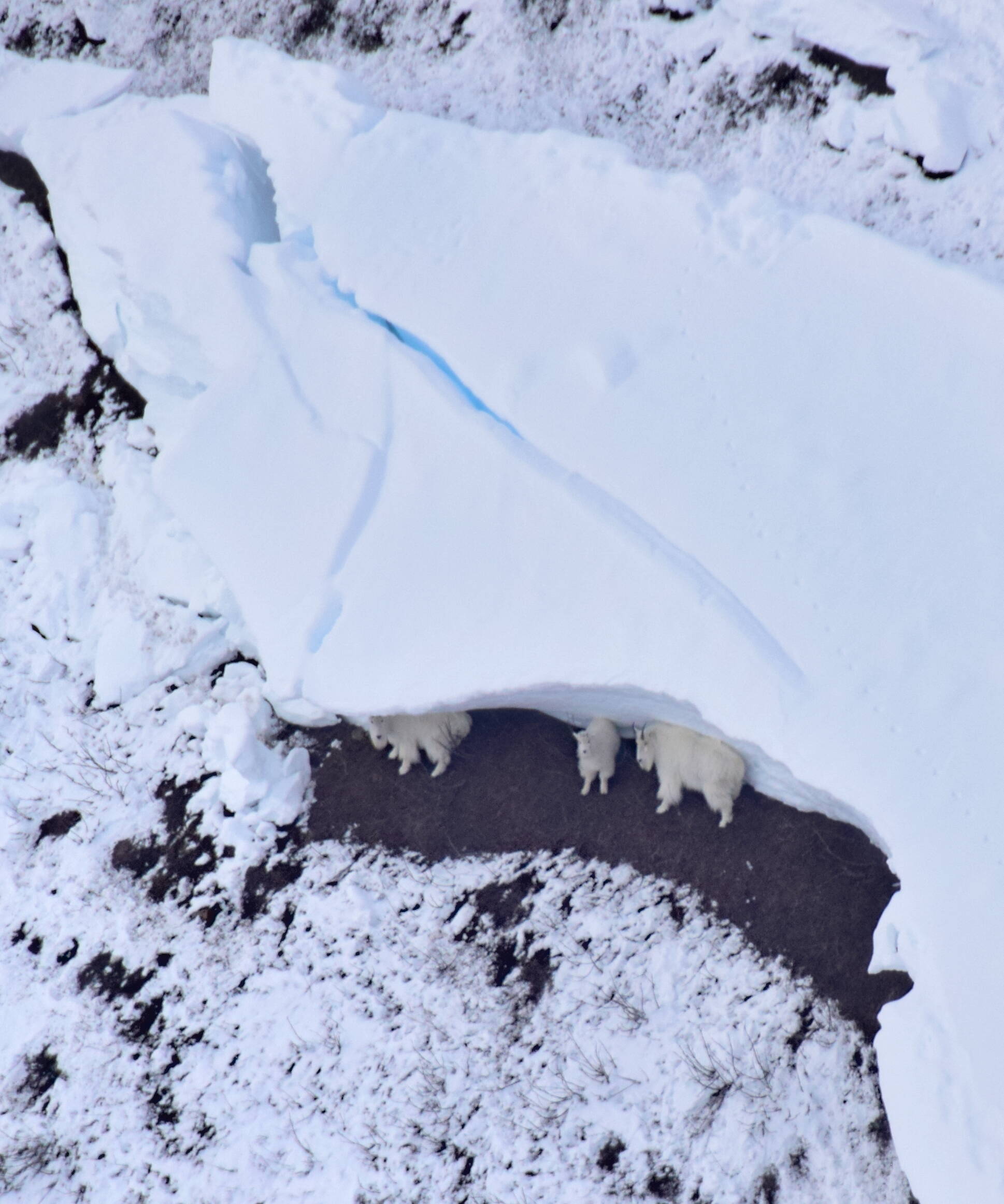
Mountain goats shelter beneath the fracture line of an avalanche above Klukwan. (Photo by Kevin White)
The study — on a species that doesn’t get a lot of attention because its habitat is so hard to reach — revealed that the steep country that is advantageous for mountain goats is often lethal. Avalanches were the among the most frequent causes of mortality in all the goat deaths the scientists studied.
“They’re putting themselves right in the line of fire with the slope angles they choose,” said Hood, a professor at the University of Alaska Southeast, during a talk he gave at the December 2024 American Geophysical Union Conference in San Francisco.
At the beginning of his talk, Hood tipped his cap to White’s extensive fieldwork, during which White attached collars that allowed both radio tracking and later GPS tracking of mountain goats. White’s 17-year dataset features many track lines etched into slopes where people fear to tread.
“We ended up with almost 1,200 goat-years of radiocollar data — which is insane,” Hood said.
The scientists enhanced that hooves-on-the-ground information by modeling and mapping millions of avalanche chutes, confirming them as areas that goats favor.
“Avalanche release areas and paths constitute most (62%) of the alpine and subalpine (places goats use) across the winter range,” the study authors wrote.
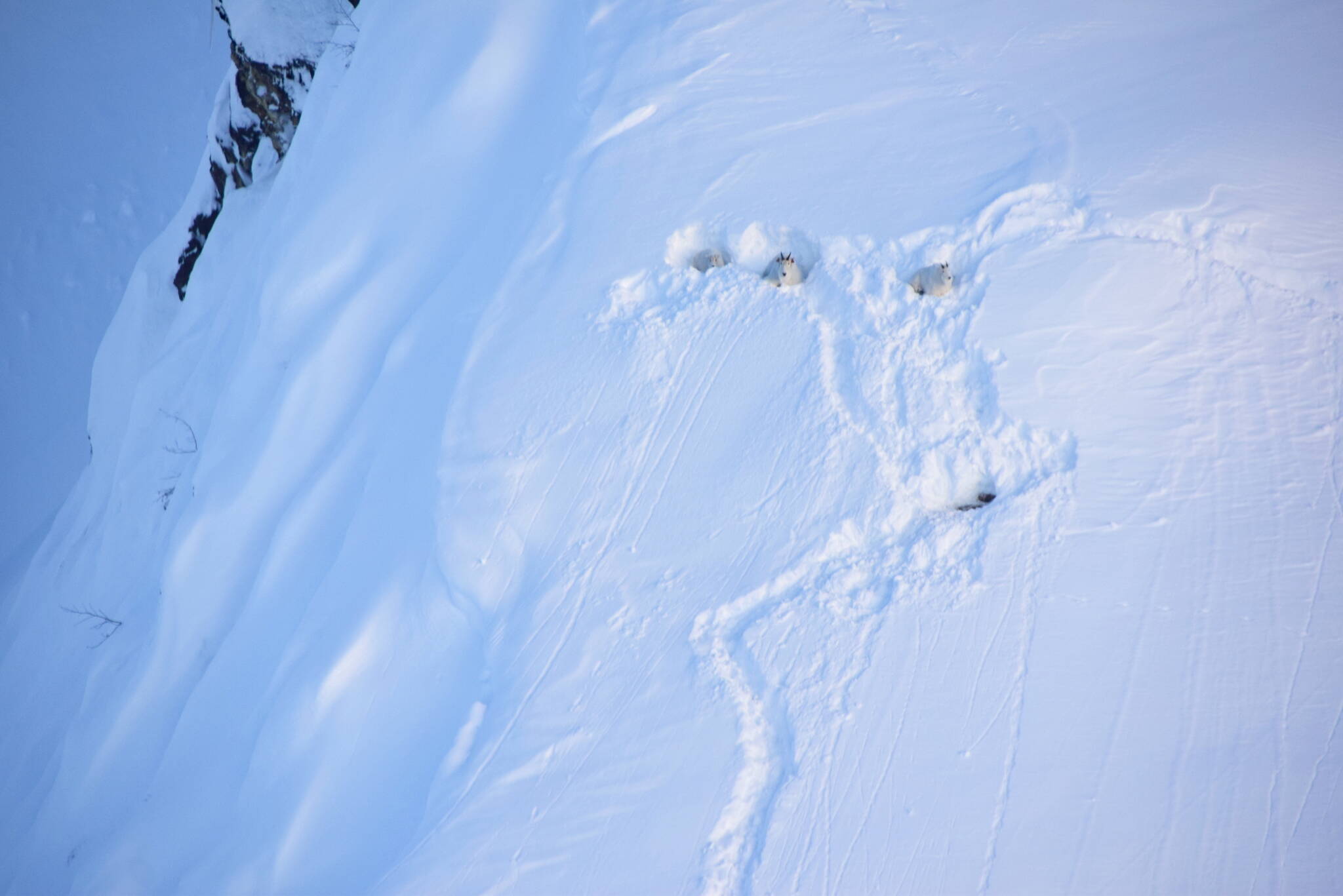
Mountain goats rest on snow beds above Klukwan following a winter storm in 2020 that deposited more than 6 feet of snow in December of 2020. (Photo by Kevin White)
How do you fit a tracking collar to the neck of a creature that lives much of its life clinging to mountain walls? White credited experienced helicopter pilots able to hover close enough to allow him to fire a tranquilizer dart out of an open door.
Within a few minutes, on a slope chosen for its unlikelihood of a goat falling off when it lost muscle control, the goat dropped to the ground. That enabled White and his partners in the field to exit the helicopter and quickly fasten a collar around the animal’s neck, monitor its vitals, and take measurements before injecting it with an antidote.
“Within 5 minutes (of receiving the reversal agent), they stand up and walk away as if nothing happened,” White said recently over the phone from Haines.
White has a reverence for spike-horned mountain goats, “a throwback to the Pleistocene.” He is particularly impressed with their hooves, which enable goats to climb over wispy trails where a fall means plunging hundreds of feet.
“A hard sheath surrounds a soft pad like a dog’s,” he said. “They can grip a wet slabby surface with the pad, and use the hard-edged sheath for gaining purchase in cracks.”
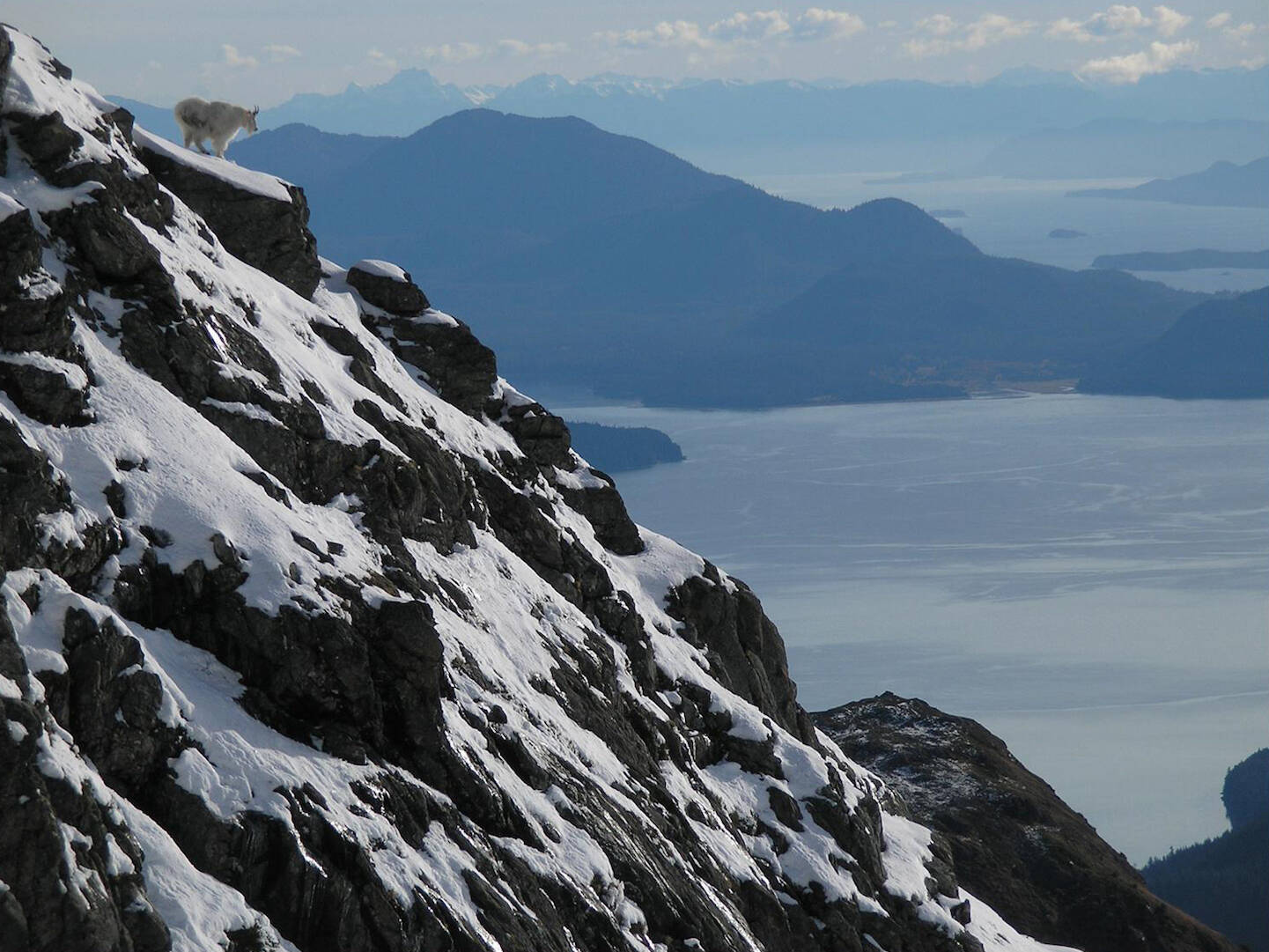
An adult female mountain goat navigates a 40-degree slope on Lions Head Mountain above Lynn Canal. (Photo by Kevin White)
Mountain goats, which range in Alaska from Southeast northward to the Wrangell Mountains, spend their summers eating sedges and shrub leaves in the highest, steepest country. They often migrate downward to old-growth forests in the winter, though some remain in the alpine all winter.
Preparing for a winter existence that White described as a “pseudo hibernation,” goats pack on an impressive amount of weight late in the summer.
“They can be up to 25 percent body fat in fall — it almost rivals what bears put on,” White said.
Males, or billies, which can live for 10 years or more in the wild, are not the “delicate flowers” they might appear from afar, White said. A male he once weighed above Haines in early fall was 385 pounds.
“That guy ended up over 400 pounds,” he said. “Like a white buffalo with piercing black horns.”
Over the years, White checked on the animals from small aircraft and also his desktop computer.
“About 10 years in, we started gathering a substantial amount of data. We realized that avalanches were a significant source of mortality,” he said.
Some years, more than 15 percent of a local population of goats would die in avalanches. In other years, none died. Because goats typically have just one kid each year, avalanches — which randomly take out prime-age females more likely to escape other fates — put a dent in local populations.
“If you have a year when 15 percent of the population is dying from avalanches, it could take a significant amount of time for the population to recover,” White said.
Avalanche chutes attract goats because their ruggedness gives them an advantage there over wolves and bears. Avalanches also sometimes sweep snow and rock away, leaving behind fertile ground from which springs savory green vegetation.
Sometimes avalanche terrain goes years without sliding, maybe further influencing goats to take their chances. They roll those dice in order to occupy a niche they don’t share with many other animals.
“Sometimes, they just get unlucky,” White said.
• Since the late 1970s, the University of Alaska Fairbanks’ Geophysical Institute has provided this column free in cooperation with the UAF research community. Ned Rozell ned.rozell@alaska.edu is a science writer for the Geophysical Institute.
