

Skip Ambrose has floated the upper Yukon River almost every year since Richard Nixon was President. Back then, in 1973, only 12 pairs of peregrine falcons perched at nest sites over a 180-mile stretch of river.
Ambrose saw that number rise to more than 60 in 2012. The birds’ subsequent rebound from the effects of a pesticide was one of the most dramatic wildlife recovery stories of all time. Peregrine falcons made it off the Endangered Species list in 1999.
But things are changing. Ambrose returned to the Yukon River in spring and summer 2024. Peregrine falcon numbers are nosediving there as they did the past few years. He thinks he knows why.
Ambrose, 78, is a biologist who has monitored peregrine-nesting cliffs along the upper Yukon River from the Canada border to the town of Circle for 53 of the last 59 years. His wife, biologist Chris Florian, has accompanied him for the past decade-plus.
Peregrine falcons are sleek predators with clear orbs for eyes and an ability to tuck their wings and close on prey at speeds faster than 200 miles an hour. Many peregrines spend their summers along Alaska rivers and their winters in Central and South America.
After a period in which every prime rock ledge looming above the upper Yukon seemed to have a pair of peregrines competing to nest there, Ambrose and Florian noticed a steep decline in the number of birds starting in 2021. That trend has continued to include the biologists’ two river surveys in 2024, the most recent in July.
“We are aware of 75 territories that have been used for nesting in this area,” Ambrose wrote in a report on the 2024 observing season. “During 2012-2019 an average of 77 percent of these territores were occuped by a pair; in 2024, only 43 percent were occupied by a pair.”
Ambrose and Florian also saw many more nest sites than usual with just a single bird in them in 2024. To them, that is a sign of birds that are missing from the population. As peregrines are quite faithful to their nesting sites, the missing birds are probably dead.
The drastic population decrease comes after decades of peregrine falcons’ recovery from the effects of DDT, a compound chemists introduced in 1947 to kill mosquitoes and other insects.
In 1973, officials with the Environmental Protection Agency banned the use of DDT, which, when ingested by falcons, caused them to lay eggs with thinner shells that often broke. In the decades since the DDT ban in the U.S. and other countries, peregrine falcons came back.
Ambrose believes Highly Pathogenic Avian Influenza, which emerged in waterfowl, seabirds and shorebirds in 2019, is now killing peregrine falcons.
Peregrine falcons — which Ambrose described as “the perfect go-look-for-sick-birds machine” to writer Tim Gallagher in a recent Audubon Magazine story — catch and eat infected birds. They die soon after.
Biologists have found 50 dead peregrines in the Lower 48 that have tested positive for bird flu. None have been found in Alaska, probably due to the difficulty of finding a small carcass in the wild areas they inhabit.
Because they noticed the less-desirable cliffs vacated early in the upper-Yukon peregrines’ decline, Ambrose and Florian were among the first scientists to notice the peregrine decline. But other researchers across the continent are noticing the same trend.
“We began to have concerns during our spring 2023 survey,” said Mike Yates of Earthspan, who with other biologists monitors migrating peregrines — including many from Alaska — on South Padre Island in Texas.
“In spring 2023 sightings dropped to 10.27 per 10 man-hours, which drew our close attention,” Yates said. “This past spring (2024) they plummeted to 7.79, far below our 45-year mean of 16.21 sightings per 10 man-hours.”
Biologists have noticed similar drops in peregrine numbers in New Jersey, Virginia, Washington and California.
“This recent decline in peregrines was quicker than declines observed after the introduction of DDT,” Ambrose said. “Loss of breeding adults is about the worst thing that can to a wildlife population, so that is very scary.
“On the positive side, it appears some individuals of the population are more resistant to avian influenza. We can only hope that number of individuals is significant enough to prevent too great a decline.”
• Since the late 1970s, the University of Alaska Fairbanks’ Geophysical Institute has provided this column free in cooperation with the UAF research community. Ned Rozell ned.rozell@alaska.edu is a science writer for the Geophysical Institute.
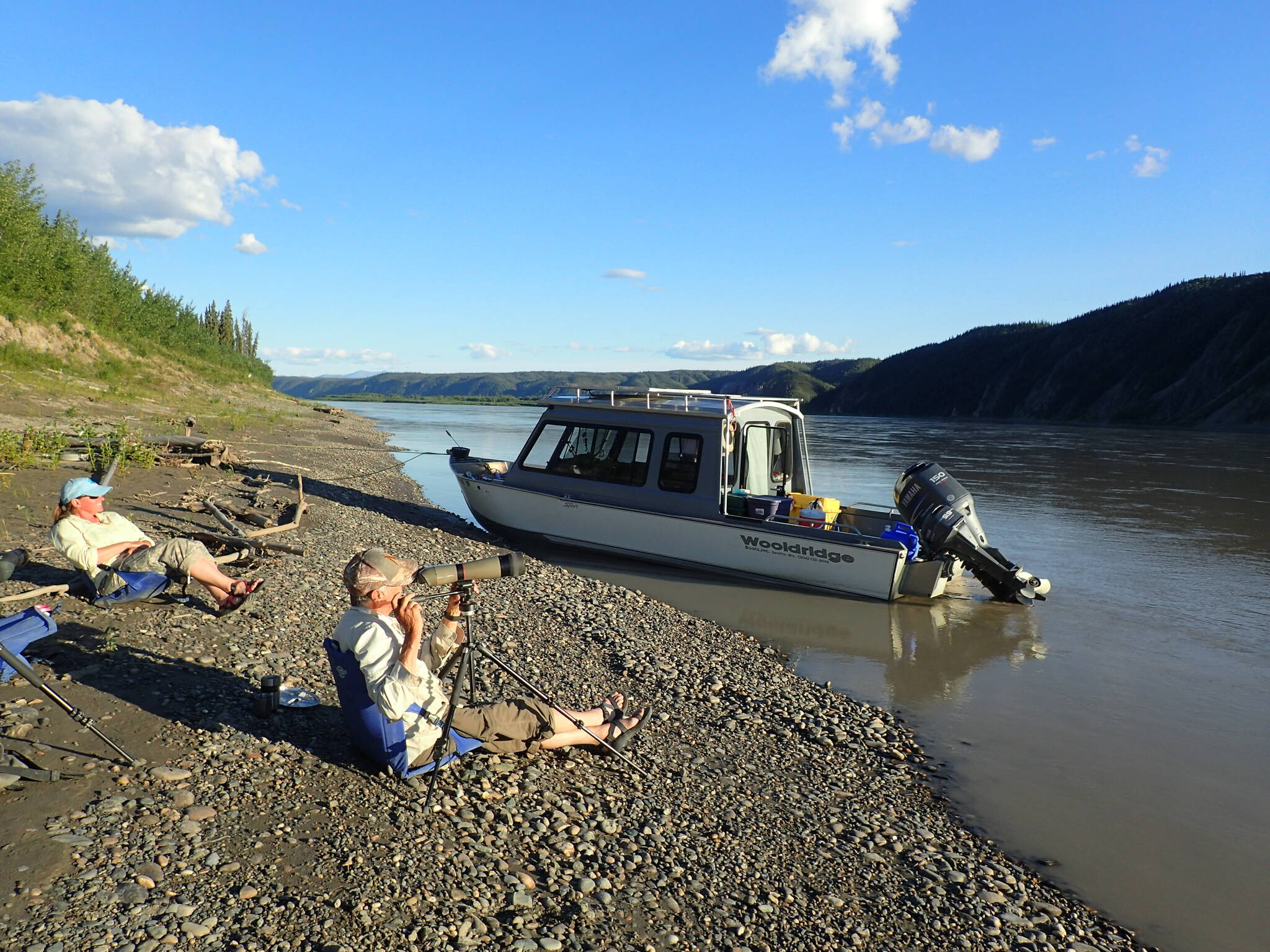
Chris Florian, left, and Skip Ambrose scan a cliffside across the upper Yukon River looking for peregrine falcons on July 13, 2018. (Photo by Ned Rozell)
