
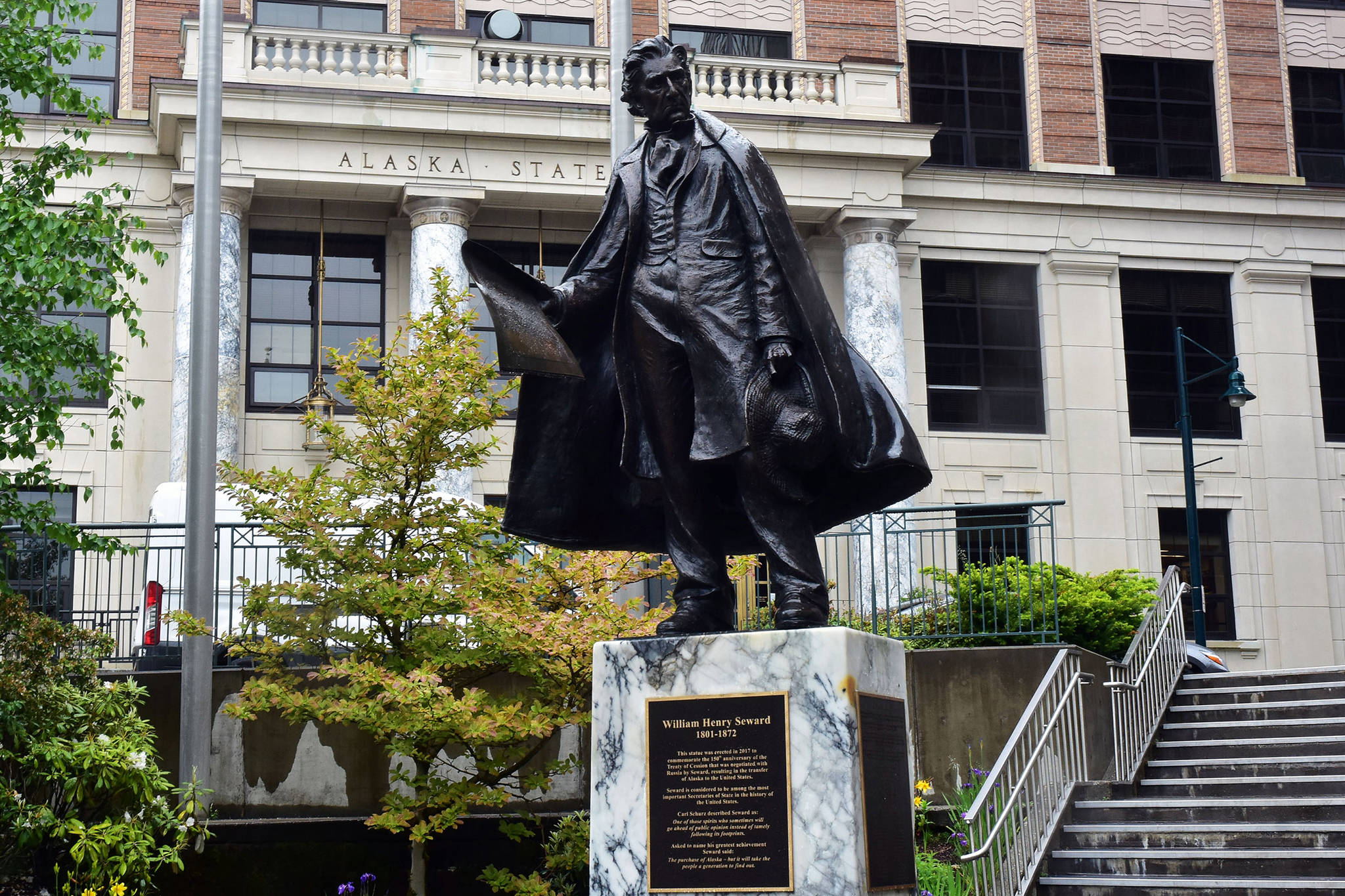
When first confronted with the idea of removing the statue of Secretary William Seward from its position near the state capitol in my current hometown, Juneau, Alaska, I was disturbed and not a little angry. Seward was an abolitionist who served in the cabinets of Presidents Abraham Lincoln and Andrew Johnson. He also had the vision and will to move the United States government to purchase Alaska. That purchase started the flow of wealth into the nation that has grown to the massive proportions of today. Alaska made it possible for generations of people like me to live the American Dream in a land of stunning physical beauty and limitless horizons. The more I thought about removing the statue of Seward, the darker my thoughts became.
[Hundreds call for statue’s removal]
Fortunately, my troubled thoughts were guided toward more productive ground by the wisdom of my fellow Alaskan, Dr. Rosita Worl. Worl is the Harvard-educated Indigenous Alaskan who is President of Sealaska Heritage Institute in Juneau. Worl reminded me of other truths in our common history. Many Alaska Natives see the statue as a reminder of the bitter, often brutal history of dispossession and displacement of Alaska’s indigenous peoples from their land and culture by the United States. To them, it represents the loss of much of their very heritage as human beings. Walking by the statue every time they come to conduct business at the State Capitol is a recurring offense that drives their thoughts to the same dark places I experienced when first confronted with the issue of removing the statue.
Here is what I know: The statue is causing pain to some of my neighbors and fellow Alaskans. Now that I have their perspectives in mind, I won’t ever be able to walk by it again without being reminded that it is hurting them, and that hurts me. What I believe based on what I know is that the statue should be moved to a place of honor in the Alaska State Museum. The ideal of the state museum is meant to be a place where the truths of the histories of all Alaskans are displayed, studied and understood.
I believe the statue deserves a place of honor because of Seward’s profoundly important contributions to our state and our nation. Those contributions include helping to end slavery under the rule of law, building the economic wealth of our nation, and making a place for me and my family to live and prosper. I also know that the processes set in motion by Seward changed the lives and culture of indigenous Alaskans forever, often in ways that caused, and continue to cause them and the rest of us pain and anger.
[Opinion: Removing the statue would be ‘Political Correctness Gone Wild’]
As Alaskans and citizens of the United States, we need to understand and respect all the truths of history in order to be able to live with each other in ways that do not cause pain and anger. Knowing the truths of history from the perspectives of our neighbors is the start of the reconciliation we need to realize our full potential as a nation. Long unresolved pain and anger prevent each of us, the state, and the nation from realizing the full benefits of our lives and society.
Let’s have the conversations necessary to understand our neighbor’s truths within our community, the borough, the state and the nation. First, we work to understand the truths we share in common, then we implement the process of reconciliation necessary to decrease the pain and anger in all of us. In consideration of the full suite of perspectives of our neighbors and fellow citizens, I believe moving the statue of Secretary Seward could be an act of reconciliation that could put us all on the path to a better world. Alternatively, we leave the wounds of pain and anger to grow larger and deeper.
[Opinion: Now is the time to develop empathy on all levels]
‘United we stand and divided we fall.’ Is one of the fundamental truths of the human species.
We need to be united around the truths we share in common, as members of our communities, boroughs, state and nation, or, as history teaches us, we will surely fall.
• Phil Mundy, Ph.D, was born in Birmingham, Alabama and first came to work in Alaska in 1976. He is a biologist who wrote the first federally recognized salmon fishing regulations for the Skokomish and S’Klallam treaty tribes of western Washington, and he testified in federal court to defend the exercise of those treaty fishing rights. In addition to working for the treaty fishing tribes, he has held professional positions with the University of Alaska, the Alaska Department of Fish and Game, the Columbia River Inter-Tribal Fish Commission, the Exxon Valdez Oil Spill Trustee Council, and NOAA’s National Marine Fisheries Service. He lives in Juneau. Columns, My Turns and Letters to the Editor represent the view of the author, not the view of the Juneau Empire. Have something to say? Here’s how to submit a My Turn or letter.
