
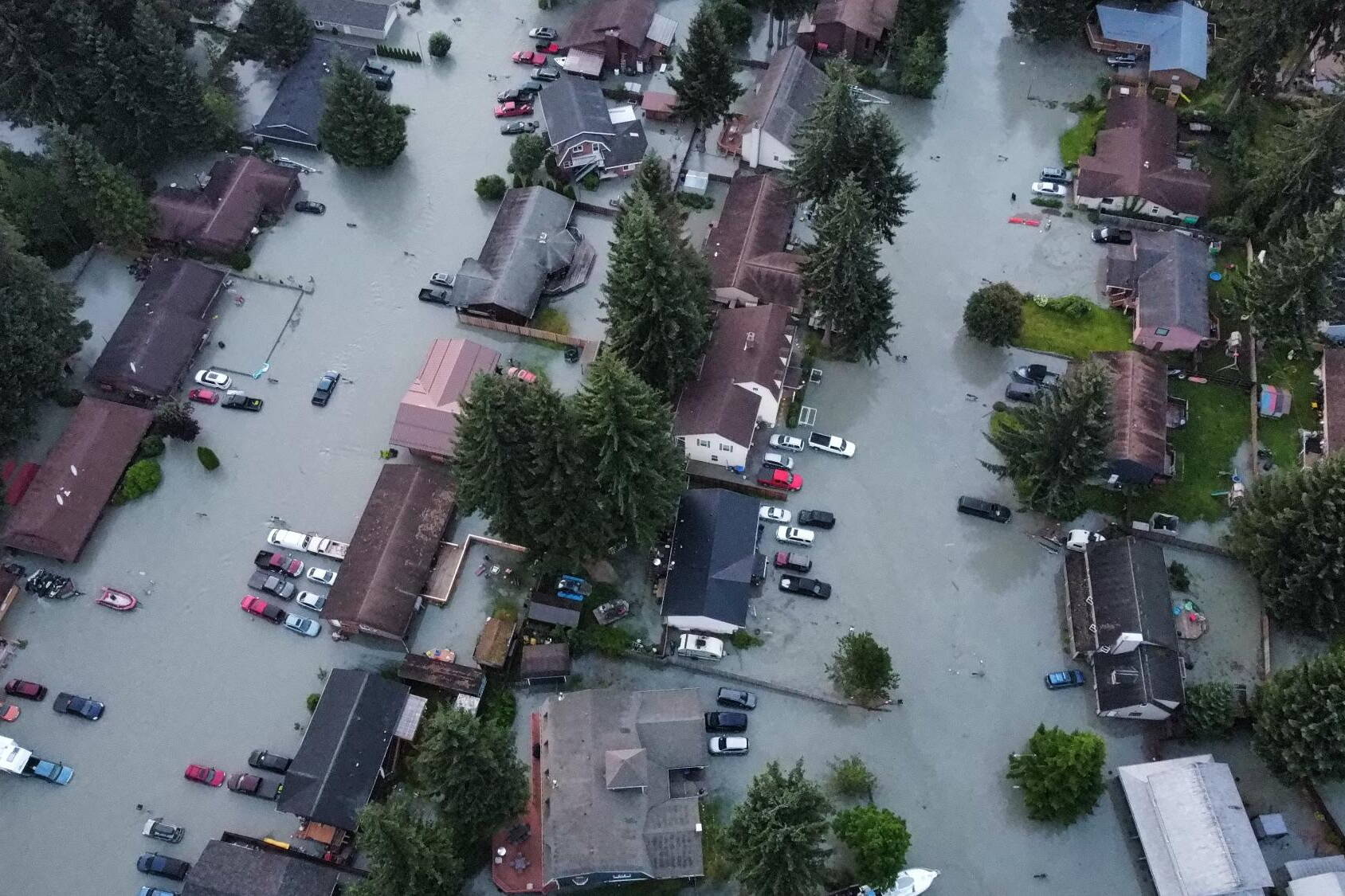
With the municipal election in the rearview mirror city leaders can now direct their time and energy to the threat Mendenhall Valley homeowners are facing if another glacier outburst causes catastrophic flooding.
At a special Oct. 3 meeting, Juneau Assembly members unanimously approved three measures addressing flood mitigation.
• An ordinance authorizing a cooperative agreement with the U.S. Army Corps of Engineers (USACE) for approximately four miles of Hesco barriers that could be installed along the Mendenhall River. USACE would provide the barriers at no cost, but CBJ would be responsible for installation.
• Introduction at the Oct. 21 Assembly meeting of a $2 million appropriation to fund a USACE general investigation study as well as initial installation of barriers.
• A request for 60,000 sandbags from USACE for distribution to homeowners.
Questions by individual members took up most of the meeting with two citizens testifying in support of the measures, urging the Assembly to prioritize this effort ahead of other issues of lesser importance.
Numerous questions were asked regarding city liability to install barriers on private property and how to pay for this effort. City Manager Katie Koester’s estimate to install four miles of barriers along the Mendenhall River is $5-$10 million. However, engineering, site preparation, and cost of fill materials are still undetermined.
The Assembly previously approved $3 million towards a Corps of Engineers study on long-term remedies, $1.375 million to repair and protect public infrastructure, and $400,000 for mitigation planning and updated flood mapping.
Not discussed was the availability of fill material (sand or loose soil). With 1.3 cubic yards per barrier cell, four miles of Hesco barriers could utilize over 9,000 cubic yards of material. Fill would need to be moved in place mostly on private property and loaded into barriers with a front-end loader. Adding another 1,300 cubic yards for filling 60,000 sandbags means as many as 1,000 dump truck loads will be needed for the effort.
The barriers could be left in place for up to five years while a longer-term fix was being engineered and implemented.
Several citizen groups have formed in response to this emergency. One Valley neighborhood group, calling themselves the Juneau Flood Fighting, Mitigation and Support Group, has expressed doubts whether the city is moving fast enough and will be ready for the next big flood. Another citizen group, informally called the Wednesday morning group, has formed a subcommittee of contractors, engineers, and university scientists who have proposed a plan that envisions constructing a levee around Mendenhall Lake in a much shorter time frame than projected by the city.
However, that plan (and others), depend on the completion of hydrologic and geotechnical studies in the next several months. It is unclear if USACE study approval is coming anytime soon or if the city could get their own less expensive critical studies underway before that, especially if they chose to use an emergency sole-source contract versus the regular bureaucratic process for city bids.
The Wednesday morning group is promoting the utilization of a USACE Advance Measures assistance program that precludes the need for environmental and federal permitting. This program is designed to “prevent or reduce damages when there is an imminent threat of unusual flooding and it 1) poses a significant threat to life and/or improved property, and (2) is beyond the capability of Tribe/State/local interests to perform in a timely manner.”
This would require coordination with the U.S. Forest Service as the current resource manager, but the plan could be integrated into their current USFS planning process involving the Mendenhall Glacier Visitor Center.
Some timing concerns were eased when experts advised that a major flood from Suicide Basin now appears highly unlikely this fall. Yet, concerns remain that a glacier outburst next year could be larger and occur months earlier than in the last two years. Hence the need for greater urgency on short-term mitigation and disaster planning.
While many unknowns remain, there are advantages to focusing on one long-term solution. The additional protection gained by moving forward on that far outweighs the risk of delay caused by indecision, unnecessary studies, and bureaucratic red tape.
• After retiring as the senior vice president in charge of business banking for KeyBank in Alaska, Win Gruening became a regular Opinion Page columnist for the Juneau Empire. He was born and raised in Juneau and graduated from the U.S. Air Force Academy in 1970. He is involved in various local and statewide organizations. Columns, My Turns and Letters to the Editor represent the view of the author, not the view of the Juneau Empire. Have something to say? Here’s how to submit a My Turn or letter.
