
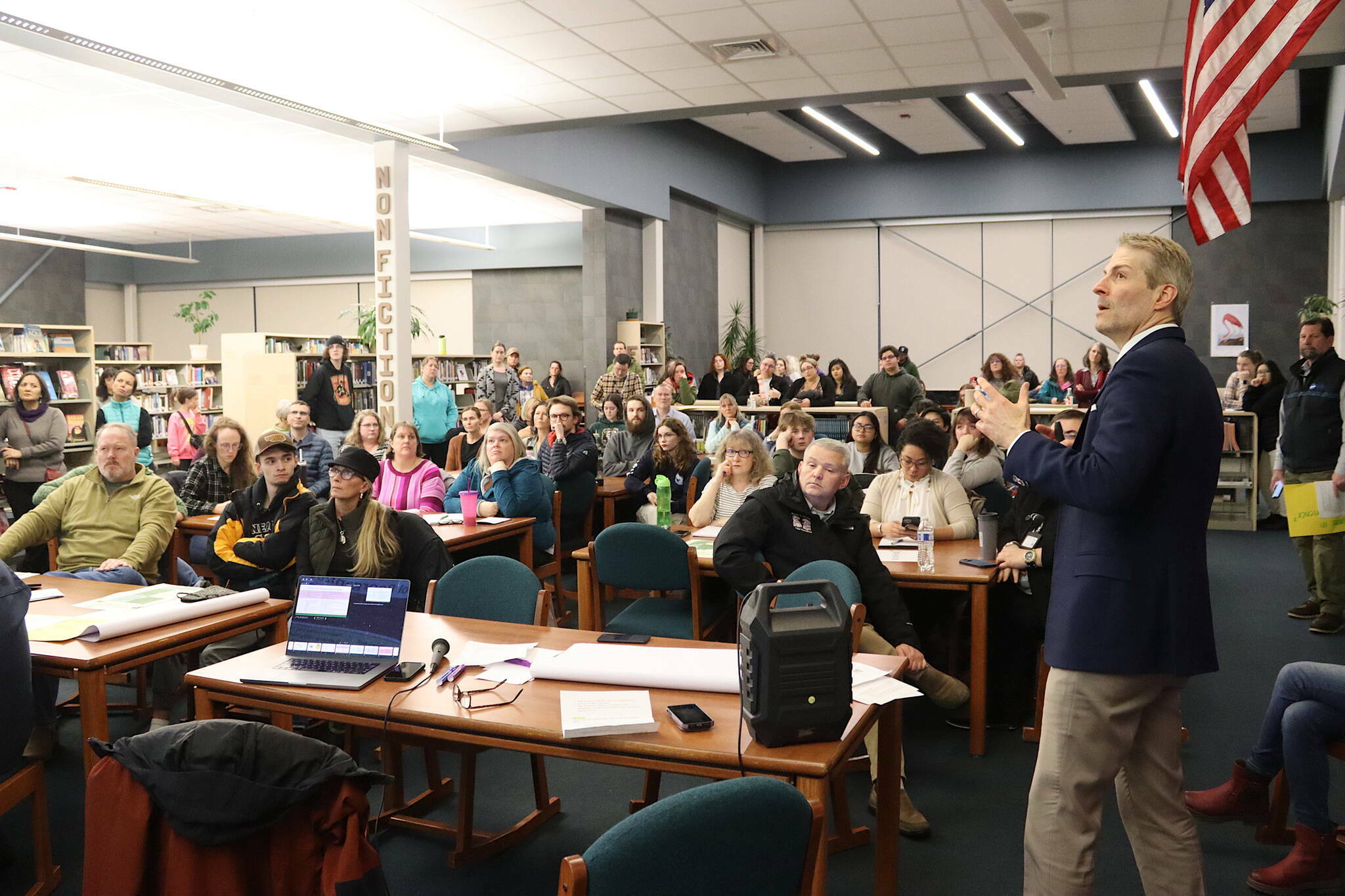
A school consolidation plan announced by the Juneau School District (JSD) has drawn fire from a dissident group calling themselves Community Advocates for Responsible Education (CARE). They are sponsoring petitions to recall two JSD board members and mounting a full-blown campaign blitz urging the board to reverse its decision to merge the two high schools.
Some may applaud their activism, but in resorting to an expensive special recall election and character assassination CARE is anything but responsible or caring.
Declining enrollment in Juneau and some school districts in Alaska (Mat-Su is a notable exception) isn’t unique. It’s being mirrored nationally, mostly in urban areas where student populations have plummeted and are expected to continue to fall.
A recent Wall Street Journal article about what Los Angeles schools are facing, and many other school districts across the country, illustrates a difficult-to-sustain dynamic: too many schools for too few students. Los Angeles is down to 413,800 students across 800 schools, from nearly 750,000 students in 2003.
A recent article in The Seattle Times discusses how school officials there could eventually close more than a quarter of the district’s nearly 70 elementary schools.
The irony facing administrators and school board officials is that as per-pupil costs continue to rise at underpopulated schools the quality of education, breadth of curriculum, and resources at those schools diminish.
Merging schools has the opposite effect. Per-pupil costs go down while programs and resources expand.
That some parents and students might focus on other aspects of school consolidations such as longer commutes, different teachers, and unfamiliar surroundings is understandable. Change is always hard, and it’s a natural and emotional reaction.
But the positive aspects shouldn’t be overlooked.
More importantly, delaying needed consolidation ignores the district’s structural deficit, further strains school budgets, and prolongs necessary acceptance by parents, students, and teachers of what eventually must happen.
JSD demographic studies confirm an additional 1,200 student loss in Juneau is expected within the next 10 years.
CARE’s brochure being distributed at petition-signing events misrepresents the process and the facts behind the JSD board’s consolidation decision. Irrelevant assertions designed to provoke emotional reactions are featured including the economic impact of students’ Valley shopping, availability of student parking, and playing sports in a different athletic league, none of which determine educational outcomes.
The contention that the public process was flawed is belied by the facts. JSD held dozens of public meetings. Input was solicited through multiple community and staff engagement meetings and a JSD budget survey. A budget newsletter supplementing public announcements was featured on the district web page and social media. Superintendent Frank Hauser was available at all public meetings to answer questions.
In a letter to the Assembly, Juneau Empire and school board, CARE claims they want their issues “addressed as a form of goodwill to begin rebuilding a climate of trust and cooperation between the community and the Board.”
But blaming current school board members for poor decision-making by past boards and administrators is neither fair nor responsible. Mounting a petition drive to recall them is petty, spiteful, and only sows further division and distrust.
Most recently, a CARE group leader, in an Empire My Turn, attempted to vilify JSD Superintendent Frank Hauser by claiming he “ has shown no respect, compassion, or courtesy to staff, students, or parents”, implying that ”another agenda [was] at play”, and finally, the district was ”being dismantled by a superintendent whose primary residence is listed in Anchorage.”
None of that is true. It certainly won’t foster the “trust and cooperation” CARE professes to desire given that respect is a two-way street.
It took many years for JSD to reach the point where the board was forced to act. Not everyone will agree with the consolidation model that was chosen. However, it preserved the most programs and ensured the district a solid financial footing going forward.
Signing petitions to recall school board members and spending over $100,000 of taxpayer dollars for a pointless recall election isn’t a solution.
Nor is smearing people’s reputations and misrepresenting the facts. In doing so, CARE has forfeited any legitimacy and credibility it may have had.
• After retiring as the senior vice president in charge of business banking for KeyBank in Alaska, Win Gruening became a regular Opinion Page columnist for the Juneau Empire. He was born and raised in Juneau and graduated from the U.S. Air Force Academy in 1970. He is involved in various local and statewide organizations. Columns, My Turns and Letters to the Editor represent the view of the author, not the view of the Juneau Empire. Have something to say? Here’s how to submit a My Turn or letter.
