
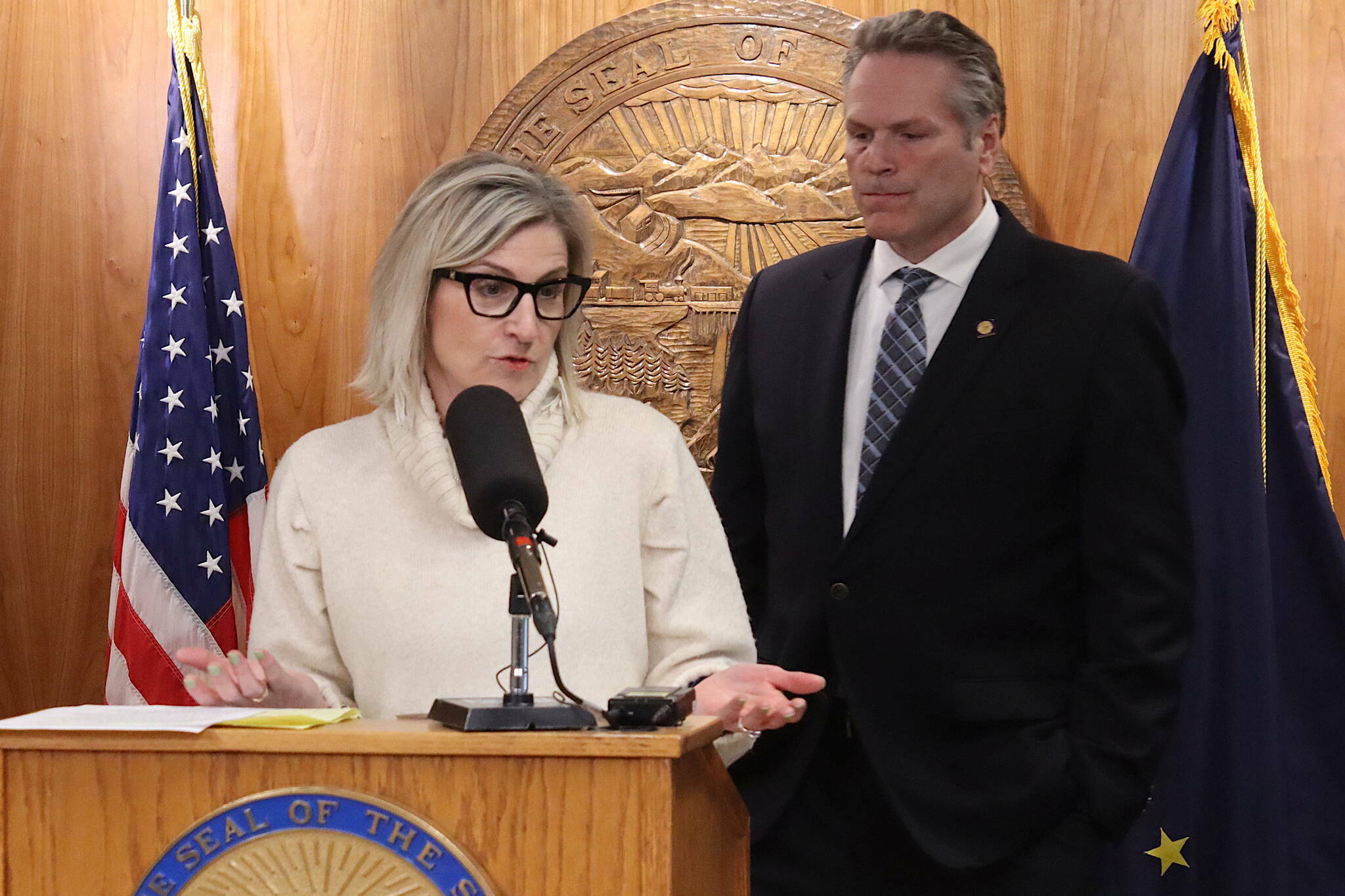
Not quite a year ago, Gov. Mike Dunleavy vetoed more than $87 million in one-time public education funding approved by the legislature. Two months ago, he vetoed a permanent increase. Now, in an apparent change of heart, he’s “open to an increase in one-time funding, especially to help with inflationary issues.”
Yes, it will help. But over the long term, the cost of running a school, or business, or the basic cost of living, never returns to pre-inflation levels.
The annual per-student funding was set at $5,930 in 2017, then raised by $30 two years ago to cover costs related to the Alaska Reads Act. The bill he vetoed in March would have raised it to $6,610. But that was still well shy of what’s needed to match the 27% cumulative rate of inflation between 2017 and now.
If Dunleavy really wanted to help school districts tackle the problem, he’d do more than toss them a bone. But considering the other simple solutions he’s proposed for complex problems, he’s clearly not the sharpest economic mind in the state capitol.
Like the teacher hiring bonuses he proposed, he doesn’t seem to be thinking about the long-term effect of inflation. Maybe because it peaked two years ago, he expects the problem will solve itself.
“Inflation has dropped from 9% to 3% — the lowest in the world,” President Joe Biden proudly proclaimed during his State of the Union speech in March. It was actually 3.4% at the time. And although it’s not the lowest in the world, it is lower than most countries, including socially liberal Norway (4.8%) and ultra-conservative Hungary (5.5%).
But according to public polling, inflation is still a major concern for most Americans.
That could be because just two years ago it was at around 9%. And during Biden’s first two years in office it averaged 6.6%, which is substantially higher than the 1.7% from 2008 to 2020.
That average annual rate of inflation was the lowest since Dwight D. Eisenhower and John F. Kennedy were in the White House. During no other similar time span was it even close.
So, let’s be clear about one thing. When it comes to the economy, neither party has a monopoly on getting it right. Whether its high inflation or this month’s record-breaking highs in the stock market, presidential policies have a lot less impact on it than partisan politicians and pundits would like us to think.
As I’ve just noted, the rate of inflation was at historical lows during the Obama and Trump years. So low it had pretty much disappeared from the public radar.
With one sort of exception — the price of oil.
That certainly contributes to inflation, both directly and indirectly. The high it hit two years ago coincided with inflation’s peak. Its decline since then has helped bring it down.
However, just as Russia’s invasion of Ukraine caused prices to soar in 2022, such spikes are usually a global reaction to other market forces, not inflationary pressures.
In July 2008, oil prices screamed to a record high of $176 per barrel. By January 2009, it was $61. Two years later it was back up to $160. It remained in the $130 range for a few years before tumbling to $44.
That doesn’t mean it wasn’t perceived as inflationary every time we filled our gas tanks or received a home heating oil bill. But with other consumer prices climbing imperceptibly during those twelve years, the dramatic rise and fall of oil prices may have left many expecting that everyday consumer goods will similarly decline to near 2020 levels once inflation is under control.
That’ll never happen.
The cost of educating Alaska’s public school students isn’t going down either.
As a candidate in 2018, Dunleavy promised he’d prioritize spending on education. But countering inflation by giving the districts one time funding is simply bad policy and irresponsible financial management.
“No more games, no more shuffling numbers,” he said in the same speech he claimed he would develop a straightforward, honest budget and a permanent, sustainable fiscal plan. We’ve never seen the latter. And his budget for education and everything else has been prepared for the land of make-believe.
Or to use a phrase he once liked tossing around, he’s become a pro at kicking the can down the road.
• Rich Moniak is a Juneau resident and retired civil engineer with more than 25 years of experience working in the public sector. Columns, My Turns and Letters to the Editor represent the view of the author, not the view of the Juneau Empire. Have something to say? Here’s how to submit a My Turn or letter.
