
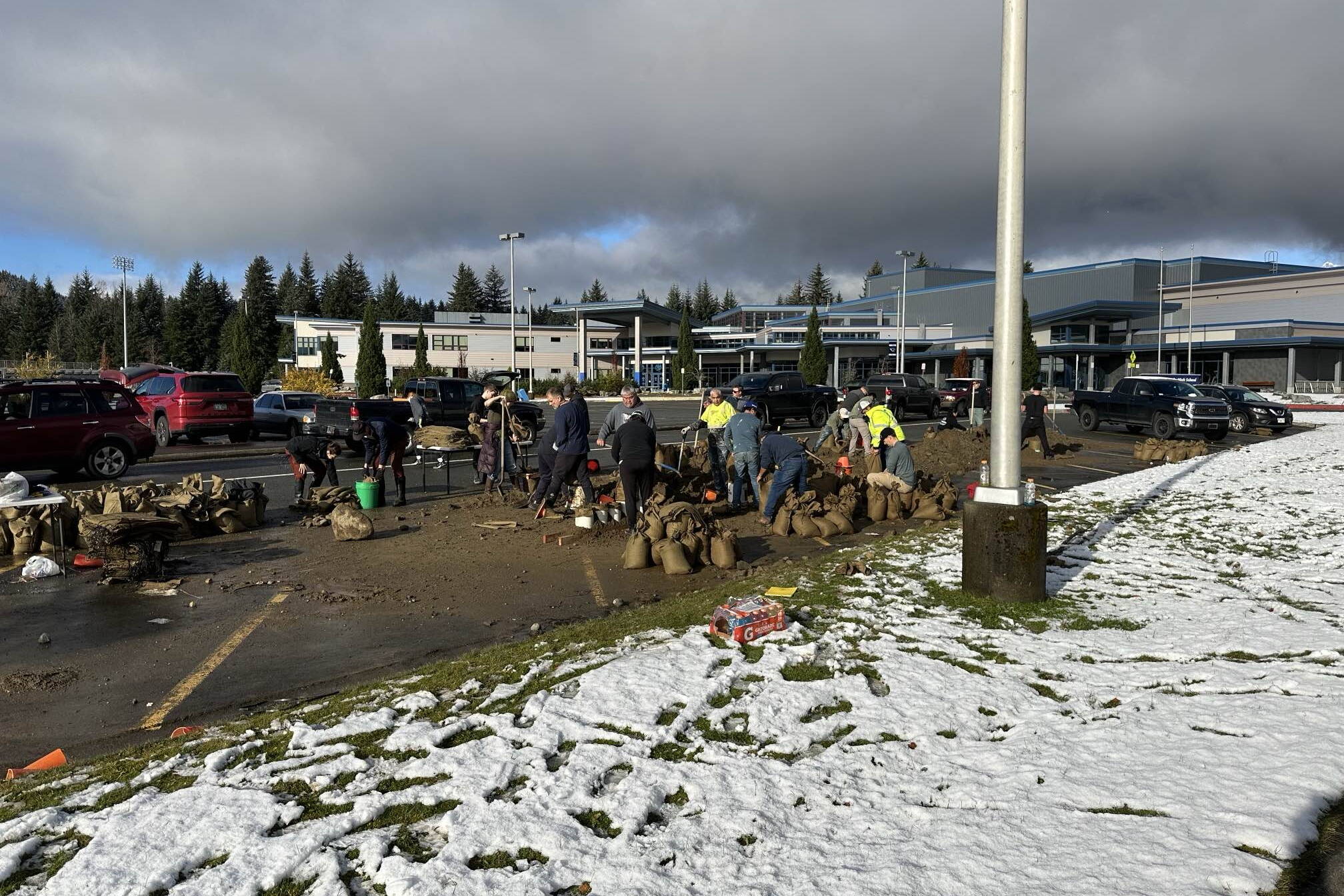
During meetings in Juneau last week, U.S. Army Corps of Engineers (USACE) officials said it will likely take a decade or more to research and implement a long-term solution to Mendenhall River flooding.
This was not what Juneau homeowners wanted to hear.
When asked why it takes so long to conduct the modeling and studies required, officials pointed to bureaucracy as the problem. “There’s a lot of agencies involved. There’s the reality of the process of government and democracy, how fast it moves.”
USACE, U.S. Forest Service, Natural Resources Conservation Service, NOAA, the National Weather Service, and the EPA were examples of agencies that must weigh in.
USACE officials noted that Juneau’s flood mitigation project is only one of many they are working on, and their resources are limited by their budget and staffing.
That’s not to suggest that nothing is happening. The meetings last week focused on short-term mitigation measures that city officials are considering.
USACE has offered to provide four miles of HESCO barriers for free that would be used to block potential flooding along the Mendenhall River. Last month the Juneau Assembly approved spending $2 million toward the cost of installing the first phase of the project, now estimated at $7.8 million (including periodic maintenance and removal).
It’s possible the cost could be lower depending on available government programs or grants.
The exact design and placement of the barriers is undetermined and dependent on preliminary modeling/maps that should be available prior to the proposed HESCO barrier installation next March. These studies are important since some fear that partial safeguards could result in moving flood water to a different area of the river where there is less protection.
Most barriers would be placed on private riverfront properties, possibly for as long as 10 years. Concerns and objections have been voiced, not the least of which is who bears the cost. The Assembly has introduced an ordinance proposing to split the entire cost 50-50 between the city and affected homeowners through an established Local Improvement District (LID). 466 homeowners, identified by flood inundation maps as being at risk in the event of a 16-foot flood event, would pay about $8,000 each as part of the proposed LID.
Community feedback will determine whether the LID is approved, but the process will delay a final decision until next March.
Regardless of the placement, repayment structure, and final approval of the HESCO barrier project, affected homeowners are looking at the prospect of waiting 10 years or longer for a permanent resolution. They will find it extremely difficult to improve or sell their home while living under the threat of a catastrophic flood.
One citizen group that formed in response to this emergency, Juneau Flood Solution Advocates, now includes several hundred members. They are actively working to “unite the flood-affected community of Mendenhall Valley in response to the challenges posed by glacial outbursts.”
This group’s primary concern is with the length of time it will take to study, design, and construct a long-term solution. City leaders have proceeded slowly and taken the position they must accept USACE recommendations. This seems overly cautious given that the assessed value of residential structures at risk approaches $1.5 billion.
Why have we accepted at face value that a long-term general investigative study will cost $6 million and take five years or more to complete?
Why investigate solutions such as tunneling through mountains or bombing glaciers that are risky and unlikely to work?
Selecting one or two solutions (a Mendenhall Lake levee and diversion channels, for example) which have been proven successful elsewhere could cut study time and cost dramatically.
Yet, the city has committed $3 million in matching funds for this $6 million study that is now stuck in limbo because funding to complete it hasn’t been secured.
Where is the sense of urgency? Why not forcefully advocate for a legislative solution to bypass the bureaucratic foot-dragging inherent in projects like this? Can the Assembly draft a resolution to our Congressional delegation to begin negotiations for an alternative approach that cuts cost and time?
Juneau cannot afford to remain solely at the mercy of government agency red tape and timetables.
• After retiring as the senior vice president in charge of business banking for KeyBank in Alaska, Win Gruening became a regular Opinion Page columnist for the Juneau Empire. He was born and raised in Juneau and graduated from the U.S. Air Force Academy in 1970. He is involved in various local and statewide organizations. Columns, My Turns and Letters to the Editor represent the view of the author, not the view of the Juneau Empire. Have something to say? Here’s how to submit a My Turn or letter.
