
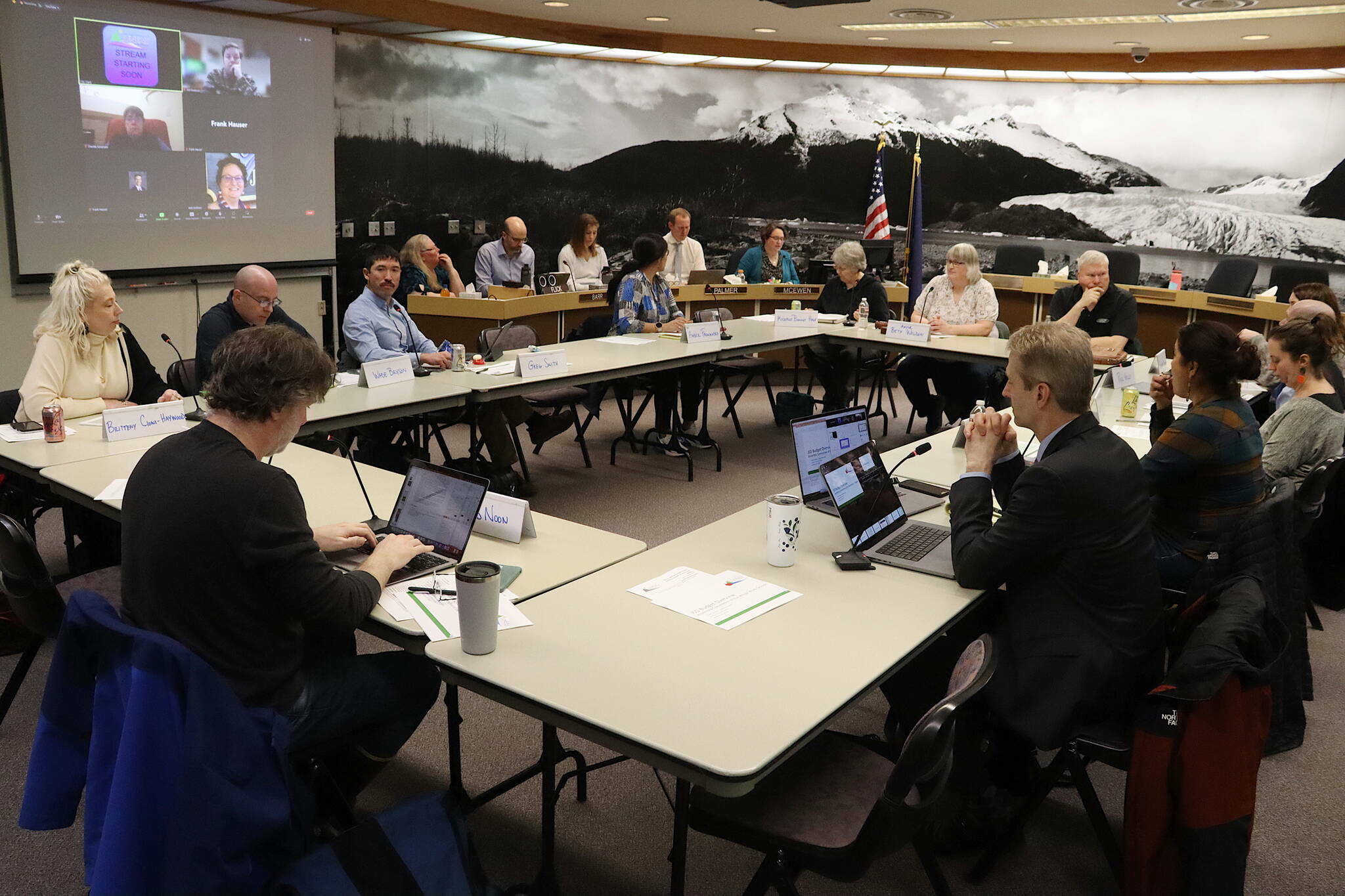
During a CBJ Assembly Finance Committee meeting on Feb. 7, opinions about how to handle a sizable deficit in the Juneau School District (JSD) budget ran the gamut.
The deficit is the result of a catastrophic enrollment loss (1,500-student drop since 1999), accounting errors, and decisions by previous school administrators and past Board of Education leadership. Some Assembly members want to blame the current board, arguing that JSD deficits are a problem primarily of their own making and financial assistance should be mostly in the form of a loan that must be paid back.
Several Assembly members, however, took the view that, while JSD must consider cuts and consolidations, their financial situation is a community issue that cannot be ignored, and the Assembly’s role should be to assist them in resolving it.
Ultimately, the Finance Committee voted to give the district more help than they requested, around $8 million to zero out their current deficit ($4 million as a loan with the balance in cash) and another $1.65 million towards the FY25 deficit. The $4 million zero-interest loan would be paid back in three equal installments beginning in FY26.
The Assembly directed the manager to draft three ordinances to formalize their action in time to have them introduced at the regular Assembly meeting on or before Feb. 26 and public testimony on March 4.
All these actions would be subject to adjustment depending on public testimony and forthcoming updated enrollment projections, possible cuts and consolidations, as well as any increase in the Base Student Allocation (BSA) which determines state funding to the district.
Some in the community will bemoan this action as a “giveaway” or argue details about the amount or structure of the grants and loans. However, there is no viable way of balancing this year’s budget without Assembly assistance.
The School Board will now turn its attention to changes needed going forward to achieve a balanced budget and how that can be accomplished with minimal negative impact on student educational outcomes. The community should accept the fact that these changes will be extremely difficult for all concerned but we simply have no choice — since by law, the JSD must produce a balanced budget. To accomplish this, the CBJ loans must be repaid, and facilities and programs will need to be reduced.
Not to be forgotten are past enrollment projections that forecast JSD losing another 1,200 students by 2032. Those numbers should be front and center in both JSD and CBJ Assembly decision-making.
Several mentions were made during the Finance Committee meeting of increasing Juneau’s property tax millage rate to help offset the hit to the municipal budget.
This would be a mistake and, in any case, unnecessary.
Juneau residents are still reeling from recent unprecedented increases in property taxes, both residential and commercial. Increasing property taxes would further exacerbate this situation, hurt the economy, and make Juneau less attractive and less affordable.
For all the handwringing from city leaders about JSD’s “structural deficit,” more attention should be paid to the city’s “structural surplus.”
Under the current CBJ property tax millage regime, the city has continued to over-collect property taxes and accumulate inordinate surpluses despite its best effort to fritter them away on projects that voters have rejected.
Currently, the city has over $140 million in discretionary funding sources available to it:
• $31 million – general fund balance
• $19 million – “rainy day fund”
• $16.5 million – new city office CIP
• $ 5 million – New JACC/civic center CIP
• $70 million – unused bond capacity
Of course, other needs compete for these funds, so JSD shouldn’t get a pass, but any one of those sources are available to assist schools with no immediate requirement to raise taxes.
Furthermore, the city bears a good measure of responsibility for the lack of economic development that has contributed to our stagnant population and the outmigration of young people that is directly tied to lower student enrollment in our schools.
Moving forward, Assembly members can do better by avoiding the “blame game,” viewing our schools as a shared responsibility, and asking themselves why economic development efforts have fallen short.
• After retiring as the senior vice president in charge of business banking for KeyBank in Alaska, Win Gruening became a regular Opinion Page columnist for the Juneau Empire. He was born and raised in Juneau and graduated from the U.S. Air Force Academy in 1970. He is involved in various local and statewide organizations. Columns, My Turns and Letters to the Editor represent the view of the author, not the view of the Juneau Empire. Have something to say? Here’s how to submit a My Turn or letter.
