
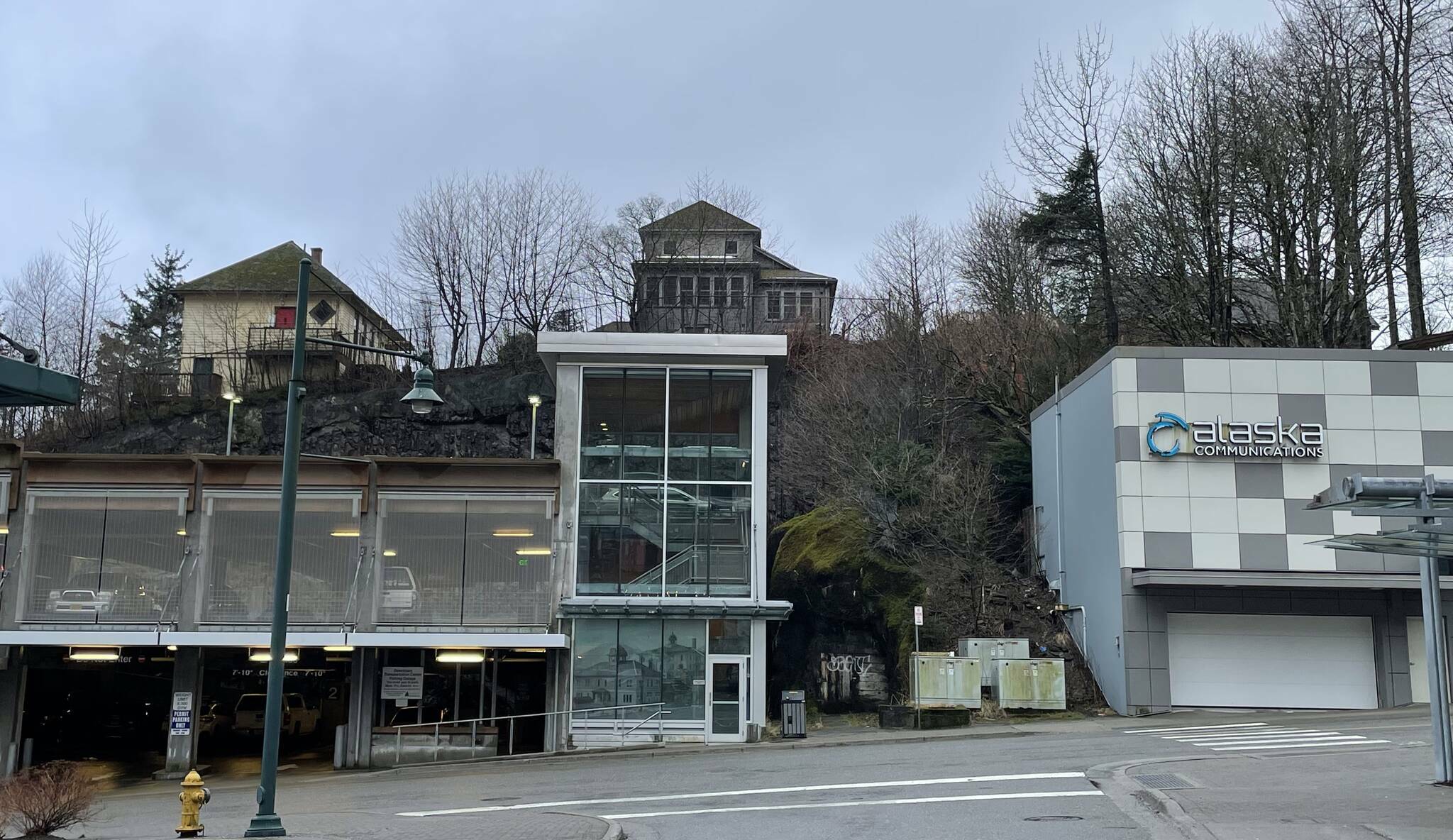
In a rare moment of near unanimity during a special Assembly meeting last month, members voted to move forward to develop Telephone Hill.
Several Assembly members spoke passionately in favor of transforming the property with an eye towards providing as many additional housing units as possible (while still observing reasonable aesthetic guidelines).
Almost four years after the city applied to acquire Telephone Hill from the State of Alaska and one year after assuming ownership of the property, it appears that a plan is finally emerging.
The Assembly deserves credit for recognizing that the economic significance of the property far outweighs any historic preservation value.
The Telephone Hill property covers approximately 4.2 acres in the center of downtown Juneau. It is envisioned as a mixed-use downtown hub incorporating green/public gathering space, multi-family housing, or even some commercial use. The available developable property is currently occupied by four single family homes, two duplexes, and a small five-unit apartment building, most with renters on month-to-month leases.
Understandably, the tenants, faced with the prospect of vacating their residences, have made emotional pleas to the Assembly to consider a no-development option. But legally and practically, this is almost impossible. The city should not be in the business of renting tax-exempt homes to private individuals when Juneau property taxpayers are burdened with ever increasing taxes on the homes and businesses they own.
Legally, if sold, the city must offer the properties at fair market value to the highest bidder. However, a recent condition report commissioned by the city and prepared by structural engineers detailed numerous structural issues and code violations on all the units, even citing unsafe conditions on the Martin-Johnston House which was deemed “hazardous and should not be occupied.” All properties in their current condition were found to be “ not economically feasible for CBJ to own or rent.”
No bank would finance a purchase without these deficiencies being resolved and there is no hold harmless agreement that could be drafted that would protect the city from liability if the properties were sold as-is.
The plan that was approved by the Assembly was Option C which was abbreviated to “Mid-Rise Apartments (100-200 units).” This option also secured the highest number of votes (555) in a survey which accounted for 29.79% of the responses. Although votes were split relatively evenly among other alternatives, most Assembly members concluded that addressing the housing shortage in Juneau was the highest priority in selecting an option.
There was some discussion about how much involvement city staff should have in formulating possible building configurations and sizes. This is where caution should be exercised. Setting restrictive guidelines would be a mistake.
The way to determine the best and highest use for the parcel is to invite experienced professional developers to create the best plan that corresponds with existing market conditions. It’s all well and good to demand a project with 100–200 units in a certain configuration, but that may not be technically or financially feasible. Additionally, parking requirements may need to be negotiated to allow some type of partial exemption.
Elected officials and city bureaucrats lack the professional judgment of experienced local developers and should not mandate designs that may not be viable.
It is encouraging that our Assembly seems to connect the dots between housing and economic growth (at least on this project) since growth directly impacts demographic trends.
Let’s hope that our city leaders take a similar view on other projects.
The possibility of a Coast Guard icebreaker being homeported in Juneau could help. However, that is still somewhat speculative. It would mean a welcome influx of 190 crew and support personnel. They could bring as many as 400 dependents, half of whom might attend our schools. But we are slated to lose almost 1,200 students over the next 10 years so it won’t stop our population decline by itself.
Projects that stimulate economic growth like the Huna Totem dock project, a regional Career Technical Education Center, better transportation options, and streamlining the budget to reduce taxes will be necessary to lower our cost of living and reverse continuing demographic decline.
That’s where the Assembly should be concentrating its efforts now.
• After retiring as the senior vice president in charge of business banking for KeyBank in Alaska, Win Gruening became a regular Opinion Page columnist for the Juneau Empire. He was born and raised in Juneau and graduated from the U.S. Air Force Academy in 1970. He is involved in various local and statewide organizations. Columns, My Turns and Letters to the Editor represent the view of the author, not the view of the Juneau Empire. Have something to say? Here’s how to submit a My Turn or letter.
