
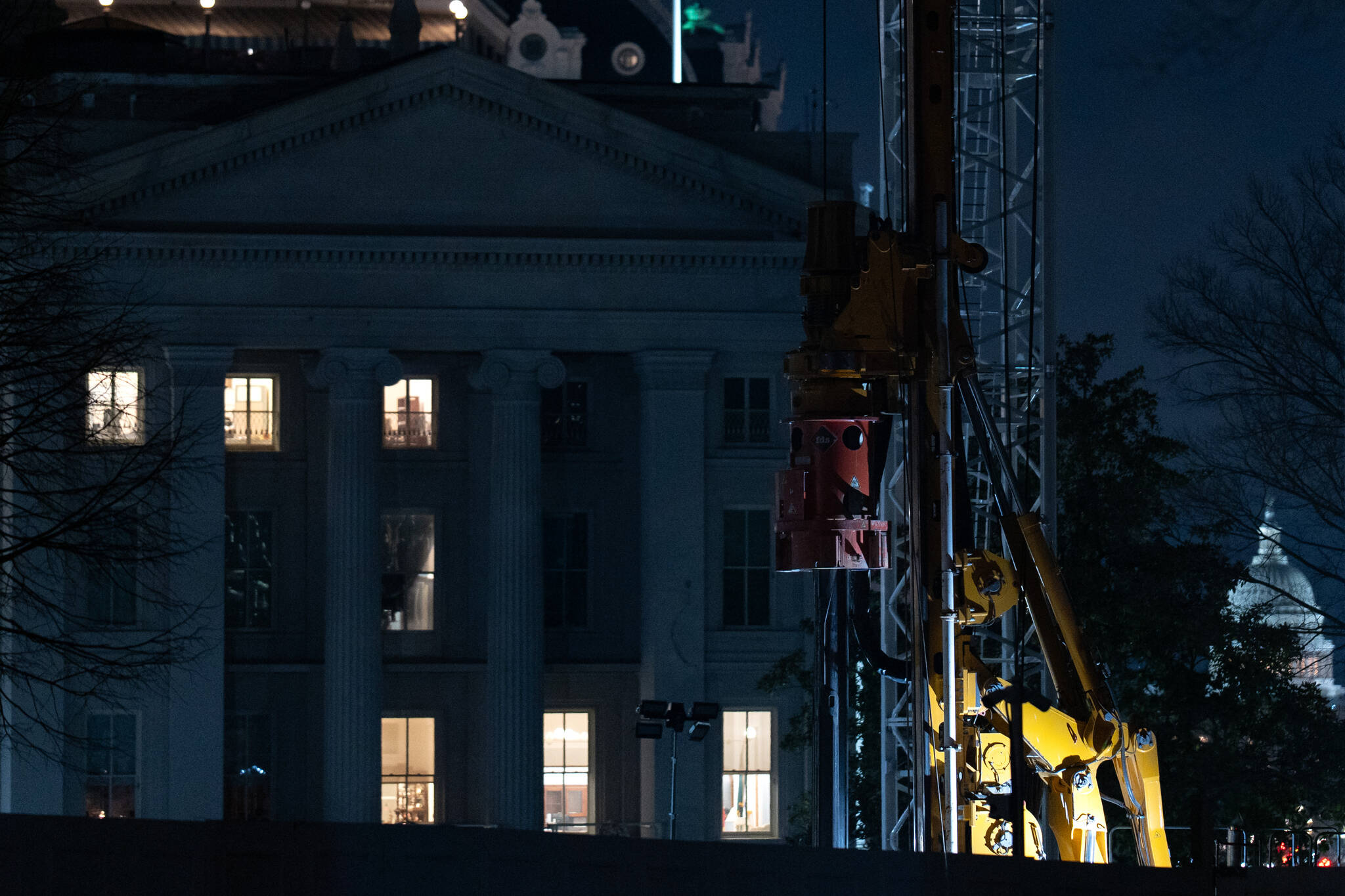
Consider who would be invited to a Golden Ballroom in the White House. It would not be the teacher grading papers late into the night, the nurse finishing a double shift or the dockworker rising before dawn. The guest list would favor donors, financiers, executives and political patrons whose access is already assured. In that sense, the ballroom defines itself before it is ever built. It signals that proximity to power is purchased, not earned, and that the people whose labor sustains the nation are reduced to spectators in a democracy increasingly staged for those who can afford the price of admission.
The White House has always drawn its dignity from restraint. It never needed to glitter to command respect. Its authority came from what it represented: a government accountable to its citizens. To turn that house into a stage for luxury is to forget its purpose. A Golden Ballroom is not simply decoration. It is a declaration that wealth, not service, now defines status in American public life.
That imagined room reflects what decades of policy have already produced. America has been reshaped to serve the wealthy. The middle class, once the anchor of democracy, has been hollowed out and told to accept insecurity as normal. The ballroom is not an isolated indulgence. It is the architectural expression of a political truth many prefer to avoid: concentrated power is no longer resisted. It is cultivated.
For much of the twentieth century, Americans chose a different course. From the New Deal through the Great Society, the nation worked to spread prosperity. Taxes were progressive. Labor was protected. Monopolies were constrained. Public investment flowed into schools, infrastructure, and opportunity. Strong unions and public programs extended security to millions. Growth reached ordinary citizens. The result was not extravagance but dignity, and with it a belief that the future belonged to those who worked for it.
That promise eroded in the late twentieth century. Policy after policy shifted burdens downward while rewards flowed upward. Tax cuts favored capital investment over work. Deregulation empowered corporate giants without accountability. Antitrust enforcement faded. Unions lost influence. Public investment shrank as private fortunes exploded. Inequality returned to levels unseen for generations. What vanished was not only income but trust in the fairness of the system itself.
The statistics confirm what daily life reveals. Productivity has surged, yet wages for most workers have barely moved. Families work longer hours for less security. Health care drains budgets and remains uncertain. Home ownership slips beyond reach for young Americans. Debt replaces savings. Retirement becomes an open question. In a nation richer than ever, millions live with anxieties their parents believed they had escaped.
This transformation did not occur by chance. It was engineered through law and money. Court decisions equated wealth with speech. Tax codes rewarded inheritance and speculation. Regulators were weakened or eliminated. Fundraising became the central craft of politics. Lobbying evolved into a permanent instrument of elite influence. As wealth concentrated, political power followed, closing the circle.
The resulting corruption is rarely criminal. It is more subtle and more corrosive. The public good becomes secondary. Banks are rescued while families drown in debt. Trade and tax policies benefit multinational corporations while communities hollow out. Public goods are privatized, and private risks are shifted onto the public. Freedom is celebrated in rhetoric while its substance is steadily extracted.
Into this long arc of inequality steps the Golden Ballroom. Gold is not neutral. It signals hierarchy. It separates those who rule from those who are ruled. Placed at the center of power, in the heart of the people’s house, it sends an unmistakable message: wealth now stands above democracy rather than beneath it. The room becomes a monument to privilege disguised as patriotism.
The greater danger lies not in the ballroom itself but in what it normalizes. When extravagance becomes acceptable at the seat of government, restraint elsewhere loses meaning. The spectacle tells the exhausted worker and the overburdened teacher that sacrifice is expected only of them. Civic pride becomes display. Leadership becomes performance. Inequality is no longer hidden. It is celebrated.
America does not need gilded halls to affirm its greatness. It needs fairness, equal justice and accountability. It needs leaders willing to rebuild a common future grounded in humility rather than ornament. A Golden Ballroom would shine like a beacon, but not of shared purpose; it would be a lighthouse for privilege, casting long shadows over the citizens it purports to serve. In its reflection, the nation must ask whether the White House remains a house of the people, or has become a hall of mirrors where wealth is elevated and democracy itself fades into the background.
