
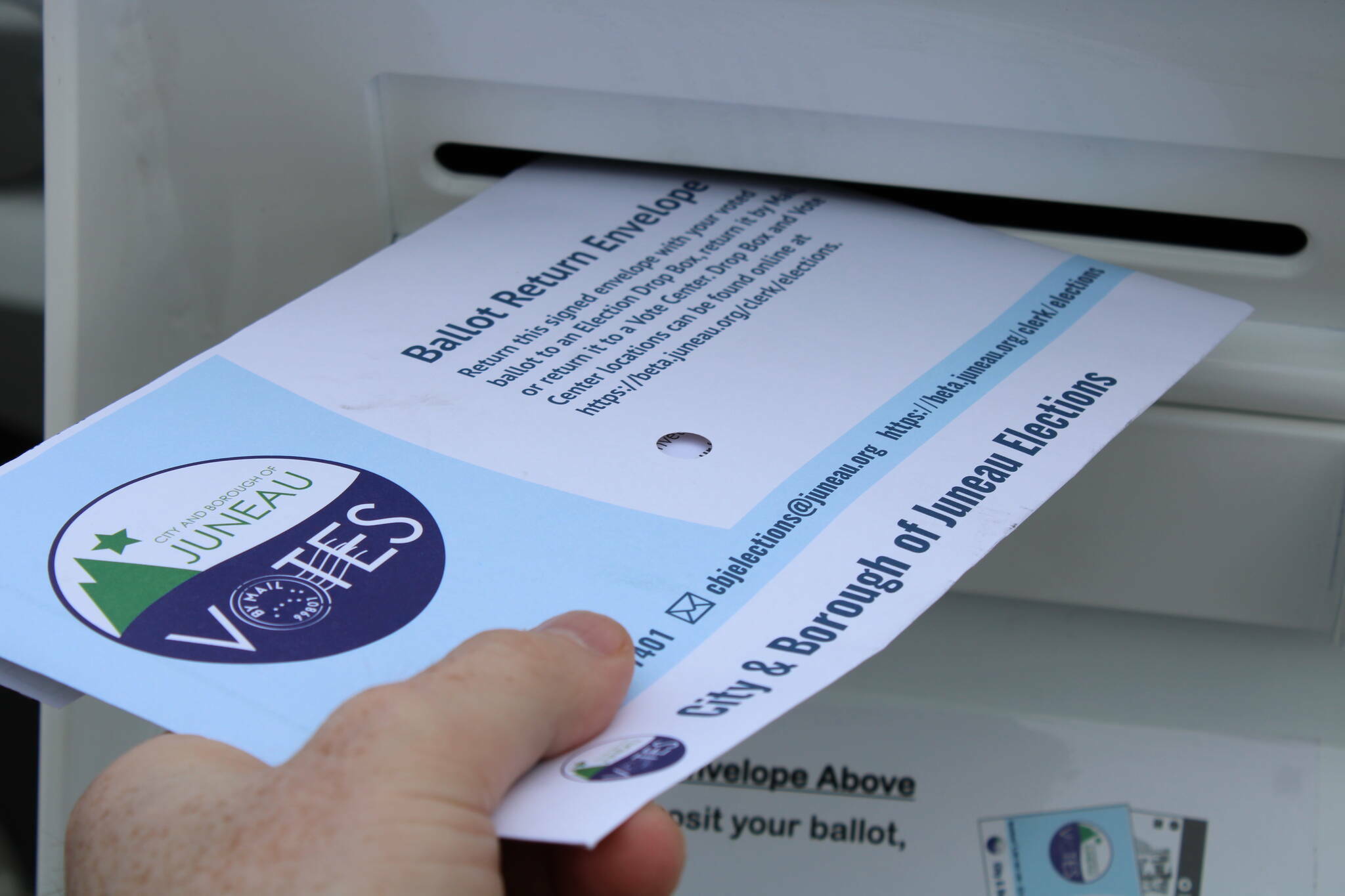
While the City Clerk’s office has done a creditable job conducting Juneau’s recent municipal election, many residents are expressing dissatisfaction with the current vote-by-mail (VBM) system.
When the Assembly unilaterally imposed VBM on Juneau’s electorate it was justified as an improvement over traditional voting that would expand voting choices, make it easier to vote and increase turnout.
In fact it has done just the opposite. Voters have been deprived of the choice to personally insert their anonymous ballot in a vote-counting machine the way they always have — in their neighborhood precincts on Election Day or through in-person early voting.
Over a week has passed since Juneau’s municipal election concluded and an unspecified number of votes are still outstanding.
The problem is, when over 27,000 unsolicited ballots are mailed to every registered voter, no one knows how many will be returned. So it’s impossible to know how many ballots remain uncounted until the election is certified weeks later.
Considering that several Assembly races were competitive and the Assembly waged a $50,000 advocacy campaign in favor of a controversial ballot proposition to partially fund a new City Hall, 2023 voter turnout has been mediocre. To date turnout only exceeds last year’s election by 101 votes. Almost 400 fewer votes have been cast than in 2018 when there were no propositions on the ballot and before VBM was implemented. Furthermore, compared to traditional precinct voting, the so-called “convenience” of VBM is a mirage when voters must deal with additional confusing paperwork and forms, the U.S. Postal Service, and the limited number of voting centers (two) or drop boxes (two).
Yet increased turnout and convenience were the primary reasons the Assembly decided to spend almost a million dollars in the first year implementing the system and several hundred thousand dollars more each year to run it.
It doesn’t have to be this way.
In a recent Empire My Turn, Rich Moniak promoted the idea of more choice in voting when quoting the managing director of the Brennan Center for Justice. The director wrote that election officials should “ensure that anyone who has the right to vote can exercise that right as simply and safely as possible. This shouldn’t be a partisan issue, but a patriotic duty. Vote by mail is just one option among many to accomplish that goal.”
If the Juneau Assembly thinks it’s important to be responsive to voters and increase transparency, then they will prove it by conducting an objective evaluation of our four-year experience with VBM and consider additional options based on the results.
First, the city clerk’s office should compile a comparison of all the voting statistics from the last five years. This data should include election costs and when, where and how people voted. How many voters actually mailed their ballot in, for instance, as opposed to dropping it off?. How many ballots had to be “cured” and how many were simply invalidated? This kind of transparency and accountability is absolutely essential to achieve a meaningful analysis in order to evaluate the efficacy of VBM.
Some states that considered VBM systems have opted for a hybrid system that allows voters to “opt-in” to have ballots mailed to them, but still preserved precinct voting for those that preferred to keep voting in-person on Election Day. Voters could sign up once for all future elections or just once if they knew they couldn’t vote in-person on Election Day. There is no reason the City and Borough of Juneau couldn’t consider a similar system.
A hybrid system would be beneficial in a number of ways:
• It would save thousands of dollars in printing and mailing costs since ballots would only be mailed to voters who requested them. Some of the savings could be used to pay staff and operate precinct voting stations on Election Day.
• It minimizes the potential for “ballot harvesting,” a political tool that can easily lend itself to abuse and has been outlawed in some states.
• Finally, and most importantly, it restores choice to the majority of voters who want to continue to vote in-person.
Vote-by-mail is not a choice if it’s the only choice.
• After retiring as the senior vice president in charge of business banking for KeyBank in Alaska, Win Gruening became a regular Opinion Page columnist for the Juneau Empire. He was born and raised in Juneau and graduated from the U.S. Air Force Academy in 1970. He is involved in various local and statewide organizations. Columns, My Turns and Letters to the Editor represent the view of the author, not the view of the Juneau Empire. Have something to say? Here’s how to submit a My Turn or letter.
