

Atticus Hempel stands in a row of his shared garden. (photo by Ari Romberg)

Atticus Hempel stands in a row of his shared garden. (photo by Ari Romberg)

My Turn: What’s your burger worth?

Atticus Hempel reflects on gardening, fishing, hunting, and foraging for food for in Gustavus.

You can purchase a cheeseburger at our local McDonald’s for $4.19. It’s something of a miracle — given how far it’s traveled and how many hands have contributed to making it.

There’s the cashier and the cook. Then whoever drove and flew the patties to 2285 Trout St. Plus the farmers who raised the cow, and whoever slaughtered it. And we can’t forget the Iowan corn farmer who grew the feed.

That’s only to name a few. Somehow paid and satisfied at $4.19 a burger.

It’s possible only because the true cost of our food lies elsewhere — in our tax dollars, in the environment, and in our health.

All that burned gasoline — moving corn to feedlots, cows to slaughterhouses, and beef to Juneau — costs real dollars in catastrophe relief that aren’t included on the receipt. Economists call this “implicit costs.”

Another misnomer of that $4.19 price tag the U.S. government pays in hundreds of billions of dollars in agricultural and oil subsidies, which artificially lower the price of a McDonald’s cheeseburger and make it harder for unsubsidized, local farmers to compete.

Whether or not you pull off Glacier Highway and step through those French doors, you’re already paying McDonald’s your tax dollars.

There are health costs too. The U.S. spent $306 billion on the treatment and management of diabetes in 2022, an increase of 66% since 2000. A McDonald’s cheeseburger packs a punch, no matter how policymakers rebrand nutrition guidelines.

What we should be eating, according to decades of nutrition research, broadly agreed upon by nutritionists, is more nutrient-rich food — which a McDonald’s cheeseburger is not.

So what is?

In June, three friends and I gathered in Gustavus and began gardening, fishing, hunting, and foraging all our food for eight months. It’s an imperfect experiment, but a revealing one.

From the sandy succession of 19th century glacial deposits, our quadruple of twenty-somethings harvested 700 pounds of potatoes, 95 pounds of beets, 400 onions, and 6 garbage bins of carrots. Our freezers hold 70 pounds of strawberries and more salmon, halibut, venison, and moose sausage than I’d like to count. Our shelves sag under hundreds of quarts of salmon, venison, and moose stock, plus 80 quarts of juice.

All of it we’re eating — or giving away.

It’s a peculiarity of the 21st century that we no longer need to pay attention to our food. You might think cheeseburgers live and breathe on laminated floors, if all you ever did was shop at McDonald’s.

None of this is to say you shouldn’t buy fast food, or that you need to eat locally. Fred Meyer doesn’t exactly advertise its supply chain either, and local food isn’t always accessible.

I’m asking what your food is worth — and I don’t think the answer shows on a price tag.

It shows in dirty fingernails.
Or in the tug on a line.

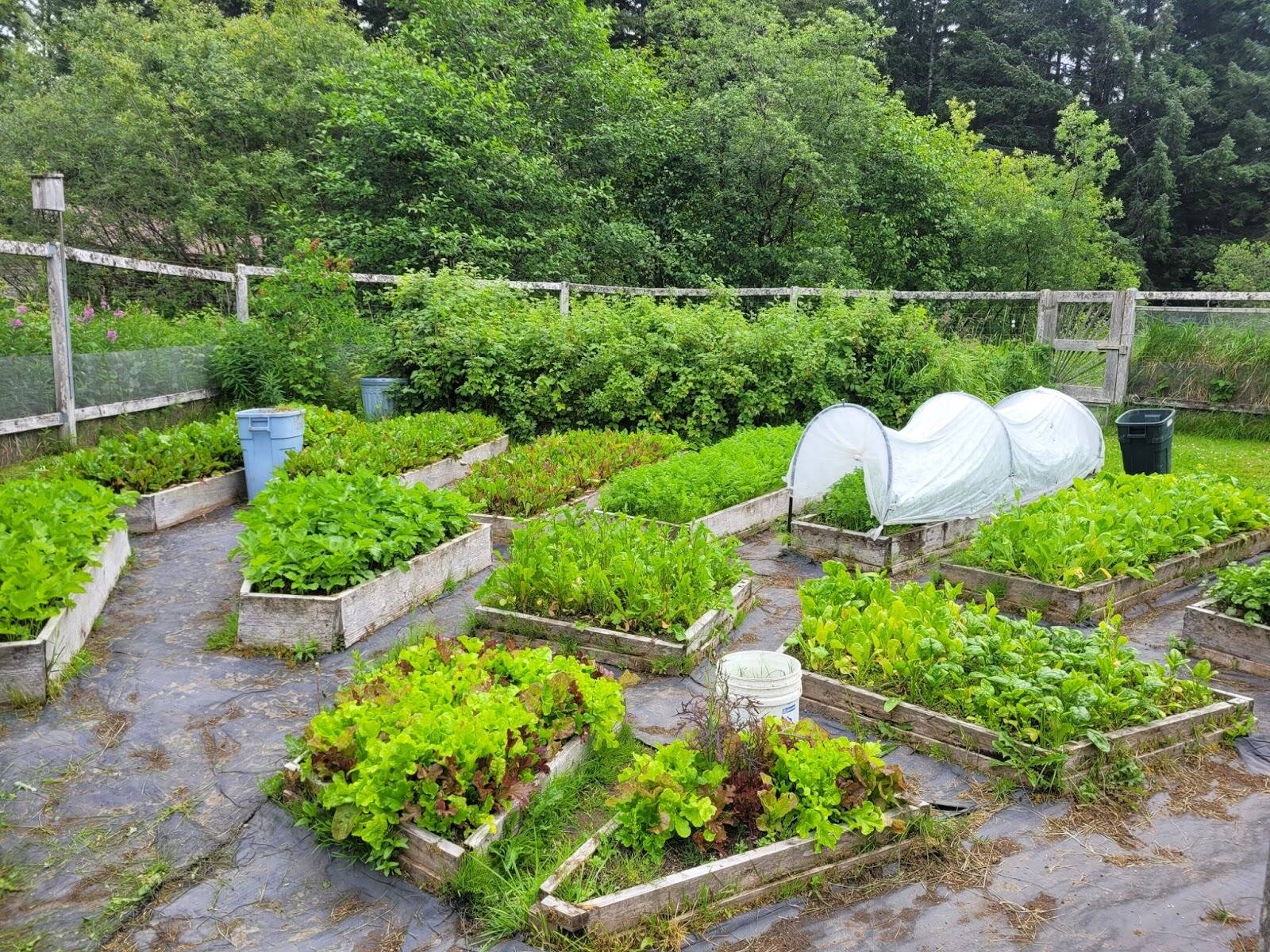
The author’s garden is pictured in summer. (photo by Ari Romberg)

The author’s garden is pictured in summer. (photo by Ari Romberg)

More in Opinion

Web
Have something to say?

Here’s how to add your voice to the conversation.

Atticus Hempel stands in a row of his shared garden. (photo by Ari Romberg)
My Turn: What’s your burger worth?

Atticus Hempel reflects on gardening, fishing, hunting, and foraging for food for in Gustavus.

At the Elvey Building, home of UAF’s Geophysical Institute, Carl Benson, far right, and Val Scullion of the GI business office attend a 2014 retirement party with Glenn Shaw. Photo by Ned Rozell
Alaska Science Forum: Carl Benson embodied the far North

Carl Benson’s last winter on Earth featured 32 consecutive days during which… Continue reading

Jamie Kelter Davis/The New York Times
Masked federal agents arrive to help immigration agents detain immigrants and control protesters in Chicago, June 4, 2025. With the passage of President Trump’s domestic policy law, the Department of Homeland Security is poised to hire thousands of new Immigration and Customs Enforcement (ICE) agents, and double detention space.
OPINION: $85 billion and no answers

How ICE’s expansion threatens law, liberty, and accountability.

Yereth Rosen/Alaska Beacon
The entrance to the Alaska Gasline Development Corp.’s Anchorage office is seen on Aug. 11, 2023. The state-owned AGDC is pushing for a massive project that would ship natural gas south from the North Slope, liquefy it and send it on tankers from Cook Inlet to Asian markets. The AGDC proposal is among many that have been raised since the 1970s to try commercialize the North Slope’s stranded natural gas.
My Turn: Alaskans must proceed with caution on gasline legislation

Alaskans have watched a parade of natural gas pipeline proposals come and… Continue reading

Win Gruening (courtesy)
OPINION: Juneau Assembly members shift priorities in wish list to Legislature

OPINION: Juneau Assembly members shift priorities in wish list to Legislature

Letter to the editor typewriter (web only)
LETTER: Juneau families care deeply about how schools are staffed

Juneau families care deeply about how our schools are staffed, supported, and… Continue reading

Kenny Holston/The New York Times
President Donald Trump speaks to reporters as he departed the White House en route to Joint Base Andrews, bound for a trip to Britain, Sept. 16, 2025. In his inauguration speech, he vowed to immediately stop all government censorship and bring back free speech to America.
OPINION: Ratings, Not Reasons

The Television Logic of Trump’s Foreign Policy.

Win Gruening (courtesy)
OPINION: Transparency and accountability are foundational to good government

The threat to the entire Juneau community due to annual flooding from… Continue reading

A demonstrator holds a sign in front of the U.S. Supreme Court as arguments are heard about the Affordable Care Act, Tuesday, Nov. 10, 2020, in Washington. (AP Photo / Alex Brandon)
My Turn: The U.S. is under health care duress

When millions become uninsured, it will strain the entire health care system.

The U.S. Coast Guard Cutter Storis is underway, June 3, 2025, from Pascagoula, Mississippi. The Storis is the Coast Guard’s first new polar icebreaker acquisition in 25 years and will expand U.S. operational presence in the Artic Ocean. (Photo courtesy of Edison Chouest Offshore)
My Turn: Welcoming the Coast Guard for a brighter future

Our community is on the verge of transformation with the commissioning of the icebreaker Storis.d