
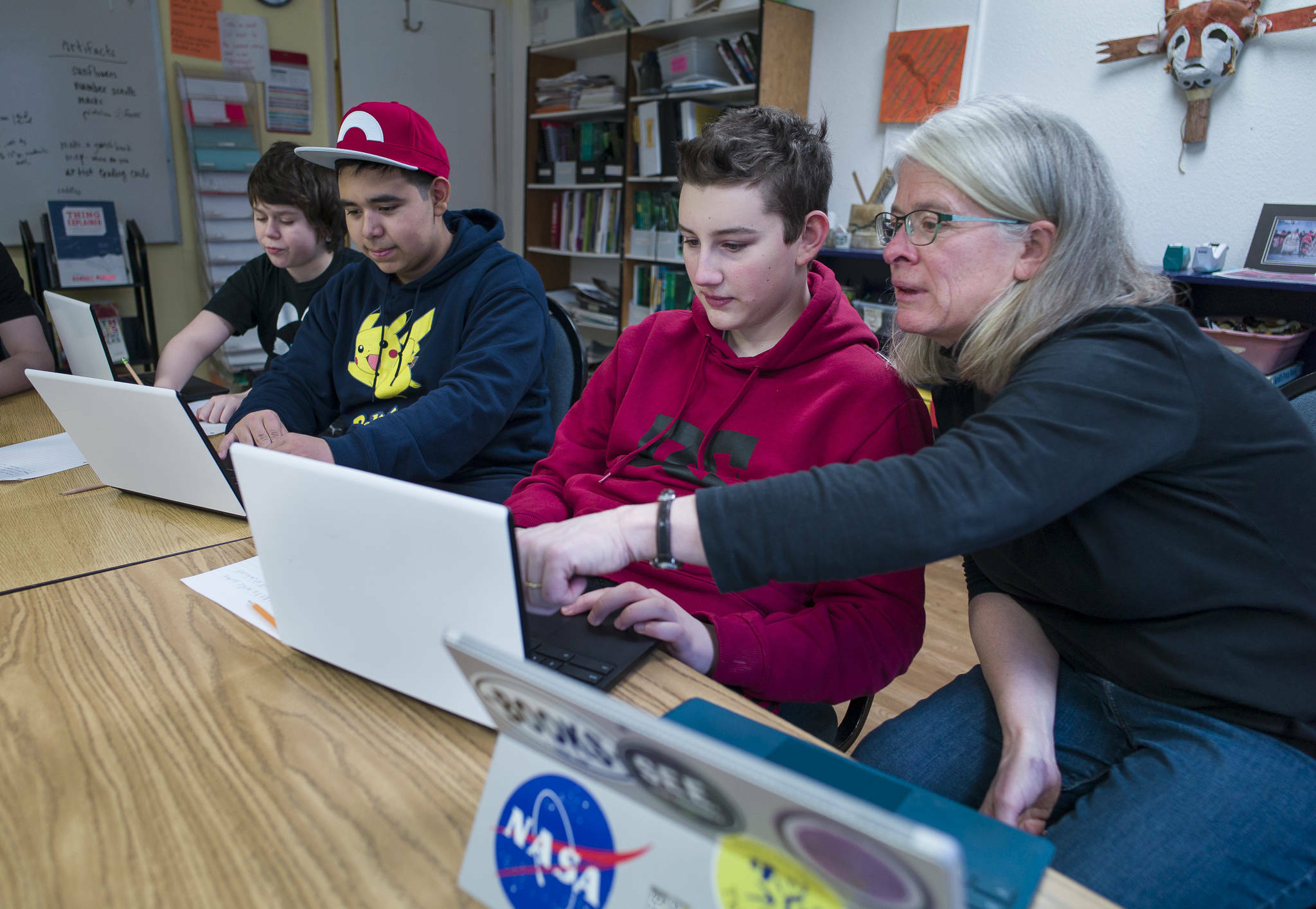
With charter schools in the news recently, it is worth examining the model and how it is being applied in Juneau’s only current charter school. Charter schools in Alaska were first authorized in 1995 as an opportunity to offer an optional, specialized-focused, public-school program that is supported by local school districts.
Charter schools in Alaska are focused on employing different educational methods and pathways and seek to concentrate on specific areas of educational specialization. The most common misconception is that charter schools, like private schools, cost money or charge tuition. As public schools, they are funded through the same sources as all other public schools, namely, the Base Student Allocation (BSA) and local and federal sources.
Juneau Community Charter School (JCCS) was founded in 1997 by parents that believed that “optimal learning occurs in an environment where active parental involvement is expected and encouraged and where student-teacher ratios are low.” Those founders worked to create an environment where children are engaged through project-focused instruction, and the flexibility to pursue educational practices that utilizes a variety of in-classroom instructional strategies and out of classroom experiences, with a curriculum focused on the arts and humanities.
Over the past 25 years the school has evolved, but has sought to maintain the basis of its original philosophy. One of the unique aspects of JCCS, and charter schools in general, is the very high level of family engagement that was emphasized in JCCS’ founding. The school is quasi-governed by a parent committee which has a large say in the school’s philosophy, activities, curriculum and personnel. Additionally, parent volunteers are routinely in classrooms assisting teachers and helping with other all-school functions.
Another fundamental aspect as previously mentioned is small class sizes. Upon its establishment, JCCS’ original class size was set at a student to teacher ratio of 1:20. The school’s charter, which was renewed by the Juneau School District (JSD) in 2015 currently provides for a student to teacher class size of 1:22. At this time, the largest class is 21 students.
Like so many other small schools in Alaska and other states, the pandemic had a profound effect on JCCS. Prior to the event, the school was close to its maximum capacity of 110 students. Because of the upheaval from COVID, enrollment has dropped. This year, JCCS, as it does every year, is engaging in a process of recruiting new students who are interested in pursuing a new educational pathway.
JCCS is open to all students and is both an ethnically and socioeconomically diverse school that is reflective of the community it serves. Like all JSD schools, classes are inclusive and seeks to deliver an educational program that is tolerant and effective at providing meaningful learning to all students regardless of their ability level or background.
Clint Sullivan, JCCS’ kindergarten/first grade class teacher, is also a parent who has two daughters at the school. In reflecting on his family’s choice, he said “After moving back home to Juneau, I looked where I wanted to work and where I wanted my own children to attend. Juneau Community Charter School became my top choice. Some of the reasons for my choice were the encouragement of out-of-the-box thinking, strong parent involvement, and an emphasis on creating community within all grades, and with parents, teachers, and families.”
In 2023, students selected the Marmot as the mascot of the school — their reasoning was that they wanted to chose a symbol that was meaningful to the local environment and reinforced the school’s commitment to the outdoors and being a part of the natural community. The word “community” in the school’s name is purposeful — it is a continual goal to engage students and families in the local community while building a community within its own walls.
Anyone interested in finding out more about Juneau Community Charter School and its programming may call (907) 523-1679 or email the school at jccs@juneauschools.org. Additionally, the school will be hosting family information meetings at JDHS on April 15 at 5:30, at TMHS on April 16 at 5:30, and a night for incoming kindergarten families on April 17 at JDHS at 5:30.
• Corey Weiss is the principal of Juneau Community Charter School and the HomeBRIDGE program.
