
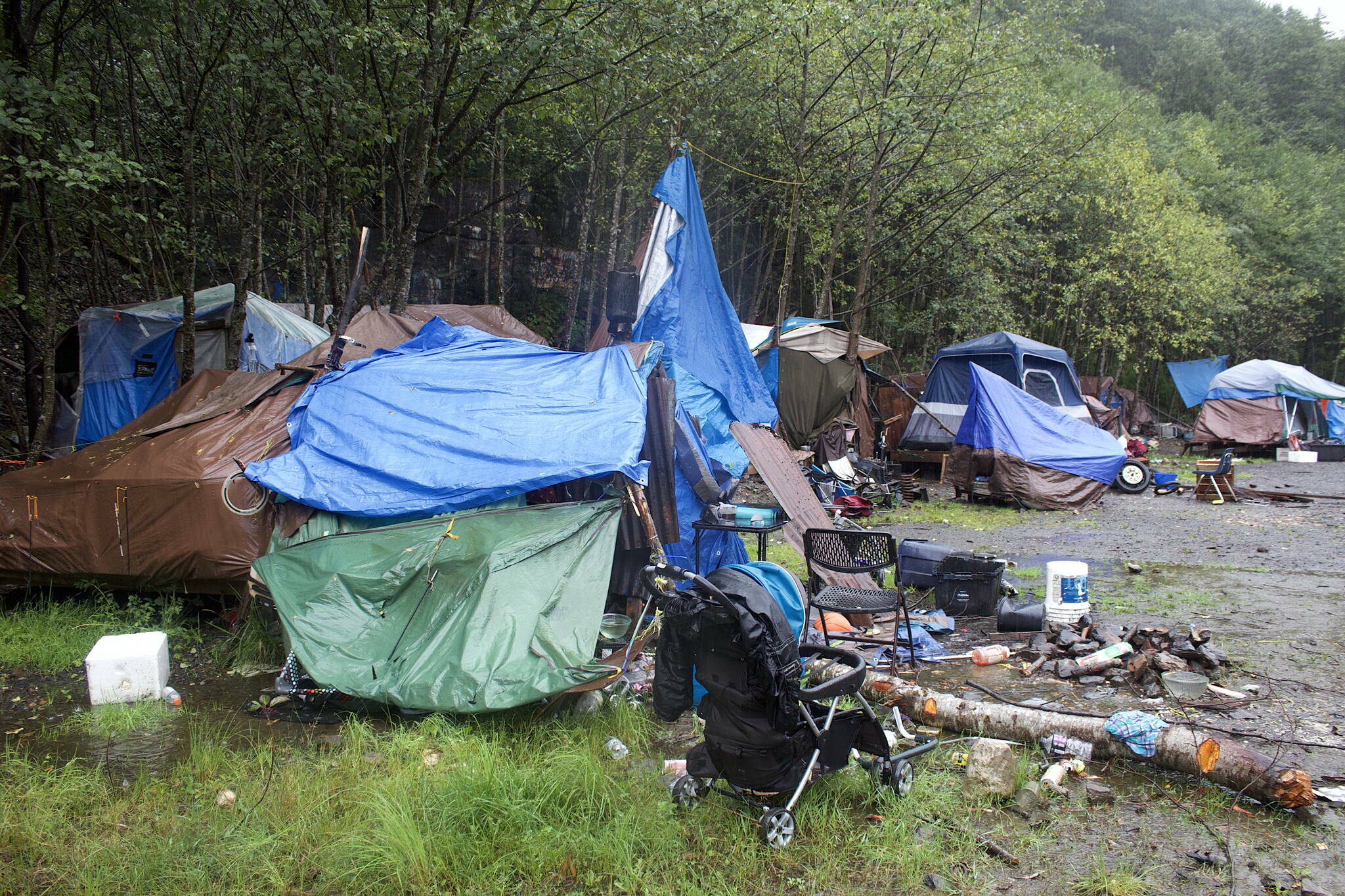
The government’s solution to solving the homeless crisis in America, including in Alaska, could be compared to someone with a leaky roof adding more pans to catch the water instead of trying to fix the roof.
About 100 years ago, the homeless were relegated to live in shantytowns. In San Francisco it was Dumpville; in Seattle it was Hooverville. Not much has changed. One of the benefits of longevity is that a person gets to live through trends, good and bad. Today, the homeless in Anchorage occupy a vacant lot on 3rd Street in Anchorage with the approval of the mayor.
Every Third World country has their own version of Dumpville, and all have the same flavor: Lawless, dangerous and sub-human conditions. There are millions passed out by state agencies and non-profits and most programs with misplaced empathy offer a hand-out instead of a hand-up in the way of training or schooling.
In my opinion the top three reasons for the increasing homeless crisis are: an inadequate educational system, inadequate care for people with a mental illness and poor choices by the U.S. government.
Many politicians cringe at the mention of a connection between the current educational system and the homeless crisis. Politicians that defend school policies that do not prepare a person with the reading and comprehension skills sufficient to find a job are simply adding to the homeless crisis and are part of the problem.
About 10% of the population have an IQ of less than 80, and without special classes are not able to read sufficiently, comprehend and problem solve in today’s job market. Too often, people with low academic skills are passed onto the next grade unprepared. Even today, Army recruiters are having some difficulty recruiting high school graduates that can read and comprehend sufficiently. And the Army is required to offer special classes to prepare some of the applicants with the skills to enter the Army.
In the 1950’s American factories acted as a safety net for people with a low education. On the East Coast, a shoe factory worker or a worker in a woolen mill could earn enough money to buy a new car or a house. Starting in the 1960s to today, American businesses with the blessing of the U.S. government started shipping low skilled factory jobs overseas. There was no plan of what America was going to do with the 10% of the population that America had no need for. And now they make up a good portion of the homeless population.
The government, nationally and locally, has an obligation to support and promote businesses that serve all the population. However, most of the tax breaks go for businesses that do not support the lower 20% of the economic ladder. A job with income not only adds to the quality of life for a person, it helps society.
Starting in the 1960s, the opening of the doors of the state psychiatric hospitals was in full swing. Every state had the option of opening supportive group homes with the aid of the federal government for people with an acute mental illness. That did not happen. Too many people were just given a disability check and dumped on the streets or placed in an apartment with little or no supervision. It was the government’s low expectation of people with a mental illness to be productive that did the most damage.
With an eye on past mistakes, at the least society — and that includes the state Legislature — must go back to the drawing board and address the main causes contributing to today’s homelessness. Alaska must provide an adequate educational system that prepares people to live independently and provide appropriate care and housing for people with an acute mental illness.
• Dorrance Collins is Anchorage resident who arrived in 1972 with a one-way ticket from Bangor, Maine, and for a few months lived at the YMCA for $6 a night. For a short time worked at the “Splash and Dash Car Wash” for $2 an hour under the table.
