
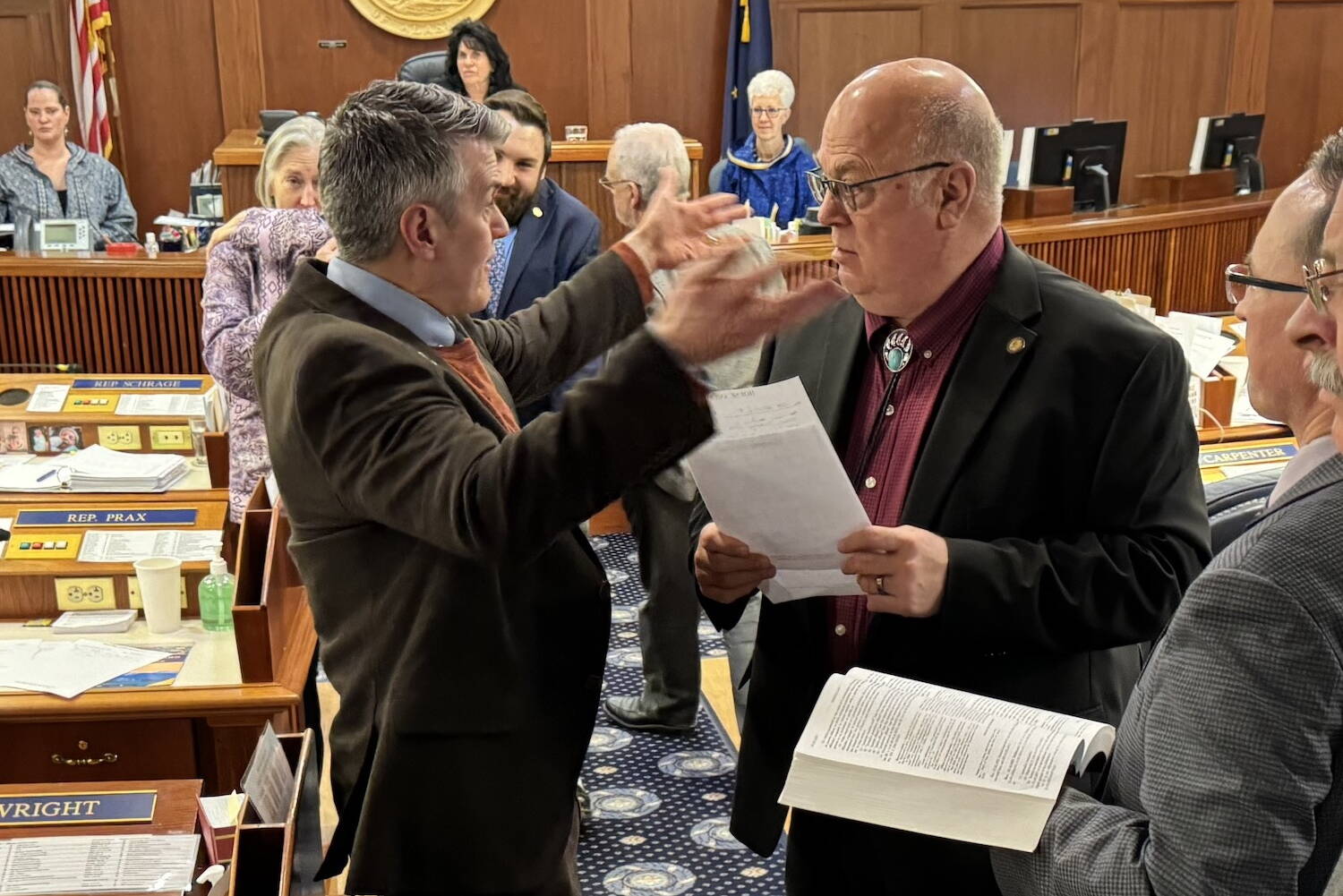
The Alaska House of Representatives unexpectedly moved on Friday to raise the state’s age of sexual consent from 16 to 18.
The proposal, from Rep. Andrew Gray, D-Anchorage, was hotly debated but ultimately approved 32-6 as an amendment to House Bill 264, which is slated for a final vote on Monday.
“I’m beyond shocked. I mean, I’m very, very happy,” Gray said. “It will make a positive difference in our state.”
HB 264 would require state agencies to screen for children who are being sexually abused, and during debate, Gray introduced an amendment that modifies the definition of sexual abuse targeting a minor.
Under current state law, if someone older than 18 has sex with someone younger than 16, it’s considered first-degree sexual abuse of a minor, a felony punishable by as much as 99 years in prison.
Under Gray’s amendment, someone older than 18 would be prohibited from having sex with someone younger than 18, with some exceptions.
Someone older than 18 could still marry someone as young as 16 and have sex with them, and Gray’s amendment doesn’t change the “Romeo and Juliet” exemption that allows someone older than 18 to have sex with someone younger than that as long as their age difference is less than four years.
The amendment, hurriedly scrawled by hand in order to meet a deadline for introduction, also doesn’t address other aspects of the state’s criminal code that have the 16-year-old limit.
“That’s how fast I could write. Everyone knows I was waiting for Legislative Legal, and they just couldn’t get (the amendment) done in time,” Gray said, referring to the nonpartisan office that helps legislators draft bills and amendments.
“My intent is to have the amendment do what I spoke about on the floor and raise the age of consent, and I believe that’s what everyone voted on,” Gray said.
He said he’s already talked to state senators about the issues with the bill as written, and he expects those issues to be fixed if the House passes the underlying bill, sending it to the Senate.
Passage isn’t guaranteed. Legislators could pull the bill back to committee for further amendments, or it could be killed by its sponsor, Rep. Sarah Vance, R-Homer.
Vance was one of six votes against Gray’s amendment, which sparked an hour of debate and discussion when it was introduced Friday morning.
Vance and others said the proposal hadn’t been properly vetted.
“It’s not in the appropriate place, a bill that is simply trying to screen our children for exploitation,” she said.
She also criticized the potential cost, which she estimated at $4 million, based on a conversation with officials at the Department of Public Safety.
Gray responded pointedly in debate.
“Here’s what I say: Who cares? Who cares how much it costs to protect our 16- and 17-year-olds?” he said.
Austin McDaniel, the department’s communications manager, was unable to confirm Vance’s figure on Friday.
“We’re confident there will be a fiscal impact; we just have to do that analysis, and it hasn’t occurred yet,” he said.
Rep. Ben Carpenter, R-Nikiski, warned legislators against voting for an amendment whose text doesn’t match their intent.
“What we say on the record here and what is written on the paper may not be the same thing,” he said.
“This topic is so important that it deserves the committee process,” said Rep. Tom McKay, R-Big Lake.
Despite those notes of caution, the House voting board rapidly lit up in green when lawmakers voted on the amendment, and after it hit 21 votes — the minimum needed for adoption — many legislators who spoke against it changed their votes from no to yes.
In the final tally, all six “no” votes came from Republicans: Reps. Mike Cronk, R-Tok; Craig Johnson, R-Anchorage; Tom McKay, R-Anchorage; Mike Prax, R-North Pole; Dan Saddler, R-Eagle River; and Vance. Reps. Jennie Armstrong, D-Anchorage, and Thomas Baker, R-Kotzebue, were excused absent and did not vote.
House Bill 264 is scheduled for a final House vote on Monday.
