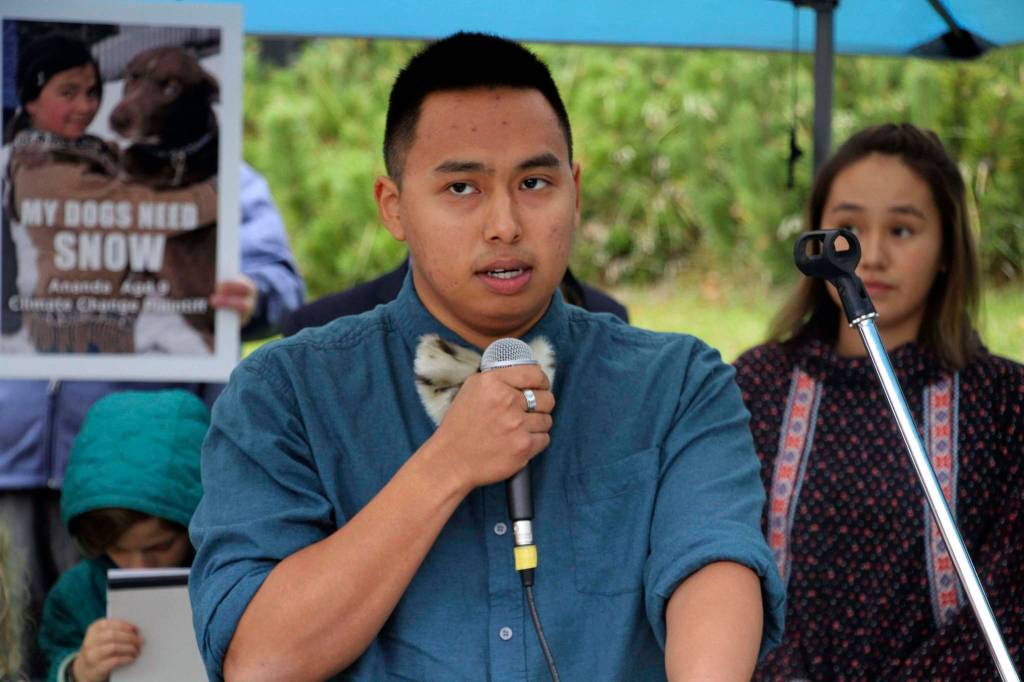
Esau Sinnok of Shishmaref speaks at a news conference after the Alaska Supreme Court heard arguments Wednesday in Anchorage in a lawsuit that claims state policy on fossil fuels is harming the constitutional right of young Alaskans to a safe climate. Sinnok and 15 other Alaska youths in 2017 sued the state, claiming that human-caused greenhouse gas emission leading to climate change is creating long-term, dangerous health effects. They lost in Superior Court, but appealed to Alaska’s highest court. (AP Photo | Mark Thiessen)

Esau Sinnok of Shishmaref speaks at a news conference after the Alaska Supreme Court heard arguments Wednesday in Anchorage in a lawsuit that claims state policy on fossil fuels is harming the constitutional right of young Alaskans to a safe climate. Sinnok and 15 other Alaska youths in 2017 sued the state, claiming that human-caused greenhouse gas emission leading to climate change is creating long-term, dangerous health effects. They lost in Superior Court, but appealed to Alaska’s highest court. (AP Photo | Mark Thiessen)

Will youth climate change lawsuit get its day in court?

Supreme Court hears arguments for and against letting it go to trial

Attorneys argued Wednesday over whether a lawsuit that alleges Alaska’s climate and energy policies violate young people’s constitutional rights should go to trial.

Lawyers on both sides of Sinnok v. Alaska made the case for why the lawsuit — that includes two Juneau youths, Seb Kurland and Tasha Elizarde as plaintiffs — should get further consideration after a Superior Court judge in Anchorage dismissed the youths’ claims. Oral arguments were heard by the Alaska Supreme Court in Boney Courthouse in Anchorage.

The Alaska Supreme Court will issue a written decision on that matter at an undetermined date.

[Alaska judge dismisses youth climate lawsuit]

“The merits of the plaintiffs’ case are for a later day, but we’re asking, give them their day in court,” said Andrew Welle, lawyer with Our Children’s Trust, a nonprofit based in Oregon dedicated to protecting the environment, during arguments.

Welle said determining whether Alaska’s energy policies are constitutional is exactly the sort of thing the court should decide, and it’s important a decision is made since climate change actively endangers the young plaintiffs.

He also said the lawsuit is outside the “narrow focus” of political doctrine, which determines whether a question is fundamentally political or legal and something over which a court can exercise legal authority.

“I would submit that it would be unprecedented for this court to rule that a constitutional challenge to a statute is not justiciable,” Welle said.

Attorney Anna Jay of the Alaska Department of Law argued the lawsuit should not go to trial since it was similar to previous unsuccessful lawsuits and would ask the court to weigh-in on a matter that she characterized as outside the judicial branch’s scope.

“The appellants raise important issues, but they are not issues that can be solved by the court,” Jay said.

She said the executive and legislative branches would be the appropriate sources of change in the state’s climate change policy.

Jay said the court lacks the resources to affect that change.

“The court can’t commission scientific studies,” Jay said during arguments. “It’s confined to the record that’s put before it in any given case.”

Justice Peter J. Maassen said he didn’t see why the court would need access to scientific data to make a declaration as to whether Alaskans have a constitutional right to a clean environment.

He also noted rights are rarely absolute.

Jay said lack of a clear definition of what a right to a stable environment means is one of the lawsuit’s weaknesses.

Justice Daniel E. Winfree said in the past the court declared Alaskans have a right to privacy.

“What does that mean?” he asked.

Winfree said it was a definition that gained clarity case by case.

Justice Craig Stowers said there seems to be an inherent tension between the state’s responsibilities to make the most of its resources and provide the most benefit to residents.

“I think that gets to the heart of this case,” Jay said. “Balancing these competing interests that are in tension doesn’t led itself to judicially manageable factors.”

Welle said managing that balance is an issue in every case that challenges the constitutionality of a statute.


• Contact reporter Ben Hohenstatt at (907)523-2243 or bhohenstatt@juneauempire.com. Follow him on Twitter at @BenHohenstatt.

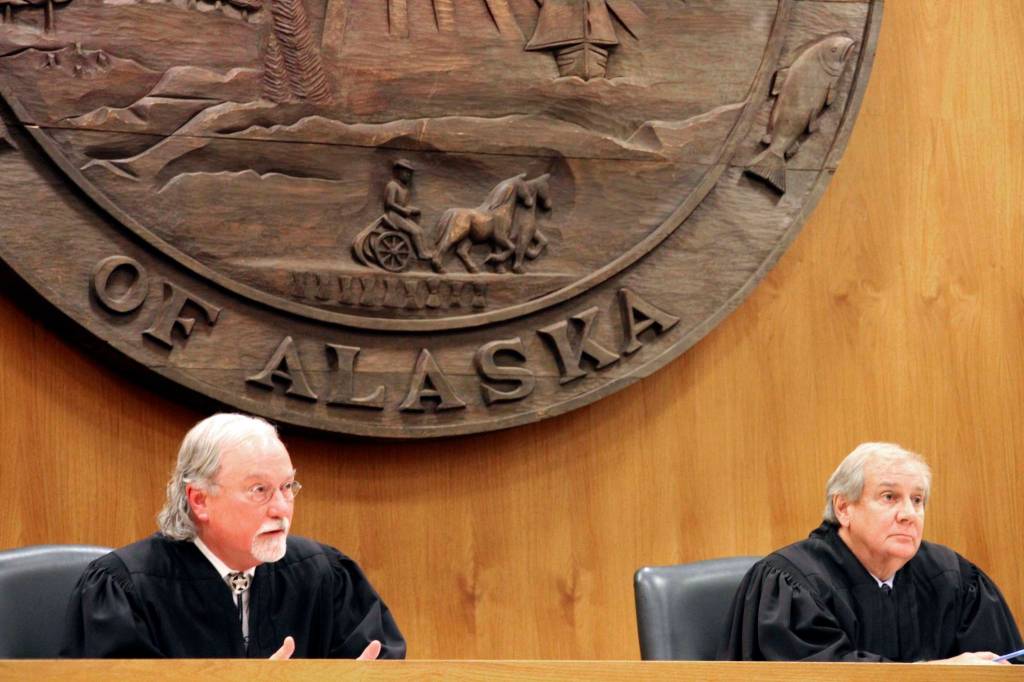
Alaska Supreme Court Justices Craig Stowers, left, and Daniel Winfree listen to arguments in a lawsuit that claims state policy on fossil fuels is harming the constitutional right of young Alaskans to a safe climate Wednesday in Anchorage. Sixteen Alaska youths in 2017 sued the state, claiming that human-caused greenhouse gas emission leading to climate change is creating long-term, dangerous health effects. They lost in Superior Court, but appealed to Alaska’s highest court. (AP Photo | Mark Thiessen)

Alaska Supreme Court Justices Craig Stowers, left, and Daniel Winfree listen to arguments in a lawsuit that claims state policy on fossil fuels is harming the constitutional right of young Alaskans to a safe climate Wednesday in Anchorage. Sixteen Alaska youths in 2017 sued the state, claiming that human-caused greenhouse gas emission leading to climate change is creating long-term, dangerous health effects. They lost in Superior Court, but appealed to Alaska’s highest court. (AP Photo | Mark Thiessen)

More in News

The northern lights are seen from the North Douglas launch ramp late Monday, Jan. 19. A magnetic storm caused unusually bright northern lights Monday evening and into Tuesday morning. (Chloe Anderson/Juneau Empire)
Rare geomagnetic storm causes powerful aurora display in Juneau

The northern lights were on full display Monday evening.

A tsunami is not expected after a 4.4-magnitude earthquake northwest of Anchorage Wednesday, Feb. 4, 2026. (U.S. Geological Survey)
No tsunami expected after 4.4-magnitude earthquake in Alaska

U.S. Geological Survey says 179 people reported feeling the earthquake.

ORCA Adaptive Snowsports Program staff member Izzy Barnwell shows a man how to use the bi-ski. (SAIL courtesy photo)
Adaptive snow sports demo slides to Eaglecrest

Southeast Alaska Independent Living will be hosting Learn to Adapt Day on Feb. 21.

Cars drive aboard the Alaska Marine Highway System ferry Hubbard on June 25, 2023, in Haines. (Photo by James Brooks)
Alaska’s ferry system could run out of funding this summer due to ‘federal chaos problem’

A shift in state funding could help, but a big gap likely remains unless a key federal grant is issued.

Photo by James Brooks/Alaska Beacon
U.S. Sen. Dan Sullivan stands with acting Coast Guard Commandant Adm. Kevin Lunday during the after the commissioning ceremony for the Coast Guard icebreaker Storis on Sunday, Aug. 10, 2025, in Juneau, Alaska.
Coast Guard’s new Juneau base may not be complete until 2029, commandant says

Top Coast Guard officer says he is considering whether to base four new icebreakers in Alaska.

Students from the Tlingit Culture Language and Literacy program at Harborview Elementary School dance in front of elders during a program meeting in 2023. (Clarise Larson / Juneau Empire file photo)
Sealaska adds more free Tlingit language courses

The new course is one of many Tlingit language courses offered for free throughout the community.

teaser
New Juneau exhibition explores art as a function of cultural continuity

“Gestures of Our Rebel Bodies” will remain on display at Aan Hít through May.

teaser
Juneau protestors urge lawmakers to defund Homeland Security after Minneapolis killings

Hundreds gathered hours before congressional delegation voted on whether to extend ICE funding.

Kyle Khaayák'w Worl competes in the two-foot high kick at the 2020 Traditional Games. (Courtesy Photo / Sealaska Heritage Institute)
Registration opens for 2026 Traditional Games in Juneau

The ninth annual event will feature a college and career fair and international guest athletes.

Most Read