Why does Mendenhall Valley have mink, otters and bear? Naturalists shed light.

Why does Mendenhall Valley have mink, otters and bear? Naturalists shed light.

Watershed covered in depth in Saturday night presentation

Two naturalists shed new light on a watershed.

Richard Carstensen, lead naturalist for Discovery Southeast, and John Hudson, naturalist for Discovery Southeast, led a tag-team presentation on a deer-leg-shaped patch of land in the Mendenhall Valley that is the Kaxdigoowu Héen, also known as Montana Creek-McGinnis, watershed.

What the creek’s Tlingit name means depends on who you talk to, Carstensen said.

“It definitely has something to do with clear water,” Carstensen said. “It also has something to do with back eddies.”

[Watershed coalition meets]

He said it may be because of the confluence of clear water meeting silty water from the Mendenhall River.

The presentation Saturday night at University of Alaska Southeast’s Egan Lecture Hall was a fundraiser for Southeast Alaska Land Trust.

Carstensen and Hudson spoke for more than an hour about the watershed and covered everything from its glacier-influence history to its modern-day importance.

Here are some takeaways from their talk.

Don’t say the M-word

Throughout the presentation Carstensen consistently referred to the creek as Kaxdigoowu Héen.

“For the last five years, I’ve been trying to transition to the Tlingit place names,” Carstensen said. “So in my writing and mapping I’ll put the Tlingit name first, the translation in italics and the important white-guy name in parenthesis at the bottom. If I say the M-word tonight, I owe John a dollar.”

[Lecture questions colonial names]

Carstensen said after the presentation he began using those place names after the publication of the book “Haa Leelk’w Has Aani Saax’u / Our Grandparents’ Names on the Land” by Thomas Thornton, which included more than 3,000 Alaska Native place names.

Carstensen said it made more sense to refer to geographic locations by names that evoked characteristics of the land than colonial figures who may have spent little or no time at a place.

“I think we’re in a place where 20 years from now kids will mostly use Native names,” Carstensen said.

The watershed is a wild place

Both Hudson and Carstensen spoke in glowing terms of the relatively preserved watershed despite its proximity to residences.

“It’s a very healthy watershed close to a lot of people,” Hudson said.

He said that’s becoming rarer in Juneau as more watershed areas are developed.

“The watershed is a refugium for critters we wouldn’t have in the Valley otherwise,” Carstensen said.

Specifically, Carstensen said mink, otters and bears tend to do well in the area, especially parts of the watershed that aren’t heavily traveled by people with dogs.

Even well behaved dogs tend to leave behind scents that scare away otters and mink, he said.

Hudson and Carstensen both said the Kaxdigoowu Héen is also an incredibly important watershed for fish, too.

Bea-very important

Beavers’ presence in the watershed help make the environment more hospitable to a variety of other wildlife.

In aerial footage of the watershed shared during the presentation, a number of their lodges could be seen dotting the water.

Their dam-building creates portions of water that a suitable for different kinds of fish and creates habitats for other animals.

“Beavers are a classic keystone species,” Hudson said.


• Contact arts and culture reporter Ben Hohenstatt at (907)523-2243 or bhohenstatt@juneauempire.com.

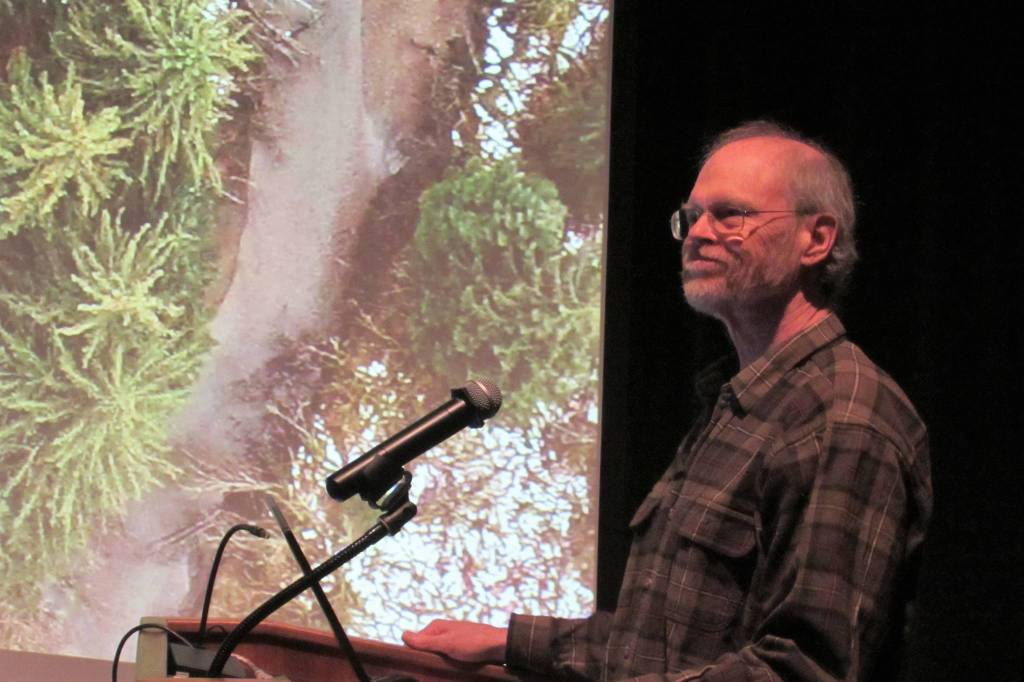
Richard Carstensen, lead naturalist for Discovery Southeast, speaks during a presentation about the Kaxdigoowu Héen (Montana Creek) watershed Saturday, Jan. 12, 2019.

Richard Carstensen, lead naturalist for Discovery Southeast, speaks during a presentation about the Kaxdigoowu Héen (Montana Creek) watershed Saturday, Jan. 12, 2019.

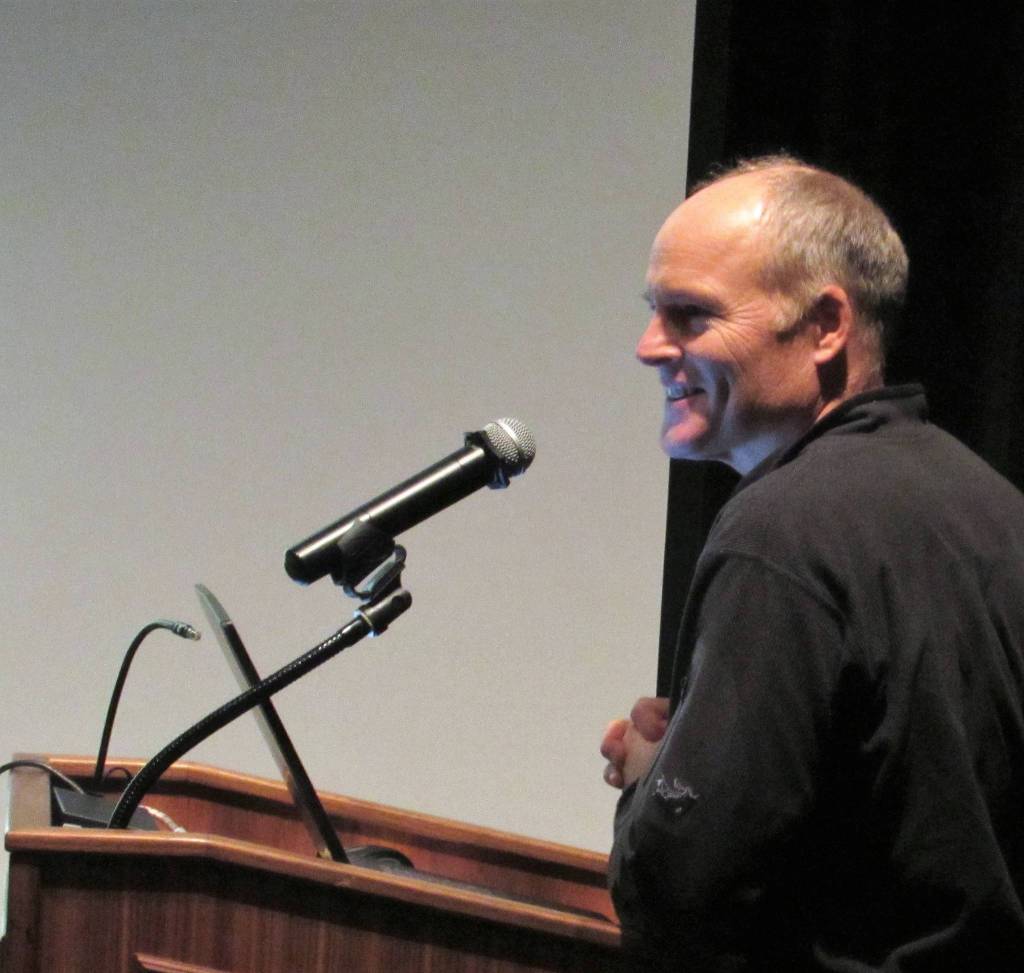
John Hudson, naturalist for Discovery Southeast, speaks during a presentation about the Kaxdigoowu Héen (Montana Creek) watershed Saturday, Jan. 12, 2019.

John Hudson, naturalist for Discovery Southeast, speaks during a presentation about the Kaxdigoowu Héen (Montana Creek) watershed Saturday, Jan. 12, 2019.

More in News

The Juneau road system ends at Cascade Point in Berners Bay, as shown in a May 2006 photo. (Michael Penn / Juneau Empire file)
State starts engineering for power at proposed Cascade Point ferry terminal

DOT says the contract for electrical planning is not a commitment to construct the terminal.

Members of the Alaska Air and Army National Guard, Alaska Naval Militia, and Alaska State Defense Force work together to load plywood onto a CH-47 Chinook helicopter, in Bethel, Alaska, Nov. 2, 2025, bound for the villages of Napaskiak, Tuntutuliak, and Napakiak. The materials will help residents rebuild homes and restore community spaces damaged by past storms. (U.S. Army National Guard photo by Spc. Ericka Gillespie)
Gov. Dunleavy approves Alaska National Guard assisting ICE in Anchorage

The National Guard said five service members will assist with administrative support; lawmakers and civil rights advocates worry that the move signals a ramping up of immigration enforcement operations in Alaska

A cruise ship, with several orange lifeboats visible, is docked in downtown Juneau. (Laurie Craig / Juneau Empire file photo)
CBJ seeks input on uses for marine passenger fees

Public comment period is open for the month of December.

Browsers crowd into Annie Kaill’s gallery and gift shop during the 2024 Gallery Walk. (Juneau Empire file photo)
Gallery Walk guide for Friday, Dec. 5

The Juneau Arts & Humanities Council announced community events taking place during… Continue reading

The Alaska State Capitol is seen on Tuesday, Nov. 25, 2025. (Photo by James Brooks/Alaska Beacon)
Alaska Senate Republicans confirm Rauscher, Tilton and open two vacancies in state House

The Alaska Republican Party is moving quickly after Republicans in the Alaska… Continue reading

Downtown Skagway, with snow dusting its streets, is seen in this undated photo. (Photo by C. Anderson/National Park Service)
Skagway’s lone paramedic is suing the city, alleging retaliation by fire department officials

This article was reported and published in collaboration between the Chilkat Valley… Continue reading

A spruce tree grows along Rainforest Trail on Douglas Island. (Mari Kanagy / Juneau Empire)
Where to cut your Christmas tree in Juneau

CBJ and Tongass National Forest outline where and how residents can harvest.

Winter dining has always carried more weight than the menu might suggest. In the off-season, eating out isn’t just about comfort food or convenience; it’s a way of supporting local businesses as they hold steady through the slower months. Photo credit: Canva.
Savoring local in Juneau: How a simple meal helps the whole community

Independent cafés and neighborhood restaurants keep Juneau strong through the slow season

Kaskanak Creek in the Bristol Bay’s Kvichak watershed is seen from the air on Sept. 27, 2011. The Kvichak watershed would be damaged by the Pebble mine project, the Environmental Protection Agency has determined. (Photo provided by Environmental Protection Agency)
Pebble Mine, halted by EPA order, gets support from national development groups

In 2023, the EPA invoked a rarely used “veto” clause of the Clean Water Act to say that there was no way that the proposed Pebble Mine could be developed without significant harm to the environment.

Most Read