
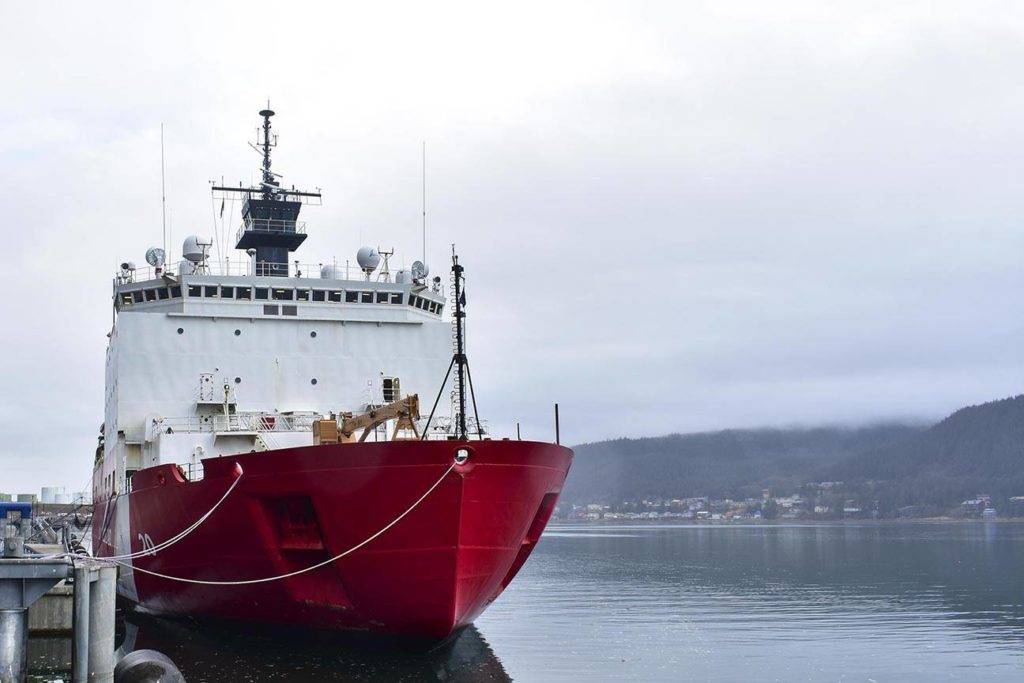
The United State’s icebreaker fleet could modernize and expand sooner than later, which could have big implications for the Coast Guard’s northernmost district.
President Donald Trump issued a memorandum on June 9 calling for an icebreaker acquisition program to support national interests in the Arctic and Antarctic.
“The United States requires a ready, capable, and available fleet of polar security icebreakers that is operationally tested and fully deployable by Fiscal Year 2029,” the memorandum read.
The Coast Guard currently has two icebreakers in commission. The heavy icebreaker USCGC Polar Star was commissioned in 1976, and the medium icebreaker USCGC Healy was commissioned in 1999. Russia and China both have larger and newer fleets of icebreakers in commission, despite China not being a polar-bordering nation. The U.S. Navy does not operate any icebreakers.
“The White House Cabinet Memo does not affect the current Polar Security Cutter acquisition,” said Lt. Brittany Panetta, a public affairs officer with Headquarters Coast Guard. “Instead, the memo calls for a holistic analysis of future U.S. polar icebreaking capability writ large, and directs an assessment of capabilities, fleet mix, and homeporting options.”
Alaskans celebrate Supreme Court decision protecting LGBTQ+ rights
To amend this lack, the Coast Guard has initiated an acquisition program for three Polar Security Cutters, a new class of icebreakers. The first keel is expected to be laid down in 2021 with delivery planned for 2024, according to the Coast Guard’s Acquisition Directorate. However, the memorandum is looking at other options in addition to the Polar Security Cutters.
Rep. Don Young, R-Alaska, suggested leasing private icebreakers as far back as 2015, writing a letter the encourage expansion of the fleet.
“Mr. President, for more than a decade, those who have operational interests in the Arctic have discussed the need for an aggressive program for icebreaker construction,” Young wrote in a letter to then-President Barack Obama before the president visited Alaska. “We urge you to look at the broadest range of options for the design and implementation of a multi-agency program for acquiring the federal icebreaking services needed to carry out federal safety, security, and environmental stewardship missions in the Arctic– including the chartering of a fleet of privately-constructed, privately-operated icebreakers that can be paid for by several pertinent agencies.”
Where the U.S. would lease such vessels is one of the things that would be looked at, Panetta said.
“The White House has directed the interagency to look at all possible options to maintain U.S. strategic interests in the polar regions, including the possibility of leasing,” Panetta said. “We will not know if leasing options will meet U.S. capability needs or any such terms until this thorough analysis is conducted.”
Coast Guard’s District 17, headquartered in Juneau and covering all of Alaska, would likely benefit from the presence of icebreakers in its area of operations.
[Former spymaster says climate change will mean greater activity in the Arctic]
“District 17 oversees all of Alaska, including the U.S. Arctic Coast and the Maritime Boundary Line between the U.S. and Russia,” Panetta said. “As such, any changes to U.S. icebreaking capabilities will certainly affect D17 by providing increased icebreaking, maritime domain awareness and strategic presence in the Arctic region.”
However, this doesn’t necessarily mean that these hulls would be homeported here, Panetta said.
“We will assess all geographic options for homeporting the icebreaking fleet,” Panetta said. “When assessing homeport options, we will look at all aspects of the cutter and the crew, including vessel maintenance and sustainment, logistics support, shore infrastructure, housing options, and other necessary support systems.”
• Contact reporter Michael S. Lockett at 757.621.1197 or mlockett@juneauempire.com.
