
The four major legislative players in Alaska’s education funding debate have now shown their opening cards, with two supporting raising the pot and two hedging their bets.
Now, its about the bidding and bluffs as the rest of the dealing take place during the next three months — and possibly the year beyond.
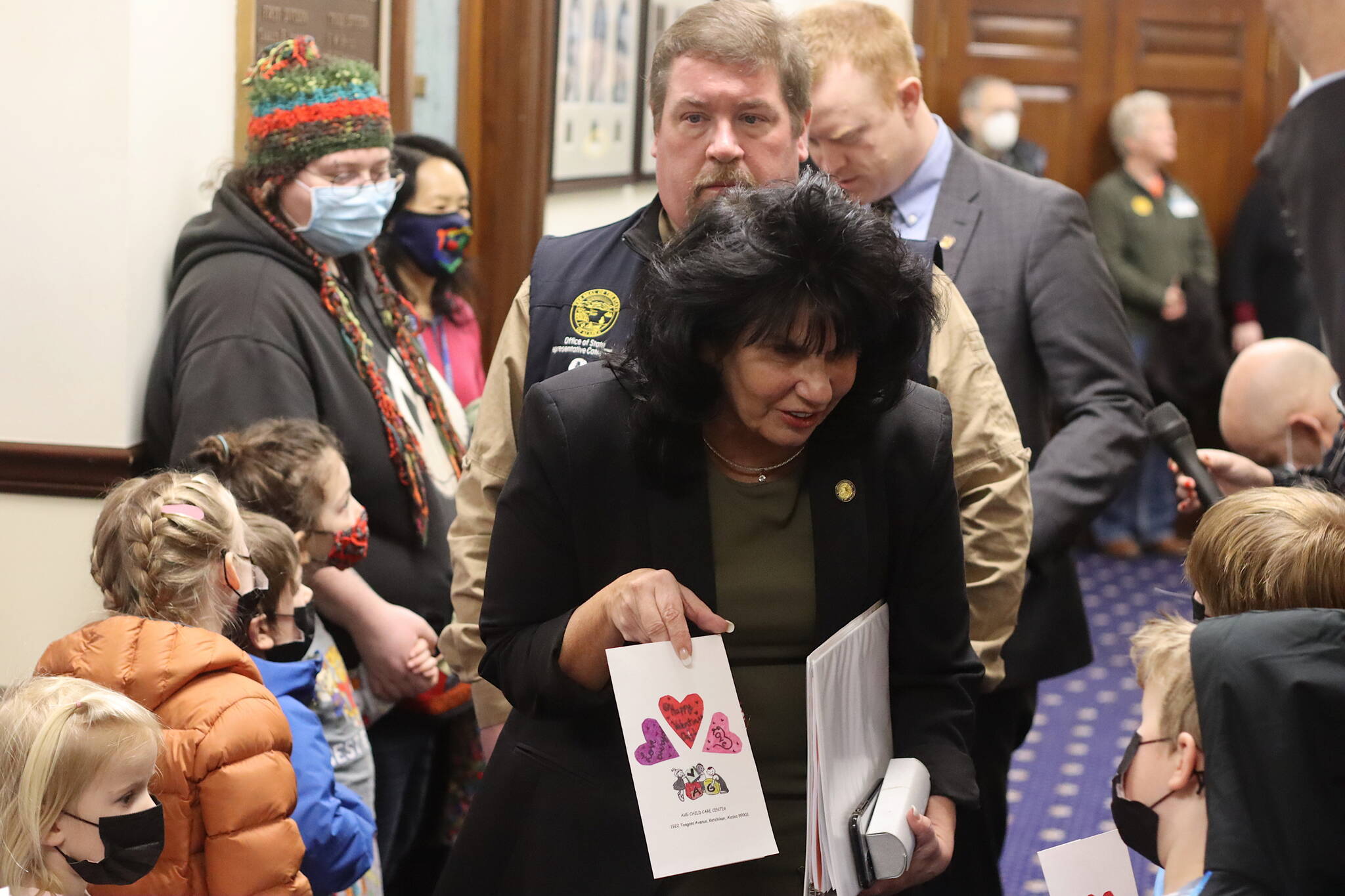
The prominence of the base student allocation as an issue during this legislative session got one of its high-visibility moments Monday as a couple dozen preschool students from Montessori Borealis in Juneau wandered the halls of the Alaska State Capitol with their adults and teachers offering Valentine’s Day cards (along with fliers requesting the per-student funding formula be increased).
Most, but not all, of the legislators and staff were at least publicly friendly while accepting the cards, although of course the tell will be the subsequent actions by lawmakers who are quietly reluctant or openly rude about such requests.
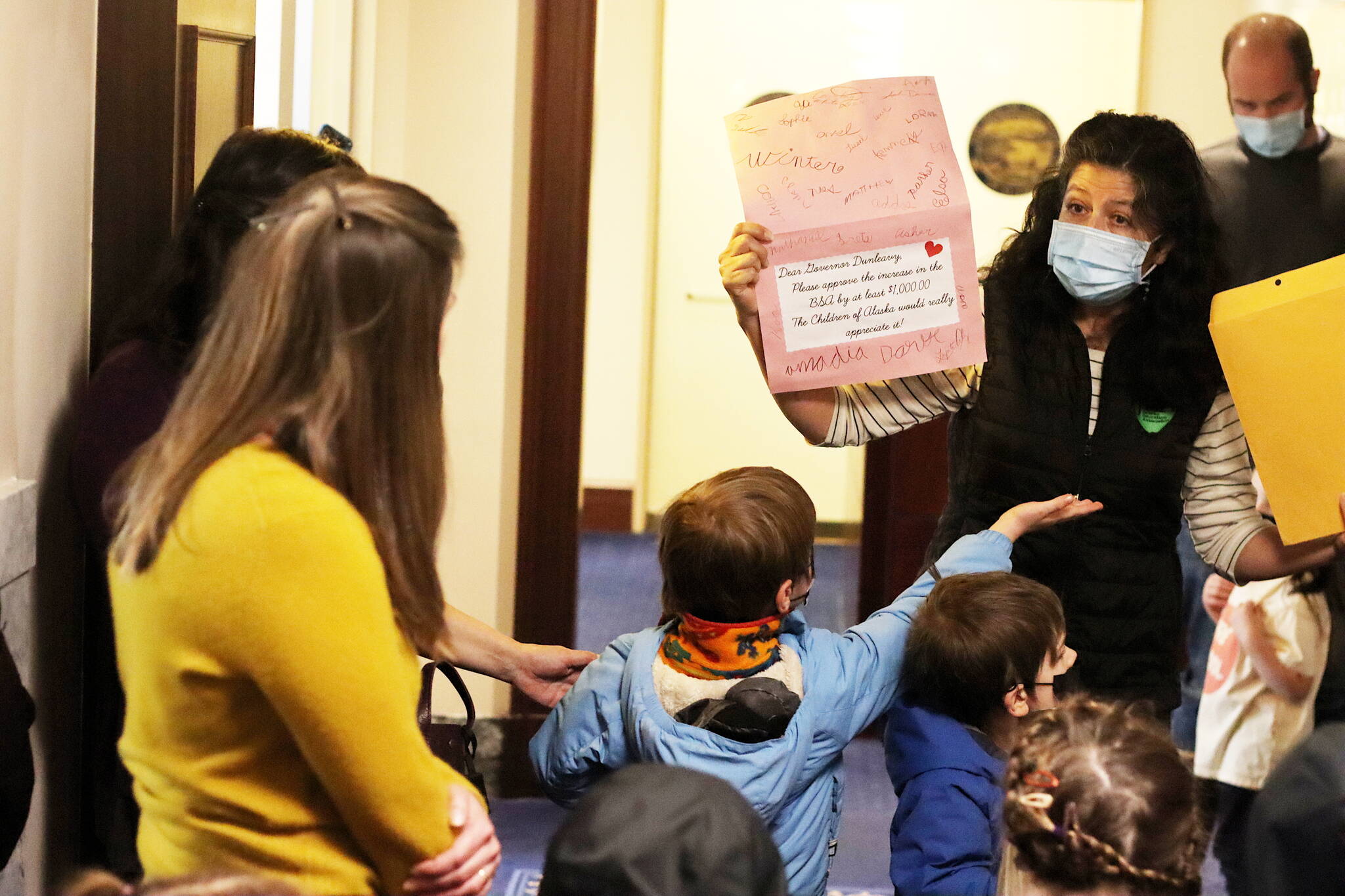
Lupita Alvarez, a teacher at the Montessori Borealis preschool program, offers a Valentine’s Day card signed by youths in the Juneau program to a member of Gov. Mike Dunleavy’s legislative staff outside his office on the third floor of the Alaska State Capitol on Monday. The students were lobbying for an increase in education funding, which the governor is proposing remain flat in his budget for next year. (Mark Sabbatini / Juneau Empire)
The current BSA of $5,960 is essentially unchanged from 2017, aside from a $30 increase added last year as part of an “accountability” bill separate from the budget, thus putting it far behind the 21% inflation that’s occurred nationally since then. One key provision so far of increasing the formula is covering the cost by reducing the roughly $3,800 Permanent Fund dividend Gov. Mike Dunleavy, a Republican, and some legislators are seeking, thus setting up the high-stakes showdown.
The hands currently held by the four main players at the political table for this legislative session in the order revealed:
— Dunleavy: No increase in the governor’s Dec. 15 proposed budget, but an acknowledgement more funding is a realistic possibility during negotiations with the Legislature. He is scheduled to release a revised budget request by Wednesday, but a spokesperson declined Monday to state if any change to education funding will be included.
— Senate majority: A $1,000 increase (about 17%) to the BSA which, while not fully covering the effects of inflation since 2017 or addressing future inflation, is a beginning place for more specific negotiations, according to leaders introducing the proposal. The majority consists of nine Democrats and eight Republicans in the 20-member senate, making the three Republicans in the minority essentially irrelevant.
— House minority: A $1,250 BSA increase (nearly 21%, or essentially covering the inflation gap) proposed by state Rep. Dan Ortiz, a Ketchikan Democrat, with the support of Minority Leader Calvin Schrage, an Anchorage independent. As with the senate bill, it contains no provisions beyond increasing the per-student funding amount. Because the state budget will almost certainly need to tap into a reserve account that requires a three-fourths vote of the Legislature, concessions to the House minority — consisting of 12 Democrats, three independents and one Republican — will also almost certainly be involved in drafting a final budget.
— House majority: No commitment to either the governor’s flat-funding proposal or a specific BSA increase, but House Speaker Cathy Tilton, a Wasilla Republican, said Monday all options will be considered “including options that reduce costs to education and the system, including health care (cost) reductions…we’re looking at outside the box things other than putting a dollar amount toward that. That doesn’t mean there would be a dollar amount that is not acceptable.” The House majority consists of 19 Republicans, two Democrats and two independents.
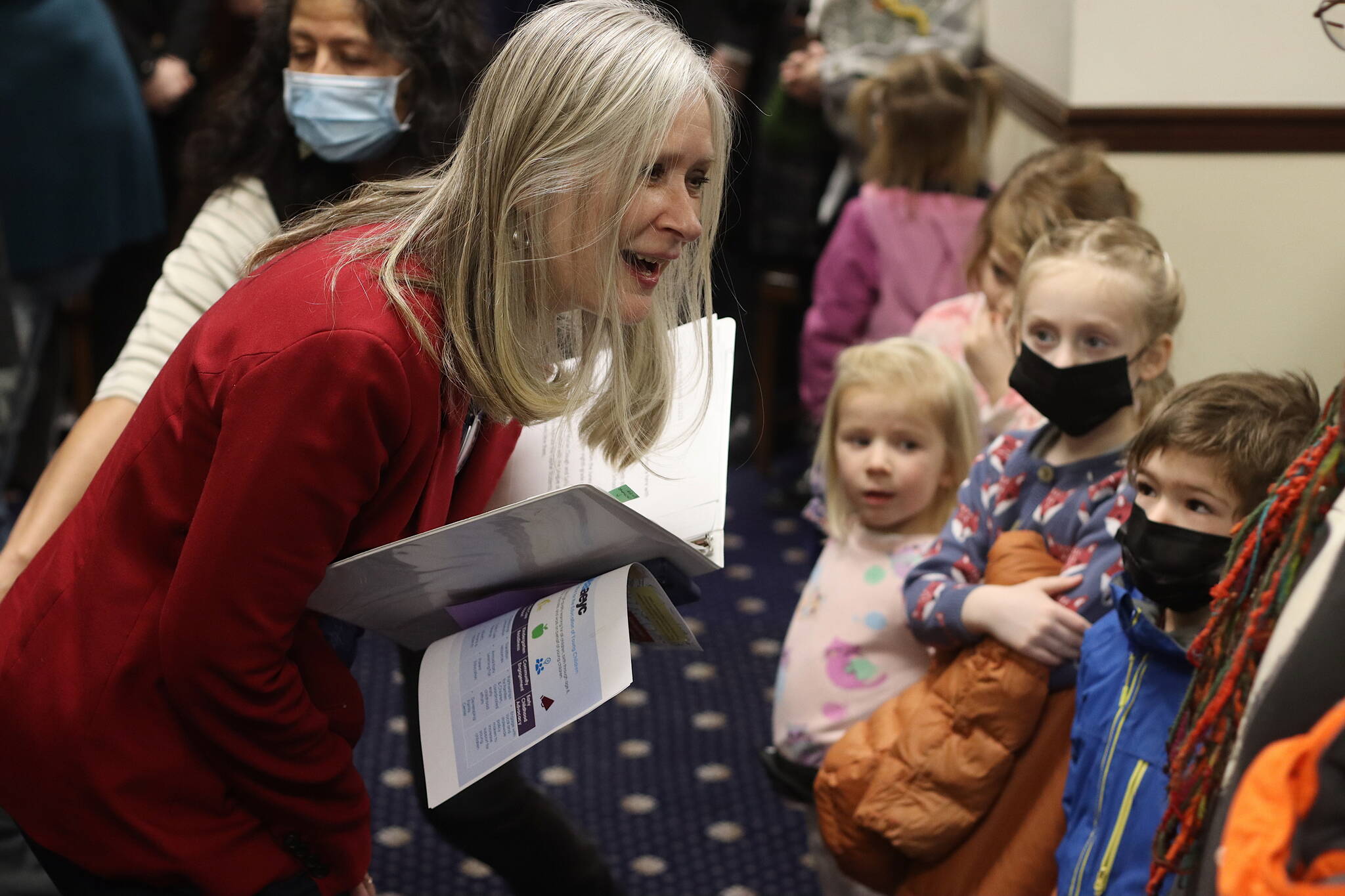
Rep. Andi Story, D-Juneau, thanks preschoolers with the Montessori Borealis program who gave her a Valentine’s Day card on Monday. Story, a prominent public education advocate, is part of the Democratic-dominated House minority that is seeking a 21% increase in the per-student funding formula during the current legislative session, more than the three other major political coalitions at the Capitol favor. (Mark Sabbatini / Juneau Empire)
Most of the players have already conceded their opening bids aren’t likely to be their final ones. In addition to Dunleavy saying an increase is “highly likely” during negotiations with legislators, Senate President Gary Stevens has stated the majority’s $1,000 proposal may not realistically pass this year — although he hopes for some increase. Meanwhile, the Anchorage Daily News reported Sunday the House majority is split between moderates favoring a substantial BSA increase, and conservatives who are reluctant and floating ideas such as allowing state funding for private schools.
Among those making no pretense of being appreciative to the students greeting lawmakers outside the House Chamber on Monday was state Rep. Tom McKay, a second-term Anchorage Republican who is a member of the House Education Committee and a Finance subcommittee dealing with education spending.
“You can keep those,” he told the youths offering Valentine’s cards before taking a few more steps toward the chambers and complaining the group was blocking the entry hallway.
It was an indicative example of the lawmakers the youths and adults with them may need to convince for their efforts to boost the BSA to succeed. Although Trevor Jepsen, McKay’s chief of staff, said Monday afternoon the representative didn’t know the youths were offering Valentine’s Day cards and when the kids came by his office after the floor session a card was accepted.
Among McKay’s most prominent education action as a legislator is seeking to prohibit transgender girls from competing in girls sports in one of the two bills he’s the primary sponsor of so far session (his bill seeking to do the same last session failed). He told the Anchorage Daily News in a 2020 candidate survey he favors “more money into classrooms and less into administration. But also attach stringent performance measures and minimum educational standards.”
Persuading politicians who’ve heard much about Alaska’s current education funding situation and oppose an increase is a formidable task, said Lupita Alvarez, a teacher at the Montessori Borealis preschool program, standing outside the House chambers. But she said such visits can serve purposes that go beyond the moment.
“Empower the children,” she said. “Let them know they can come here and voice their concerns. And for (the legislators) let them know these are future voters.”
• Contact reporter Mark Sabbatini at mark.sabbatini@juneauempire.com
