
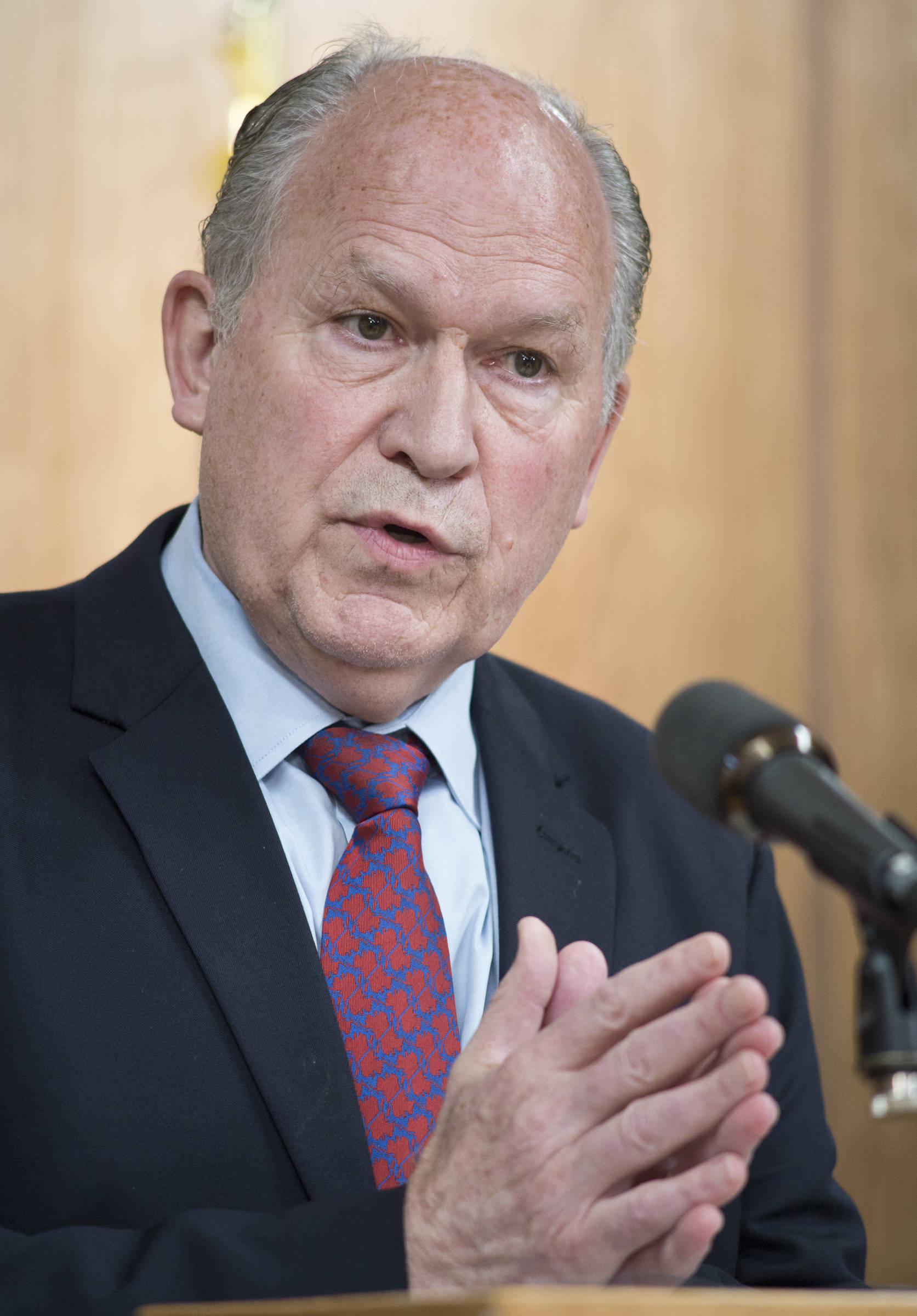
Gov. Bill Walker has signed a shutdown-averting $8.8 billion state operating budget into law.
Walker signed the budget on Friday, one day before the start of the state fiscal year and eight days after the Alaska Legislature approved the budget. He made no vetoes.
The budget uses $2.3 billion from Alaska’s Constitutional Budget Reserve to close a multibillion-dollar annual deficit, and it cuts the Alaska Permanent Fund Dividend to $1,100. It does nothing to alleviate the budget crisis caused by fallen oil prices.
“I thank members of the Legislature for coming together to avert a shutdown of government services,” Walker said in a prepared statement. “However, the job is not complete. Without a complete fiscal plan in place, uncertainty looms over our economy. It’s time to fix this problem for good to ensure a stable foundation for generations to come. A compromise fiscal plan can be achieved in the coming weeks — if the Legislature is willing to engage.”
Thus far, the Legislature appears unwilling.
After lawmakers approved the budget one day after the summer solstice, they largely departed Juneau even though a special legislative session called by Walker will continue through July 15.
Last week, members of the Alaska Senate’s 13-member majority said they will return to Juneau on July 10 in an attempt to fulfill the sole item on the special session agenda: reforms to the state subsidy of oil and gas drilling.
Lawmakers agree that the state needs to replace its system of cashable tax credits with something else. Where the Senate Majority and the coalition House Majority differ is whether the subsidy should be reduced as well as reformed. The Senate Majority favors a system of tax writeoffs that would save the state little money when compared to the current system. The House Majority favors a more complicated system that would save the state hundreds of millions of dollars.
The Senate Majority argues that the House proposal could deter companies from drilling in Alaska, thus costing Alaskan jobs. The House Majority argues that the Senate proposal does nothing to alleviate Alaska’s annual deficit.
With the passage of this year’s budget, that deficit becomes even more critical. By this time next year, the Constitutional Budget Reserve will no longer contain enough money to fill the deficit, barring a rise in state revenue or substantial budget cuts.
This year’s budget is funded with $2.2 billion in federal money, $4.9 billion in “undesignated general funds” and $1.6 billion in other funds (typically fees and license revenue).
It’s the undesignated funds, earned through oil revenue and non-targeted taxes, that are most eyed by lawmakers.
According to the Alaska Office of Management and Budget, the state has cut $1.3 billion in undesignated general fund spending between July 1, 2014 and July 1, 2017.
At the same time, the state has raised more money in fees and what are known as “designated” general funds.
The state’s operating budget has declined $790 million since July 1, 2014 when all three categories are combined.
Spending on the Permanent Fund Dividend has also fallen. The Legislature agreed upon a $1,100 dividend, almost $800 less than the 2014 figure. That will save the state an additional $582 million but cost individual Alaskans more than $1,000 each.
Later this year, lawmakers must also consider a capital construction budget that is part of the state’s annual routine. In exchange for about $100 million in state dollars, Alaska will become eligible for more than $1 billion in federal funds earmarked for highways, bridges and other infrastructure.
If cuts to the capital construction budget are considered alongside the operating budget, the Legislature will have slashed state spending by more than 43 percent since 2013.
• Contact reporter James Brooks at james.k.brooks@juneauempire.com or call 523-2258.
