
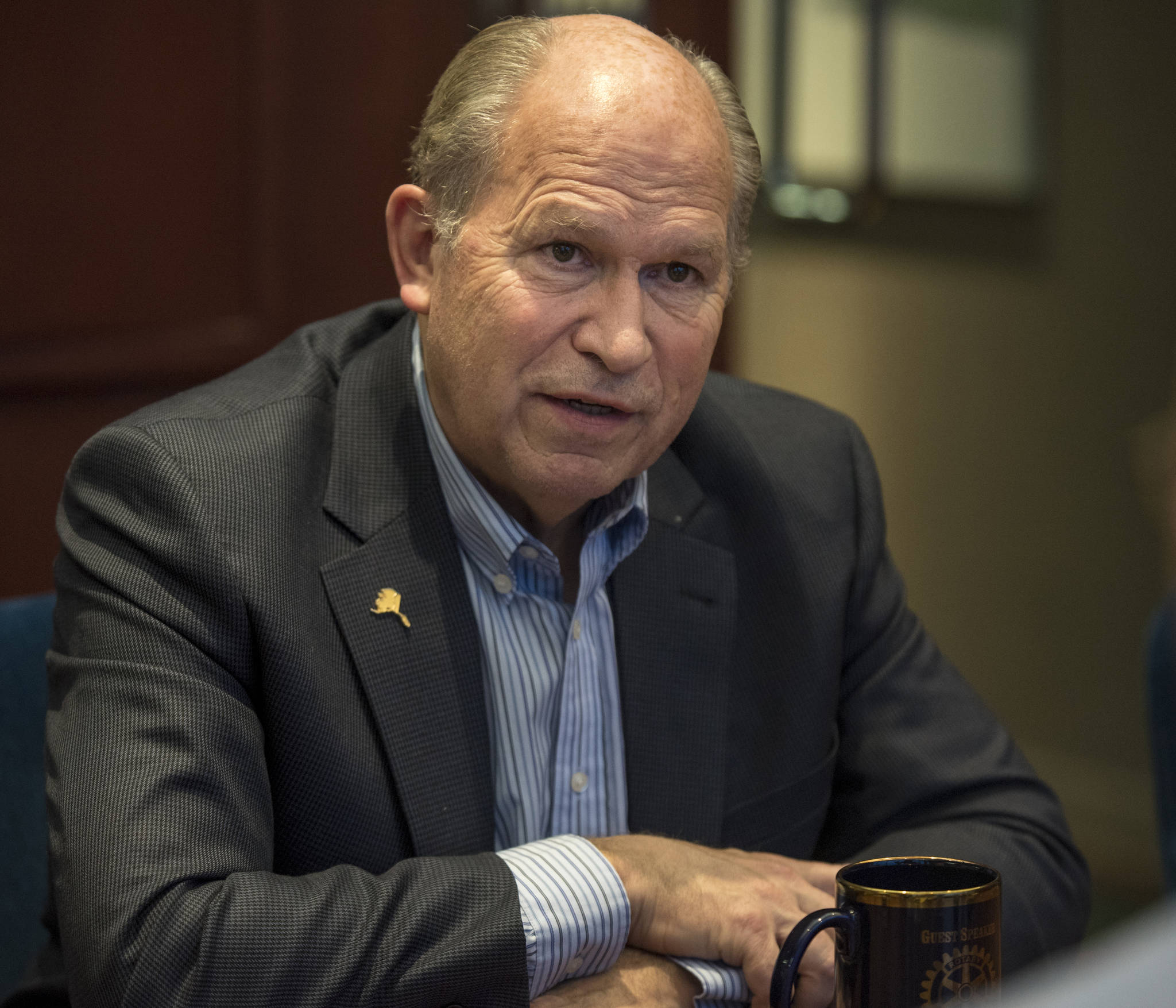
To help solve Alaska’s multibillion-dollar annual deficit, Gov. Bill Walker is calling for a 1.5 percent payroll tax on everyone working in Alaska.
The proposal, which will be considered by the Alaska Legislature during a special session in Juneau, was formally announced Friday afternoon. Reporters received advance notice of the proposal Friday morning in a briefing from revenue commissioner Sheldon Fisher.
“The revenue bill will be a modified head tax. It’s structured to raise $300 million to $325 million a year,” he said.
Under the proposal, anyone who collects a paycheck in Alaska would have 1.5 percent of that check withheld by the state, just as unemployment taxes and Social Security taxes are withheld.
There’s a break for the rich, however: The maximum tax payment will be twice the amount of the previous year’s Permanent Fund Dividend.
This year’s dividend, $1,100, would mean a tax cap of $2,200, the amount paid by someone paid $147,000 per year.
That cap will cost the state about $10 million in lost revenue, according to figures presented Friday at the media briefing.
The PFD itself is exempted from taxes, as are investment earnings and retirement earnings. There is no benefit for married couples.
According to figures presented by the Alaska Department of Revenue to legislators earlier this year, 12,461 Alaskans reported earning more than $100,000 in 2016. In addition, 11,813 couples reported earning $200,000 or more.
Incomplete fix
Even as part of a comprehensive deficit-fighting strategy, the tax is not expected to close the state’s fiscal gap.
Lawmakers have been considering Senate Bill 26, a proposal to use some of the earnings of the Alaska Permanent Fund for government services. The House and Senate have each passed different versions of the bill, and a compromise is needed before SB 26 becomes law.
That bill is expected to cut the deficit by about $1.8 billion, but the exact amount depends on the version of the bill that is signed into law.
Fisher said the state currently has a $2.6 billion deficit. That will rise to about $2.9 billion next year because the Legislature used about $265 million from one-time funds that will be empty after this year.
If SB 26 becomes law alongside the governor’s tax bill, there will still be a deficit of several hundred million dollars.
Without SB 26, the deficit will remain in the billions.
“There is the view that (an SB 26 approach) or using interest earnings needs to be a part of this,” Fisher said.
Special session agenda
Walker’s official announcement Friday includes a proclamation that the special session will start Oct. 23. Neither the coalition House Majority or the principally Republican Senate Majority rejected the taxation idea out of hand.
“I don’t know what to think as of yet because I don’t know what the Senate thinks,” said House Majority Leader Chris Tuck, D-Anchorage.
While the House passed an income tax measure earlier this year, the Senate voted it down.
In a prepared statement, Senate President Pete Kelly, R-Fairbanks, said the Senate Majority “welcomes additional discussion on the state’s fiscal problems” but wants to see the governor propose more budget cuts first.
“With this information in hand, the Senate will be able to accurately determine what, if any, actions must be taken to raise additional revenue from Alaskans,” Kelly said in the statement.
If the Senate is the reluctant one on the governor’s tax idea, the House is the reluctant body on the other special-session item, a criminal justice bill known as Senate Bill 54.
That measure, which would partially roll back the criminal justice reform bill known as Senate Bill 91, passed the Senate 19-1 earlier this year.
“We offer our support to the House to do the same,” Kelly said of SB 54, “and stand by to work out any differences.”
Senate Bill 91, which emphasizes rehabilitation, counseling and treatment instead of jail sentences for low-level offenders, has been criticized for contributing to a rise in crime statewide. It isn’t clear if that’s true, but that hasn’t stopped calls for it to be rolled back or revoked entirely.
The House has referred SB 54 to three committees, and Tuck said he expects the issue to take an entire 30-day special session.
Local legislators react
After the governor’s tax announcement, the Empire asked Juneau’s legislative delegation for their initial thoughts.
Rep. Sam Kito III, D-Juneau, said he had not been informed of the details of the governor’s proposal. When provided with a copy of the information given to the Empire, he said by text message, “The only comment I have at this time is the desire to make sure that the head tax proposal is not regressive, and that I will be working to make sure that any proposal is fair to all Alaskans.”
Rep. Justin Parish, D-Juneau, was traveling on the East Coast but responded to the Empire by text message.
“I want a fair and balanced solution to our fiscal crisis,” he wrote. “The governor’s tax proposal is an improvement over the status quo, which could see catastrophic cuts to services and the ultimate elimination of the PFD program. His tax proposal still falls short of being fair. But if the Senate is willing to pass it, it can certainly be a starting point for conversation.”
Sen. Dennis Egan, D-Juneau, applauded the governor for bringing up the tax idea.
“We have a problem and we have to fix it,” he said. “I’m really pleased about the governor not doing a sales tax, which is great for my district because all of my communities have a sales tax already.”
Egan also pointed out that the state will need to hire about 50 staff to administer the new tax, and that could be a benefit to Juneau.
“It’s going to cause an increase in employees, which is fine with me as long as they’re in Juneau,” he said.
• Contact reporter James Brooks at james.k.brooks@juneauempire.com or call 523-2258.
