
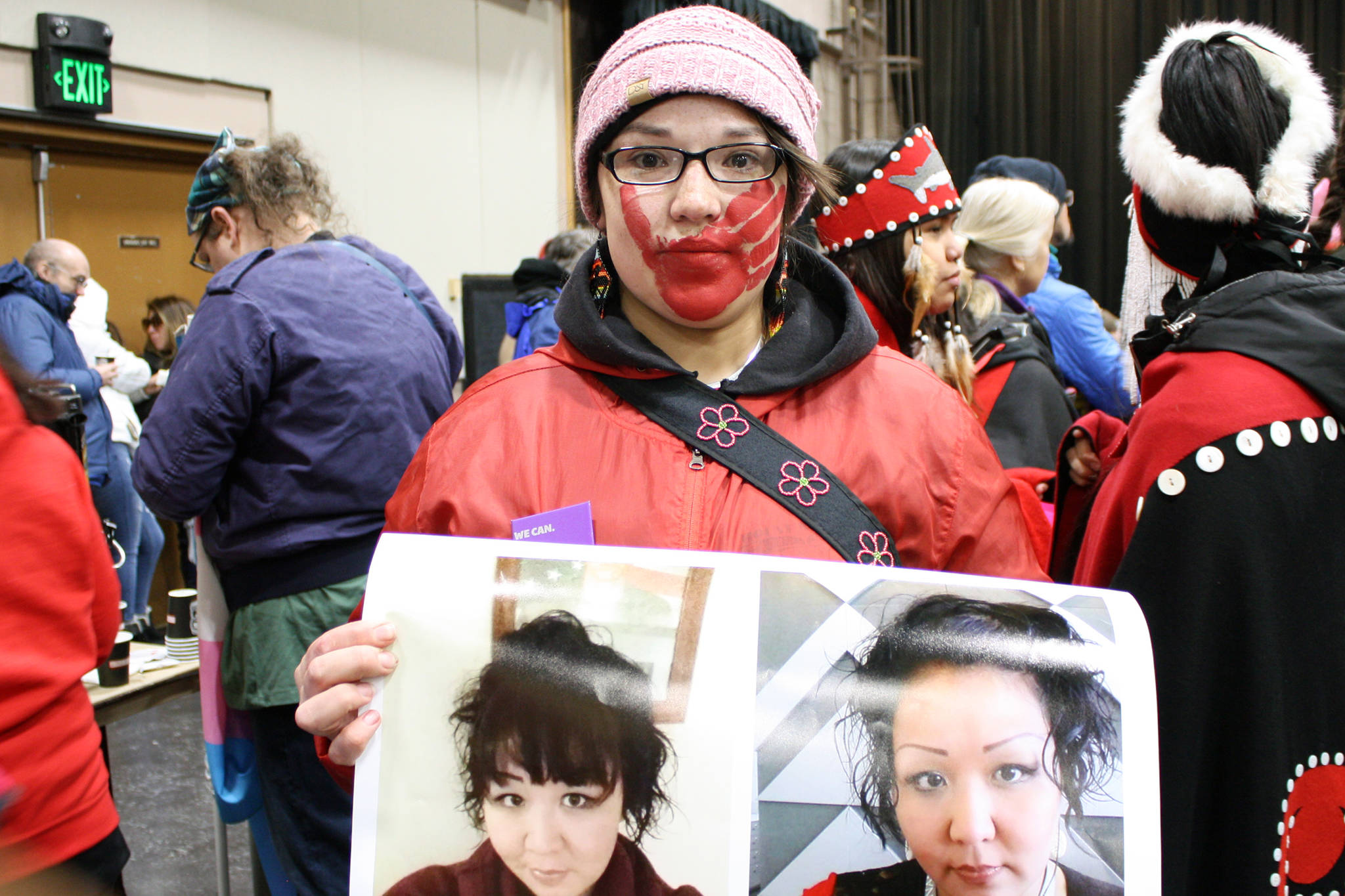
The plight of Indigenous women in Alaska and across North America isn’t new, but accurate data may help end the massive racial disparity in killings and disappearances.
Now, it’s a matter of rebuilding those data systems so the numbers themselves aren’t inaccurate from the outset, said panelists at a forum held by the Central Council of Tlingit and Haida Indian Tribes of Alaska on Thursday.
“Thirty percent of Alaska’s murder victims are Indigenous people even though they’re just 16% of the population,” said Catherine Edwards, 6th Vice President of Tlingit and Haida and part of the Task Force on Research on Violence Against American Indian and Alaska Native Women, during the forum. “Murder is the third leading cause of death for American Indian and Alaska Native women.”
Better systems, truer data
For a problem to be solved, it must be identified so it can be accurately excised, said Abigail Echo-Hawk, co-founder of Data for Indigenous Justice, an Alaska-based nonprofit looking to illuminate the problem.
Echo-Hawk has also worked around the country as part of the Urban Indian Health Institute, which examines the disparity in health between Indigenous people in the U.S. and the rest of the country, talking to communities and gathering information.
“They would say, ‘This is happening. Our women are being killed and missing. And you’re not doing anything about it,’” Echo-Hawk said during the forum. “We found that the data on them was not being collected.”
That lack of accurate collection of data is not new, and a foundational issue in treating the appalling rates of murder and disappearances in many Alaska Native and American Indian communities, said Charlene Apok, co-founder of DIJ.
“These systems were not made for us. They never were. A lot of the way law enforcement organizations capture data today is from the U.S. Census which was made to erase us,” Apok said during the forum. “It’s a systemic issue. This isn’t anything new we’re doing today.”
Inconsistent standards for identifying the ethnicity of victims of crime across law enforcement organizations, as well as nonstandard systems of recording and poor standards for reporting that data, have hidden the true depths of the issue, Echo-Hawk said.
“I identify as someone who never saw justice in the justice system. Law enforcement did not see the same value in my life as they saw in others,” Echo-Hawk said. “Our women, our people, deserve better, and it’s going to be through grassroots efforts that push change. We have not seen change from the federal government and law enforcement deciding we deserve better. It came from grassroots efforts.”
The problem comes as much from those collecting the data on the law enforcement side as those who created it, Echo-Hawk said.
“These systems weren’t built for us. It really starts at the system’s origin. The people who create these systems tend to be white males. We have all these deep systems issues,” Echo-Hawk said. “These systems push us out and the end result is we don’t have the information we need to fight for our relatives. What are you doing to us is genocide.”
Fighting on all levels
The fight against the injustice occurs on all levels, said state Rep. Tiffany Zulkosky, D-Bethel.
“Being an Alaska Native woman serving in the Legislature is a challenge, catching specifically racist references in the building or sitting in committee and hearing specific biases against Alaska Native people,” Zulkosky said. “There continue to be challenges.”
One of Zulkosky’s main efforts is improving public safety across Alaska’s rural communities.
“There’s a lot of challenges and uphill battles in bring communities to the same starting line for public safety,” Zulkosky said. “We’re seeing declined spending across the state. We’re seeing movements to try and eliminate rural public safety funding.”
About one in three communities have no public safety officer, said Zukolsky. Efforts to increase support and effectiveness of the Village Public Safety Officer program exist, but have had a hard time getting signed into law in the last several years. There are other issues with existent law enforcement agencies that also need addressing, Zulkosky said.
“We had one cold case investigator for the entire state, with hundreds of cases,” Zulkosky said. “Different law enforcement, whether municipal, whether state, classified data differently or handled cases differently. Standardization is one of the things we seek to bring as best practices.”
The federal best practices recommends no more than five cases per investigator in order to make progress. Working with each of the communities on an individual basis is key, said Bryan Schroeder, U.S Attorney for the District of Alaska.
“Every community is going to be a bit different. You have to work with each community individually to get an idea of what their needs are. Get everyone together to talk before there’s an issue, before someone’s missing,” Schroeder said. “I had a boss that had a phrase, ‘The wrong time to be exchanging business cards is at the scene of a crisis.’”
All of this comes as two bills aimed at helping reduce the number of murdered and missing indigenous women — House Bill 38 and Senate Bill 63 — are working through the Alaska State Legislature.
The House bill would standardize and enlarge departmental capability for searching for missing and murdered indigenous women in Alaska, as well as enhancing communication with Tribal entities by mandating the addition of liaisons to streamline things, as well as standardizing data collection methods. The Senate bill would allow for guardianship of a missing person, Zulkosky said.
“Often, when families are searching for missing loved ones, they are unable to access cellphone or bank records,” Zulkosky said. “This bill, as I understand, allows for limited access.”
All this work is aimed at making Alaska safer for all Alaskans, with the participation of all Alaskans, Zulkosky said, quoting former Lt. Gov. Valerie Davidson with her saying, “nothing about us without us.”
“I hope that a lot of what we talked about today is the beginning of a movement to make public safety more equitable for all Alaskans,” Zulkosky said.
