
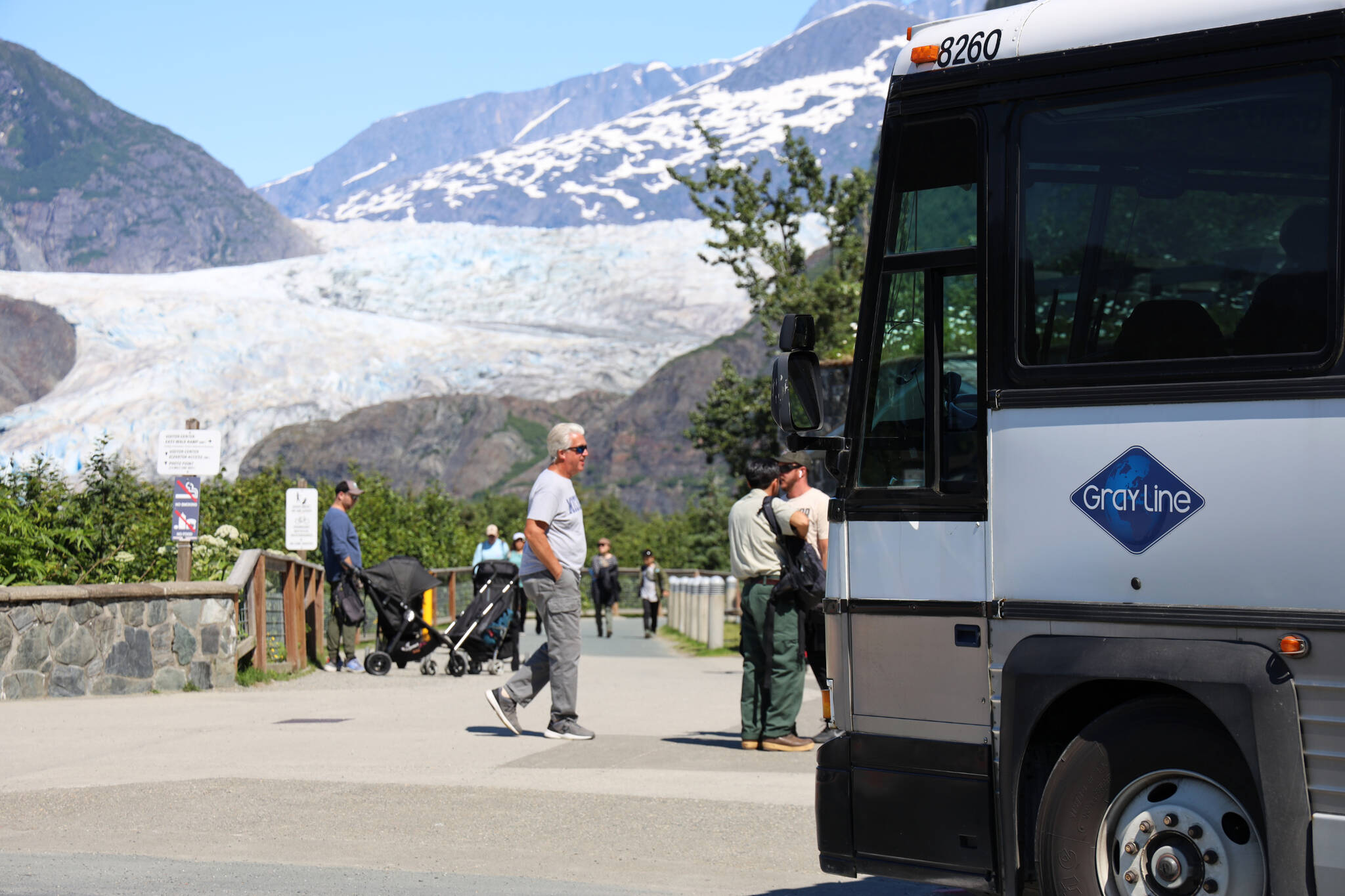
Local tourism companies are being forced to turn away tourists in Juneau seeking to visit the Mendenhall Glacier Recreation Area this summer as commercial tourism limits in the area are being reached at a rapid pace due to “unprecedented increases in visitation,” the Forest Service announced Friday.
Each year the Forest Service doles out permitted “service days” to Juneau tour providers, like bus companies or taxi services carrying tourists, in order to manage the area and protect the local ecosystems.
A service day equates to one tourist visiting the Mendenhall Glacier for one day. A decision made in 2015 following an environmental analysis set a total capacity of 517,650 people for the summer. Individuals going to the glacier on their own do not need a permit.
That number — set eight years ago — is already well below the 627,220 passengers who have visited Juneau this year as of Thursday and below the 1.67 million visitors expected to arrive this summer in total.
“This could result in some commercial services being unavailable to visitors who arrive in the second half of the summer season,” the Forest Service announcement stated. “Considering that challenge, the agency is asking for the public’s patience and understanding.”
In 2019 the Forest Service added 55,460 more service days as a “short-term solution” based on improvements made to facilities in the area. But as tourism begins to bounce back following three years where cruise ship traffic was reduced due to the COVID-19 pandemic, the short-term solution will reach its limit later this summer.
“After the analysis, the decision was made based on protections for the ecosystem, and as well as proper visitor experience and safety that was the property capacity,” said Paul Robbins, public affairs officer for the Forest Service. “That capacity will remain until the new plan goes into effect.”
The “new plan” is in reference to a draft preferred plan of action to overhaul the Mendenhall Glacier Recreation Area “to accommodate the needs and desires of the local community, as well as the hundreds of thousands of visitors we receive every year,” said Tongass National Forest Supervisor Frank Sherman in a previous statement.
The new plan would include the construction of a new welcome Ccnter, reconfiguration of the existing “bus overflow” lot and trail and access improvements to name a few.
If approved — which could occur this fall — the overhaul would allow for an increase to the area’s annual visitor capacity of 999,000 expected 30 years from now, compared to the current 544,890. It also extends the defined peak use period to 214 days, from April 1 to Oct. 31, reflecting a longer cruise ship season.
Work on the first projects could begin this winter, but longer-term projects such as parking lots will likely take at least a few years as part of a phased implementation process that is dependent on funding, Robbins said.
According to Serene Hutchinson, the general manager for Juneau Tours and Whale Watch, if nothing is changed this season to increase the capacity, her company is likely going to face “a huge loss in the second half of the season.”
“I hope they figure something out because I have buses and staff that I need to keep busy the second half of the season with a fraction of the amount of visitors,” she said. “I have employees right now in my office who I am paying to not book tours — all they do is sit there and answer the phone and say “sorry, no, I can’t book you to the glacier.”
Hutchinson said she has been “ringing the alarm” about the need to increase capacity for years.
“I knew that our winter sales, if they were any indication of what was coming, I knew we were going to run out of permits,” she said. “It’s really easy math, right? If we’re going to get approximately 1.6 million people to visit Juneau this season, and our permit only allows for 500,000-plus, that means a lot of people aren’t gonna get to go to the glacier park.”
Hutchinson said she hopes the Forest Service can find another way to allow for an increase in capacity as the long-term plan continues to remain years out, and encouraged visitors to check out the other “lovely sights” Juneau has to offer beyond visiting the glacier.
According to Alexandra Pierce, the City and Borough of Juneau tourism manager, there is growing concern that as these bus services turn away tourists, an increased number of visitors will begin using the city’s public transportation system, Capital Transit, to travel to the Glacier instead. She said that could have a negative impact on local riders and put a strain on the system which is already facing a driver shortage.
“Because of public transit authority, we don’t have the ability to refuse service to anyone who’s a fair paying transit user so that — and we have a driver shortage — is a problematic issue that we’re really watching,” she said. “I think our local operators are working really well and trying their best to handle and manage that.”
Pierce said she would be sharing more information on the topic at the Monday night Assembly meeting.
• Contact reporter Clarise Larson at clarise.larson@juneauempire.com or (651)-528-1807.
