
The design is ready. The money’s in the bank. Now, what does President Donald Trump think?
In a meeting with the state Marine Transportation Advisory Board meeting on Friday, Alaska Department of Transportation Commissioner Marc Luiken warned board members that an effort to build a new oceangoing ferry may be about to run into federal trouble.
“The Buy America is kind of raising its head on this particular project,” he said.
“Right now, based on the current administration’s stance … they have not given one Buy American Act waiver. That’s the challenge in front of us.”
Under federal law, “all steel or iron products that are permanently incorporated in a Federal-aid highway construction project” must be made in a “domestic manufacturing process.”
That law holds true even if no one in the United States builds a particular part.
The only way to get around the law is to request a waiver from the administrator of the Federal Highway Administration, and Trump hasn’t appointed one yet.
Waivers aren’t easy to get. They require extensive justification and a thorough vetting process that can take weeks or months.
“The procurement guidelines are really, really strict,” said Alaska Department of Transportation spokeswoman Aurah Landau. “It’s not an easy and quick process to do that.”
Since Trump was sworn into office, it’s become much harder to get a waiver.
In fact, since Trump became president, it isn’t clear the federal government has approved a single one anywhere in the U.S.
It’s not clear whether that lack of waivers is linked with Trump’s repeated desire to encourage American manufacturing.
“FHWA has not granted a waiver, as far as I know, since the new administration,” Luiken told the advisory board. “Ultimately, it is an issue we have to get through before we put out a solicitation (for construction).”
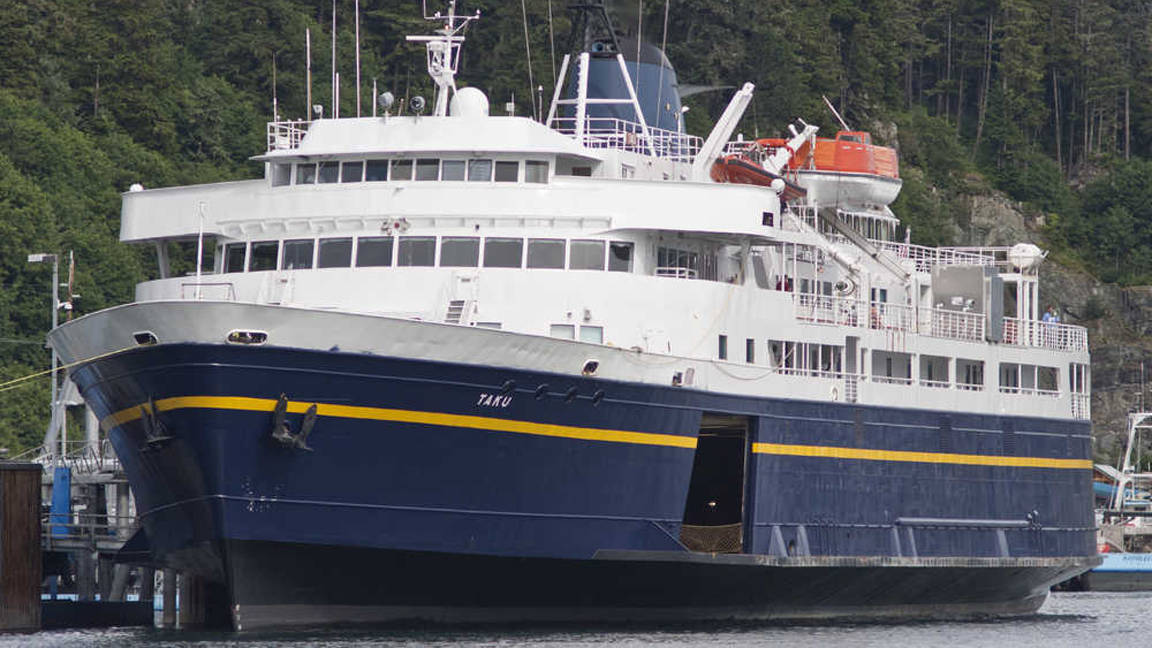
The new oceangoing ferry is intended to replace the Tustumena, which was built in 1964 to serve Kodiak, the Alaska Peninsula and the Aleutians. After decades of pounding by the North Pacific, the Tustumena is showing its age: For the second time in the past decade, it has been put out of service for an entire summer after drydock workers discovered extensive amounts of wasted steel that requires replacement.
The Tustumena’s distinctive aft elevator makes it one of only two ships that can deal with the vast tides and fixed docks at remote western ports. The other ship, the Kennicott, is also one of the few that can travel between Alaska and Washington state, which means it doesn’t make the “chain run” to Unalaska.
Without the Tustumena, Unalaska has been without ferry service for an entire year.
The Tustumena is expected to return to service later this year, but it isn’t known how long the state can keep it operating. That’s why the Alaska Legislature this year appropriated money from the state vessel replacement fund for a new Tustumena. The federal government will pick up 90 percent of the cost, and the state will pay the rest.
That comes with a Buy American Act requirement, which is a problem.
“Just like American cars, you don’t build ships in America with all American components,” Luiken said.
Building the new Tustumena is estimated right now to require 75 waivers — and that figure is down tremendously from the 1,250 waivers that were originally planned.
Navigation equipment might come from Norway, engines from Germany and cabling from Great Britain.
The ferry Columbia is an example. Last September, it struck an underwater object and put into Portland for repairs. No company in the U.S. still manufactures parts for the 50-year-old Columbia, so the Marine Highway System had to turn to a firm in Germany. Its waiver was submitted before Trump became president.
The ship will return to service this fall, after a yearlong layup.
The Trump administration’s apparent reluctance to issue Buy American waivers is showing up in other places within the Marine Highway.
In December 2013, a storm damaged the ferry terminal in Gustavus. Designers are working on a fix, and construction is expected to start next year, but the state needs three Buy American waivers to do the work.
One is for something as simple as steel cabling. To save money, the state decided to use a vehicle bridge (connecting the ferry to the terminal) that it recycled from the Whittier ferry terminal and had kept in storage.
While the bridge is still good, its steel support cables aren’t. They need to be replaced — and they’re a patented design from Great Britain.
The only American cables available are guaranteed for just two years. The British cables are guaranteed for 10.
“It’s not really a good solution for the state,” Landau said of the American option. “We’d have to pay the maintenance cost.”
“If we can’t get them from the manufacturer, we either have to redesign or build as much as we can and hope the waiver comes through,” Landau said of the state’s three requested waivers.
The Gustavus experience may foretell the story of the new Tustumena to come.
The state currently expects to solicit construction bids in midwinter and anticipates a new ship will hit the water within four and a half years — if all goes as planned.
• Contact reporter James Brooks at james.k.brooks@juneauempire.com or call 523-2258.
