

People in Southeast Alaska share a home with abundant wildlife — often glimpsing the animals surrounding us in the Tongass National Forest. Sometimes people and wildlife intersect for better or worse. This week, the Empire is featuring a multi-part series about the work of animal rescue groups that stand by to assist animals that need help.
Seeing a whale is an exciting experience. Seeing a whale you’ve helped free from a crab pot thrive can move a person to tears.
Although whales and other large marine mammals don’t usually interact with humans, when those animals need help, dedicated volunteers peppered throughout Alaska and coordinated by the National Oceanic and Atmospheric Administration are trained and ready to pitch in.
Members of the Alaska Marine Mammal Stranding Network respond to stranded, injured, entangled and dead marine mammals.
“Most whales can free themselves if we give them time and space,” said Sadie Wright, large whale entanglement and oil spill response coordinator for NOAA Fisheries, in a phone interview last month.
Wright said whale entanglements are relatively rare. Often members of the Alaska Marine Mammal Stranding Network can use a set of best management practices to make it easier for the whale to free itself.
She said volunteers often assist by setting up a perimeter to make sure the whale has the time and space needed to escape the entanglement.
[To the rescue: Helping birds soar again]
When more extensive assistance is needed, the process starts with a careful assessment of the situation.
She recalled a November 2020 incident near Tenakee where a humpback whale became ensnared in a series of buoys and large crab pots.
After residents heard the sounds of a whale in distress, trained responders arrived on the scene to find the whale entangled. According to an Empire story at the time, the whale could breathe but could not unbend as a result of being “hogtied” and anchored to the bottom of the ocean by a crab pot.
“Because we had a team in Tenakee, we were able to deploy and assess the entanglement,” she said, explaining that a team of trained and experienced experts made a video and reviewed it to create a plan before proceeding with any action.
Once it was evident that the whale could not move, rescuers pulled a team together and organized a flotilla of boats to go out at first light, she said.
Wright explained that over a few hours, the team was able to make a few cuts to the line ensnaring the whale, which freed the animal enough for it to swim away with only a single buoy attached to its face.
“We learned this summer that the whale was resighted, and it’s fine,” she said. “I got to relay that information to a person involved.”
Wright said news that the whale is now thriving prompted tears of joy from a person involved in freeing it last year.
“It’s a relief when all the time and training all pay off,” she said. “This animal could have succumbed.”
Wright said that finding the whale again was “amazing” and credited the Happywhale website and the Alaska Whale Foundation with facilitating the tracking process.
“How much we know about how the whale is tremendous,” she said.
[To the rescue: Marine animals get a new lease on life]
Not a DIY operation
Wright said that helping whales free themselves from entanglements is hazardous work that should only be undertaken by trained people. She said the network of volunteers includes people who often work around whales as part of their livelihood or research pursuits.
“We always worry about people taking it into their own hands,” she said. “It’s very dangerous work, and it takes lots of training to keep volunteers safe. I can’t say enough about how dangerous whales can be.”
Wright said that people who aren’t part of the network still play a valuable role in helping to identify entangled or stranded whales.
“We very much rely on the public to let us know about what they see,” she said, adding that people should not try to intervene or provide hands-on assistance.
She said people who see a stranded whale or other marine mammals should call 1-877-925-7773, 24 hours a day, seven days a week. She noted that boaters out on the water can use VHF radio to contact the Coast Guard.
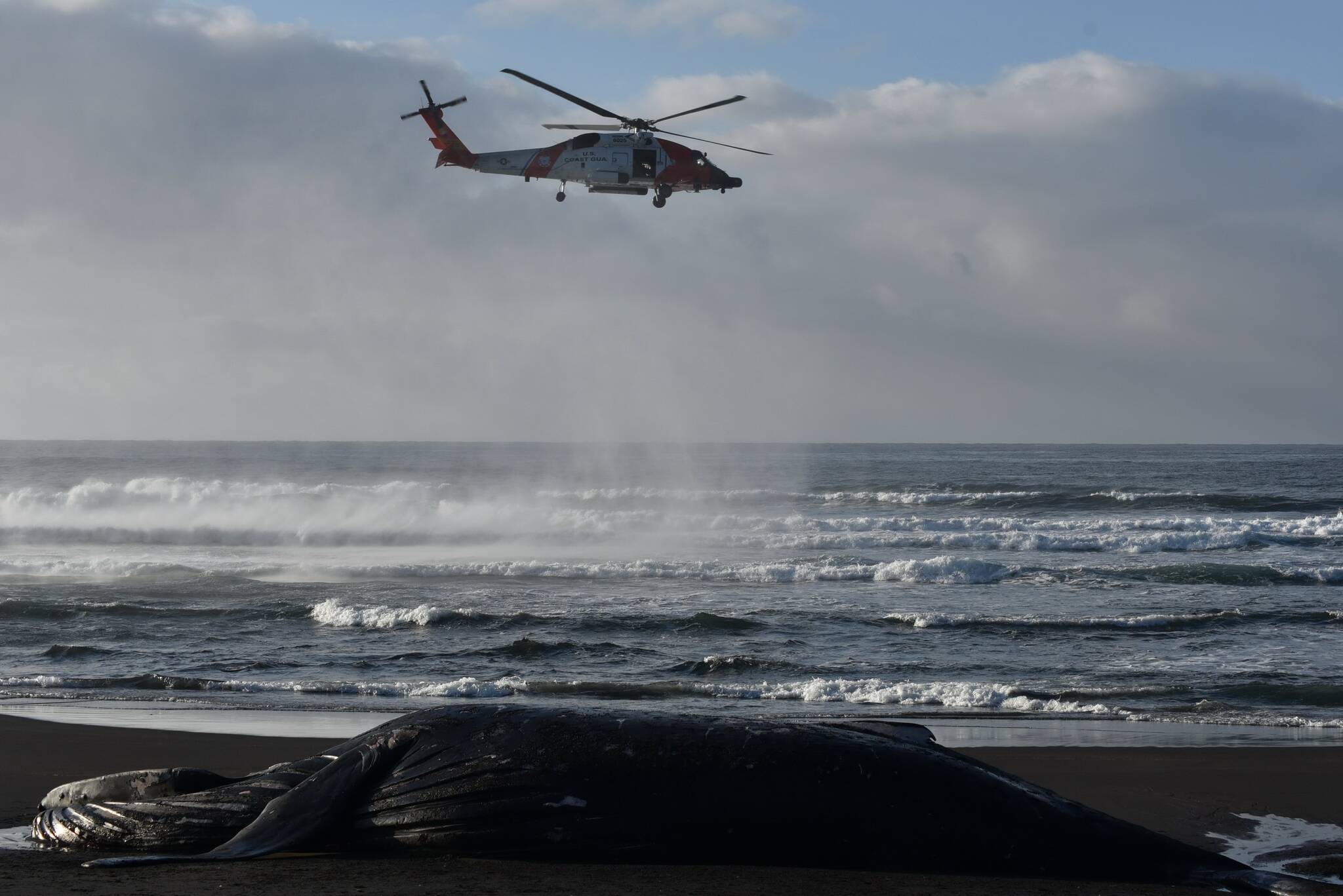
Courtesy photo / Alaska Marine Mammal Stranding Network A U.S. Coast Guard helicopter helps ferry volunteers to the carcass of a beached humpback whale on Kuzof Island on Thursday, March 18, 2021.
“They will gather information about the whale and relay the information back to us,” she said. “The Coast Guard has been great about relaying that information to us.”
According to NOAA’s website, “the most important information to collect is the date, location of stranding (including latitude and longitude), number of animals, and species.”
The website urges, “take pictures from different angles if you are able.”
Learning opportunities
Lauren Wild, a researcher and assistant professor of fisheries at the University of Southeast Alaska in Sitka, is a volunteer member of the stranding network. But, she’s also called in when dead marine mammals are found.
She said that dead marine animals help scientists and researchers learn more about the animal, the species and the environment.
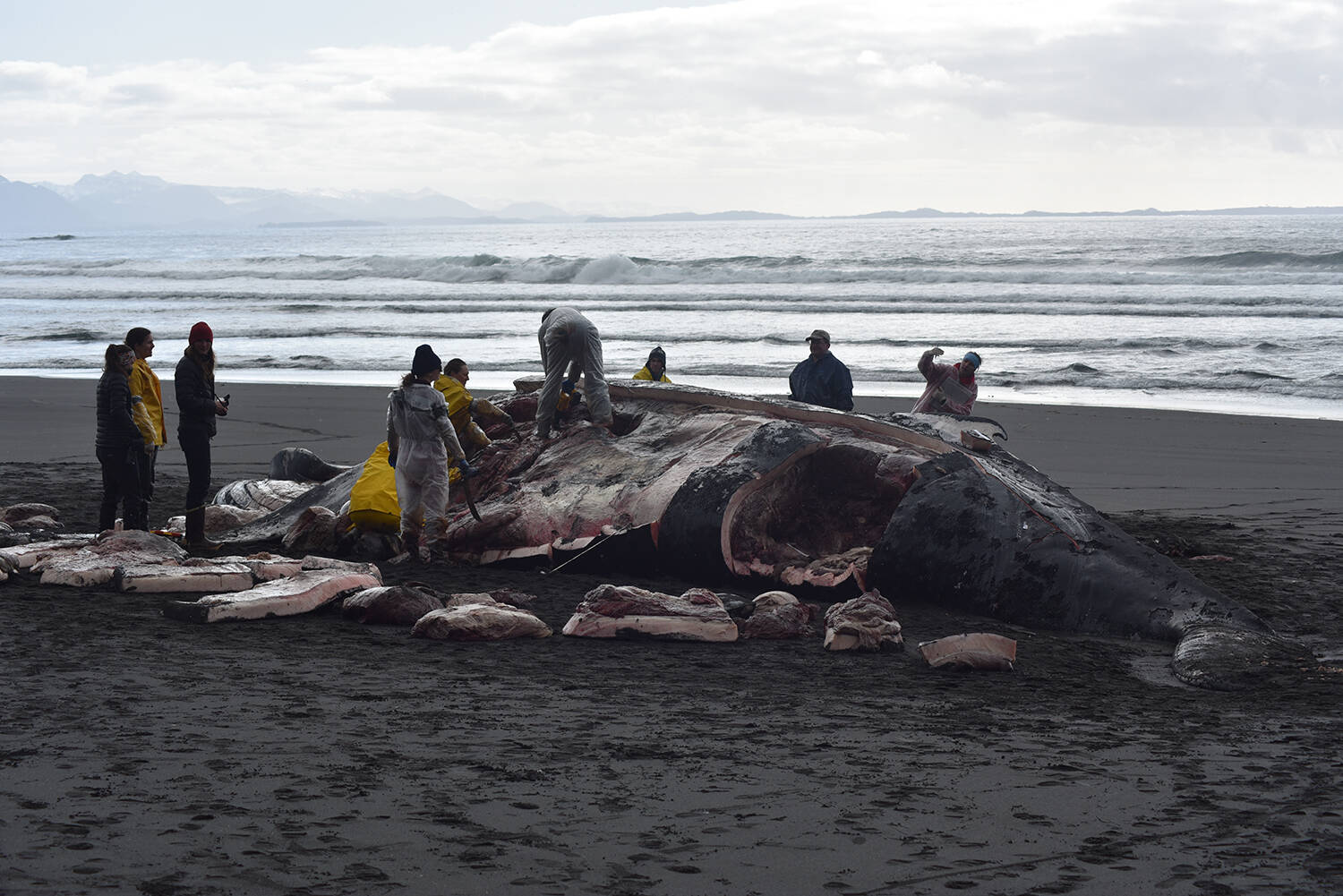
Coutesy photo / Alaska Marine Mammal Stranding Network Volunteers with the Alaska Marine Mammal Stranding Network take samples from a beached humpback whale on Kuzof Island on Thursday, March 18, 2021.
Ellen Chenoweth, an affiliate professor at UAS and volunteer with the stranding network, explained that most dead whales don’t make it to shore.
“Humpback whales fill with gasses, start to sink and then resurface again. I’d say the vast majority don’t end up on shore,” Chenoweth told the Empire in a phone interview last month.
“These animals are mostly hidden out of reach,” she said. “To walk up to a dead whale and look at it and learn about how it’s put together and learn how it functions is certainly interesting for people into marine mammals.”
[To the rescue: Animal ambassadors educate, recuperate]
Wild agreed.
“For people who study marine mammals, it’s a really exciting experience to work with an entire animal,” she told the Empire in a phone interview last month. “It’s really fun to see the whole body at once. Unfortunately, these animals are dead, but you get to do cool stuff like open their bodies and see what they are eating and really check out the anatomy.”
Chenoweth led a team that used a drone to create a virtual necropsy of a whale found near Sitka in March for people interested in learning more about whales and the necropsy process.
The 4-D tour is available free online at https://sites.google.com/alaska.edu/virtual-necropsy/home
• Contact reporter Dana Zigmund at dana.zigmund@juneauempire.com or 907-308-4891.
