
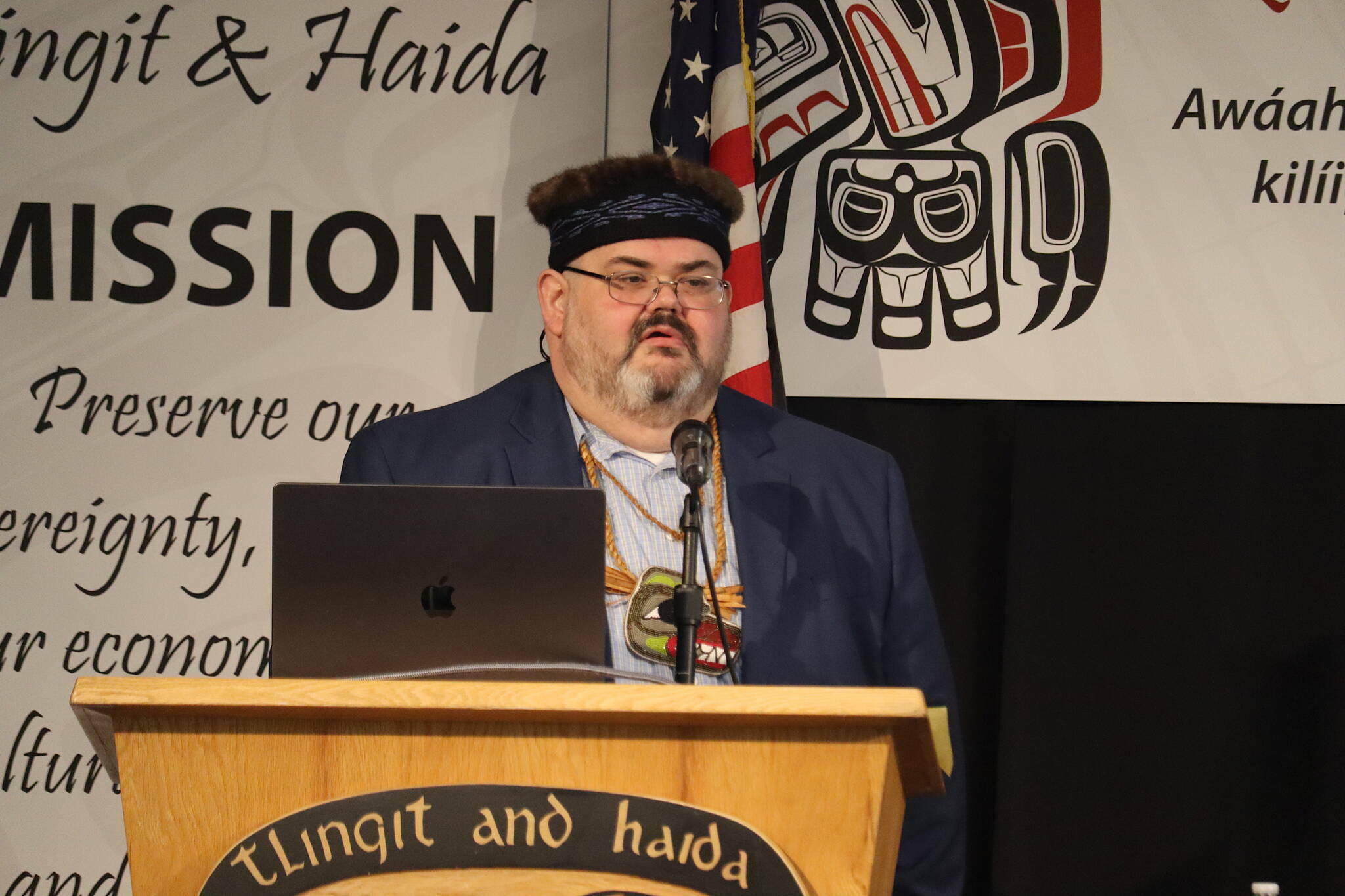
Alaska’s largest tribal government marked its return after two years to the largest statewide Alaska Native organization on Tuesday, with the tribal president declaring “unity is our greatest strength” during uncertain times.
The Central Council of the Tlingit and Haida Indian Tribes of Alaska participated in an Alaska Federation of Natives board meeting, which occurred about two months after Interior Alaska’s major tribal consortium — the Tanana Chiefs Conference — also voted to rejoin AFN after a two-year absence.
“Two years ago the Tribe made the difficult decision to leave AFN due to concerns that tribal voices were not being equitably represented; however, the current political climate demands greater unity among Alaska Native peoples,” Tlingit and Haida President Chalyee Éesh Richard Peterson wrote in a post Tuesday on the tribal council’s Facebook page. “In uncertain times, unity is our greatest strength. Tlingit & Haida is committed to standing together with AFN and our fellow Alaska Native organizations to protect our rights, lands, and future generations.”
Tlingit and Haida’s Executive Council voted to rejoin AFN “following careful deliberation and dialogue and ongoing conversations with AFN leadership,” Peterson wrote.
“Rejoining AFN is not a reversal of our concerns, but a commitment to ensure that tribal governments have a seat at every table where decisions are being made,” he added.
Tlingit and Haida, which recently concluded its 90th annual Tribal Assembly with more than 100 delegates in attendance, represents more than 37,000 tribal members worldwide, according to its website. AFN members include 178 federally recognized tribes, 154 village corporations, nine regional corporations, and 11 regional nonprofit and tribal consortiums, according to its website.
“We are thrilled to welcome the Tanana Chiefs Conference and the Central Council for the Tlingit and Haida back into the Alaska Federation of Natives,” AFN President Benjamin Mallott said in a prepared statement Tuesday. Their return strengthens our collective voice and enhances our ability to advocate for the rights and needs of Alaska Natives. Together, we can continue to make impactful strides toward self-determination and unity across our communities.”
Peterson, in an interview in May of 2023 when the tribal council voted to withdraw from AFN, stated the decision wasn’t meant to be an “indemnification” of AFN.
“I think the driving factor is that we have grown to a place where we’re pretty good at doing advocacy ourselves and can pursue our own priorities — this isn’t an anti-AFN move,” he said at the time. “We still want to hold up the AFN and collaborate with them, and we don’t want to be leaving anybody behind — right now, we’re just looking at our own priorities.”
But Peterson noted in his State of the Tribe address at the tribal assembly that a range of challenges to funding, sovereignty and other issues are looming due to various actions by the Trump administration. The news website Grist reports more than $350 million has been frozen for tribal nations and Alaska Native communities during President Donald Trump’s first 100 days of his second term.
Tlingit and Haida announced May 1 it is halting its traditional Alaska Native foods distribution program due to Trump cancelling funding. Numerous other tribal programs have also seen cuts, and Trump signed an executive order in March rescinding an order by former President Joe Biden expanding tribal sovereignty and self-governance.
Biden’s order was referenced by the Federal Emergency Management Agency in recognizing expanded tribal involvement in emergency responses and the Environmental Protection Agency in awarding a $15 million grant for five Southeast Alaska composting facilities, as well as other projects for other Alaska Native tribes ranging from fisheries management to broadband connectivity.
• Contact Mark Sabbatini at mark.sabbatini@juneauempire.com or (907) 957-2306.
