
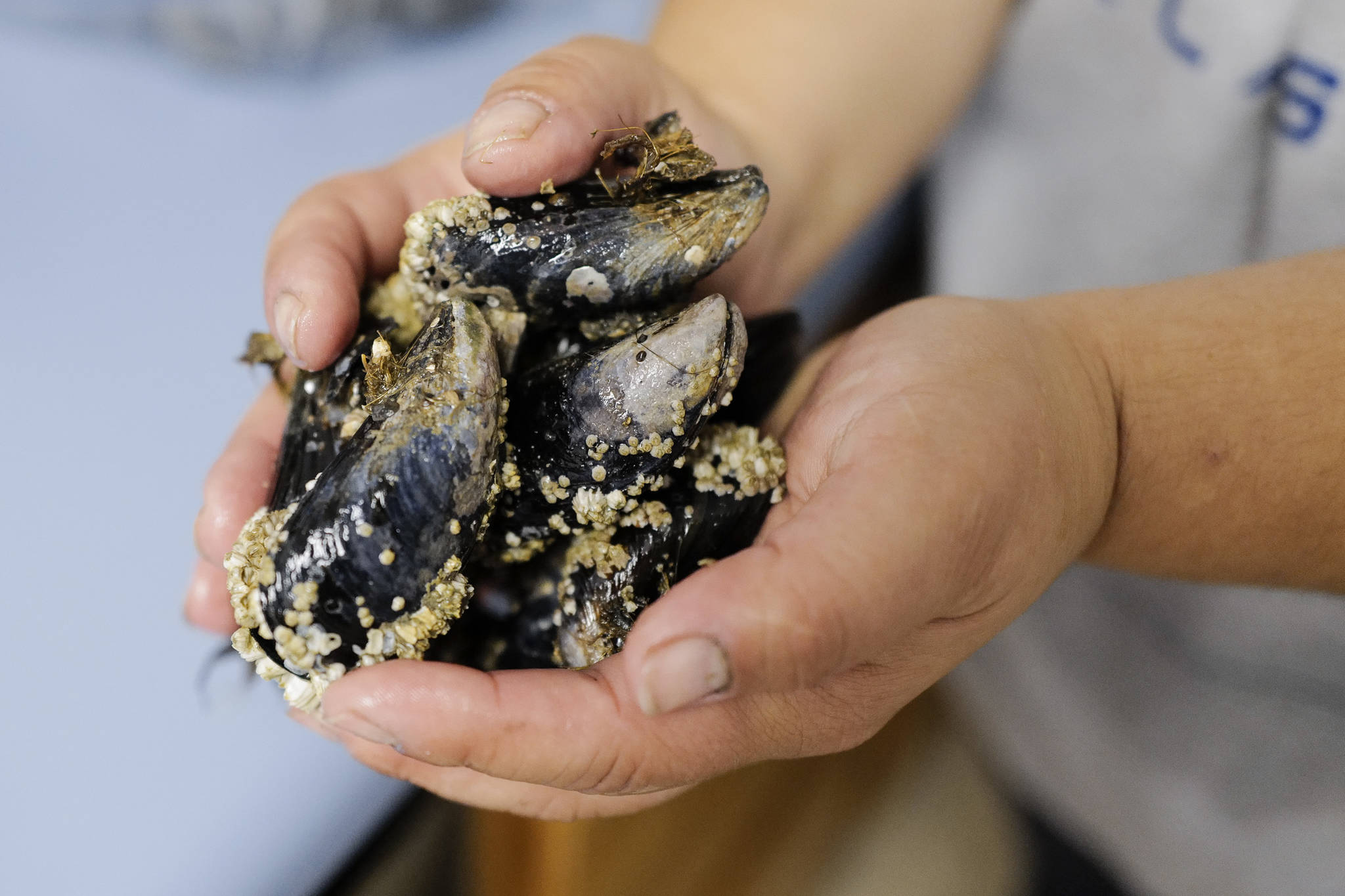
Climate change is a titanic issue for humans everywhere, but it affects few people as closely as the Alaska Native tribes who depend on the sea for food, for their livelihood and for their way of life.
“We are dependent on the ocean. It’s not just tribal, it’s everybody,” said Kenneth Weitzel, a natural resource specialist for Central Council Tlingit Haida Indian Tribes of Alaska.

Kenneth Weitzel, a natural resource specialist for Tlingit and Haida, talks on Friday, Aug. 2, 2019, about working on the Climate Change Action Plan, published in May giving data on climate change, sea level shift, carbon ratios, and shellfish toxin levels. (Michael Penn | Juneau Empire)
Weitzel was lead author of the Climate Change Adaptation Plan, published in May by Tlingit and Haida giving data on climate change, sea level shift, carbon ratios and shellfish toxin levels put together over the last two years.
The report, put together with help from NOAA’s Alaska Sea Grant and the University of Arizona Institute for Tribal Environmental Professionals, is a document showing what’s happening to Southeast Alaska and how the tribes in the region can handle it. The study cost $136,000 and was funded by a land conservation grant from the Bureau of Indian Affairs.
“They gave us a platform to bring people together, to put us in touch with people who could help,” said Weitzel, talking about Sea Grant’s invaluable contribution to the report.
Much of the data comes from a team of scientists with Tlingit and Haida doing regular tests on the water and shellfish around Juneau, which they send to a lab in Sitka specializing in testing shellfish and water for toxins, particularly those which cause Paralytic Shellfish Poisoning (PSP), which occurs when shellfish accumulate neurotoxins from filter feeding on algae in the ocean.
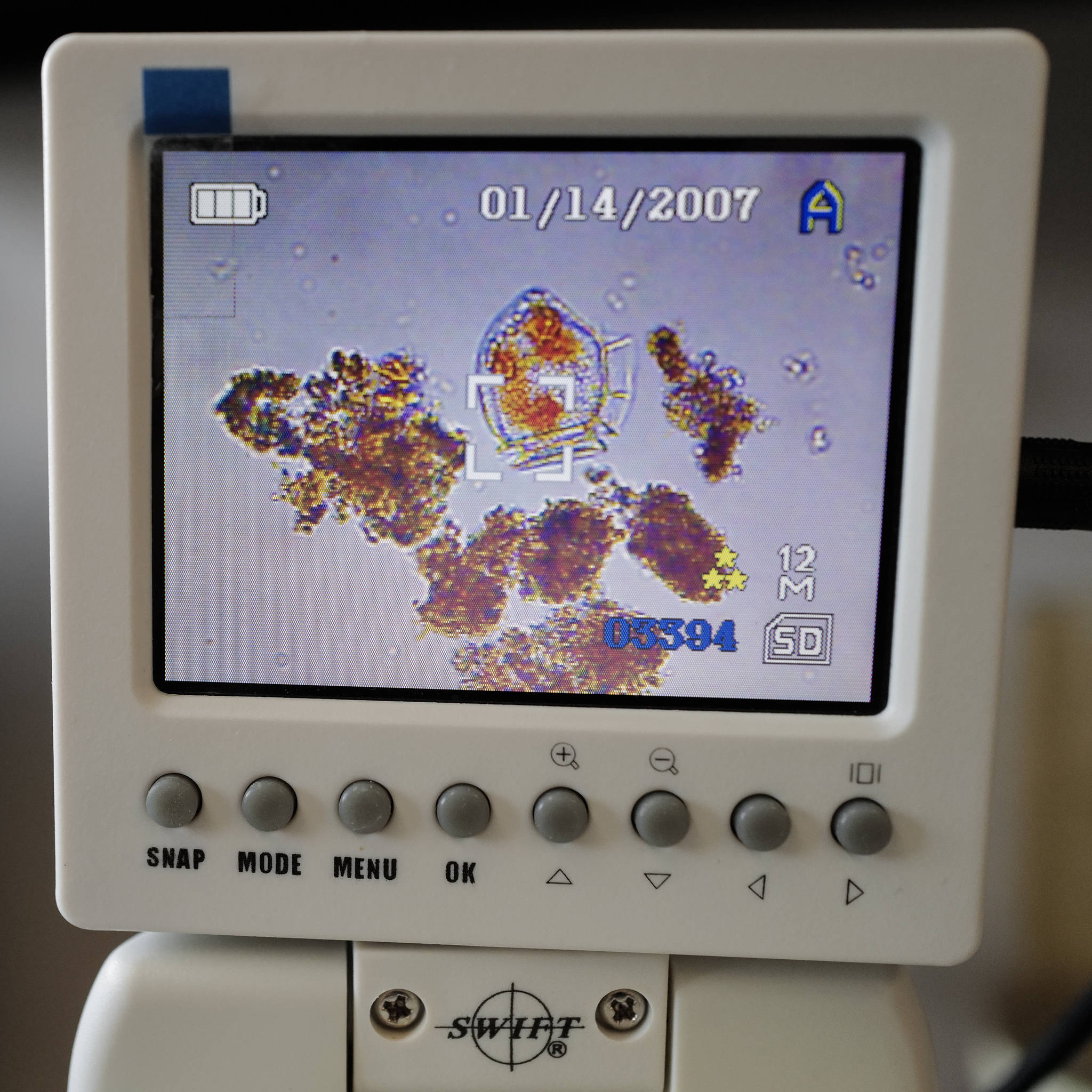
A monitor show plankton as Lindsey Pierce, a environmental technician for Tlingit and Haida, checks water samples taken at Point Louisa on Friday, Aug. 2, 2019. (Michael Penn | Juneau Empire)
The scientists go down to the shore during low tides, and collect shellfish and water samples to send off to test. The Sitka lab, called SEATOR, short for Southeast Alaska Tribal Ocean Research, conducts these tests for tribes all over the region, Weitzel said. The results of these tests are published online so folk can see if the shellfish in an area are generally safe to eat.
Shellfish aren’t just threatened by toxin accumulation. As the glaciers melt, the enormous weight of millions of tons of ice sloughs off, relieving pressure on the continental crust and allowing it to rise. This has had the effect of artificially raising the seabed in the region.
“It seems minimal but compared to everywhere else, it’s dramatic,” said Cer Scott, an environmentalist with Tlingit and Haida.
“You have these shellfish beds that are rising out of the water,” Scott said. “The coral reefs are being pushed out of the water.”
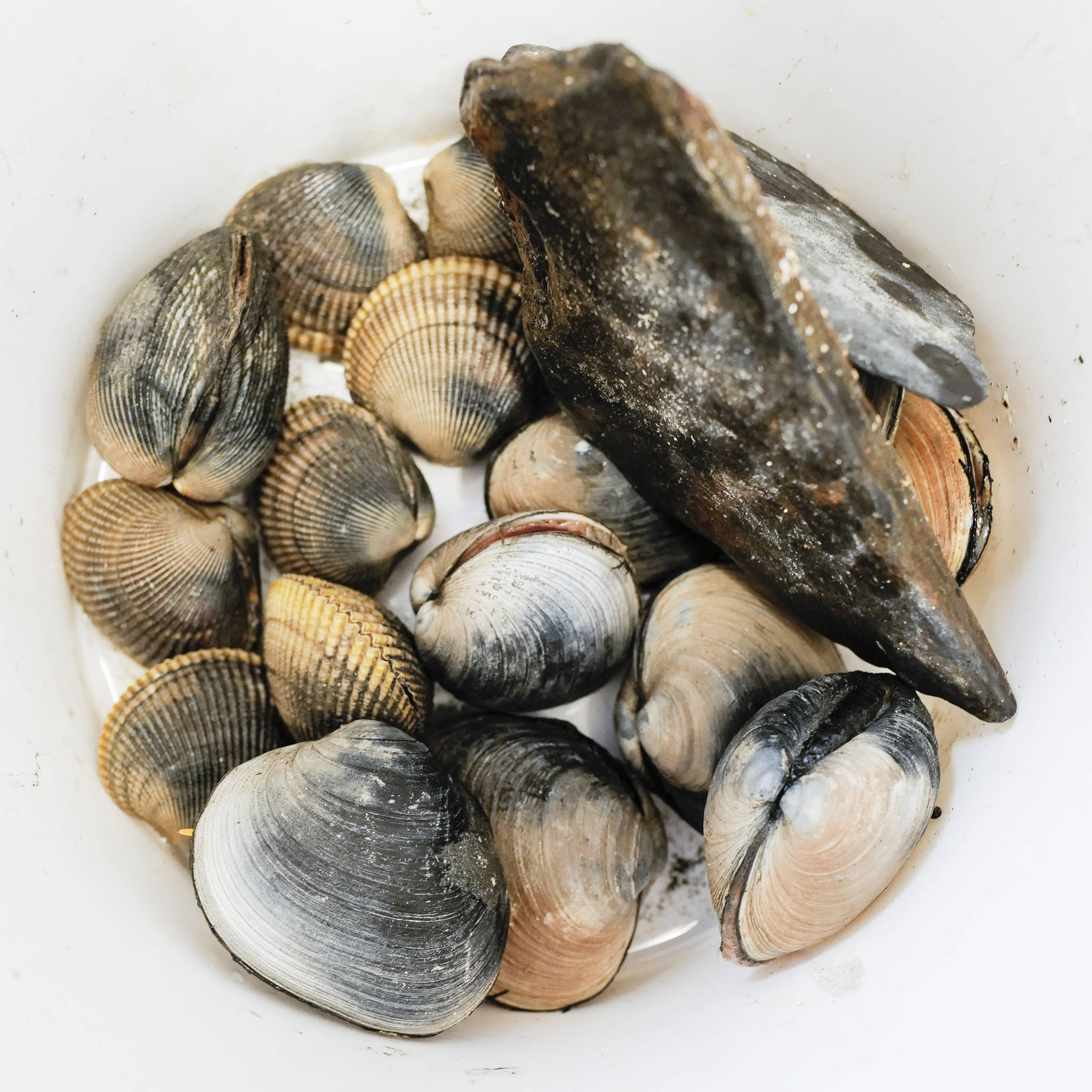
Butter clams and cockles collected by Tlingit and Haida natural resource specialists for data on climate change, sea level shift, carbon ratios, and shellfish toxin levels. The samples will be sent to a Sitka lab specializing in testing shellfish and water for toxins, particularly those which cause Paralytic Shellfish Poisoning (PSP). (Michael Penn | Juneau Empire)
This is causing disruption in the ability for these organisms to live and grow, as well as other effects that are difficult to predict. Even as the melting glaciers and icecaps promote sea level rise, the pressure relief on the tectonic plates is letting the seabed rise faster.
“We are outpacing sea level rise,” Weitzel said.
Equally important to the plan is data gathered on carbon isotopes, Weitzel said. Specific isotopes of carbon, the element found in almost every form of life on earth, can tell us what’s in the atmosphere or where the specific carbon something is using comes from, be it volcanic activity or burning fossil fuels.
For most of the thousands of years of data available to researchers, the ratio of 12C and 13C, two different kinds of carbon, has held roughly stable. Since the Industrial Revolution, Weitzel said, the rate of 12C has skyrocketed. As plants prefer to build using 12C, it’s present much more often than 13C in fossil fuels, Weitzel said.
“It indicates that people are responsible for greenhouse gasses,” Weitzel said, refuting a claim made by some that the planet heating up is a natural event.
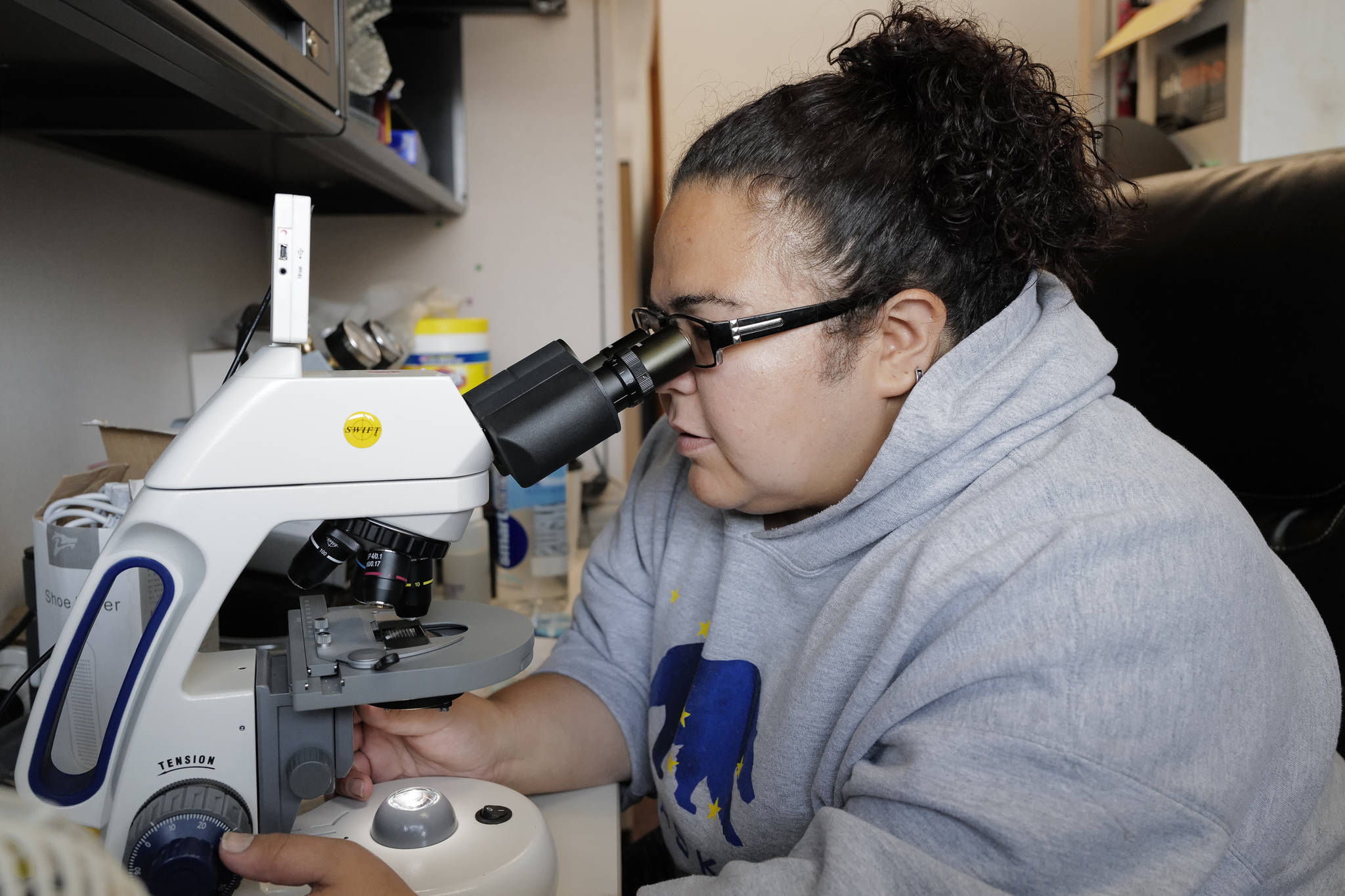
Lindsey Pierce, a environmental technician for Tlingit and Haida, looks for plankton in water samples taken at Point Louisa on Friday, Aug. 2, 2019. (Michael Penn | Juneau Empire)
The plan isn’t just a warning about coming changes in the climate of Alaska, however. It’s also a road map for adapting to it. Part of the plan is a matrix of the most and least vulnerable animals and plants to rapid climate shift, with salmon at the top of the most vulnerable and a number of mammals at the other end of less vulnerable.
It also offers suggestions on how to mitigate those vulnerabilities, from small changes in the places these plants and animals live to larger ones that will require more effort on a higher level.
“A lot of other strategies are to get a more active voice in the management,” said Weitzel.
Tribal governments haven’t often had a lot to say over the management of fish and wildlife resources, said Weitzel, but if the tribes are to preserve their way of life, that needs to change.
“Data is power,” Scott said. “If we collect it on our own, that’s more power we can use to support our cause.”
The report is available online here, and a template exists for any tribe in the region that wants to base its own climate change plan off of it.
• Contact reporter Michael S. Lockett at 523-2271 or mlockett@juneauempire.com.
