
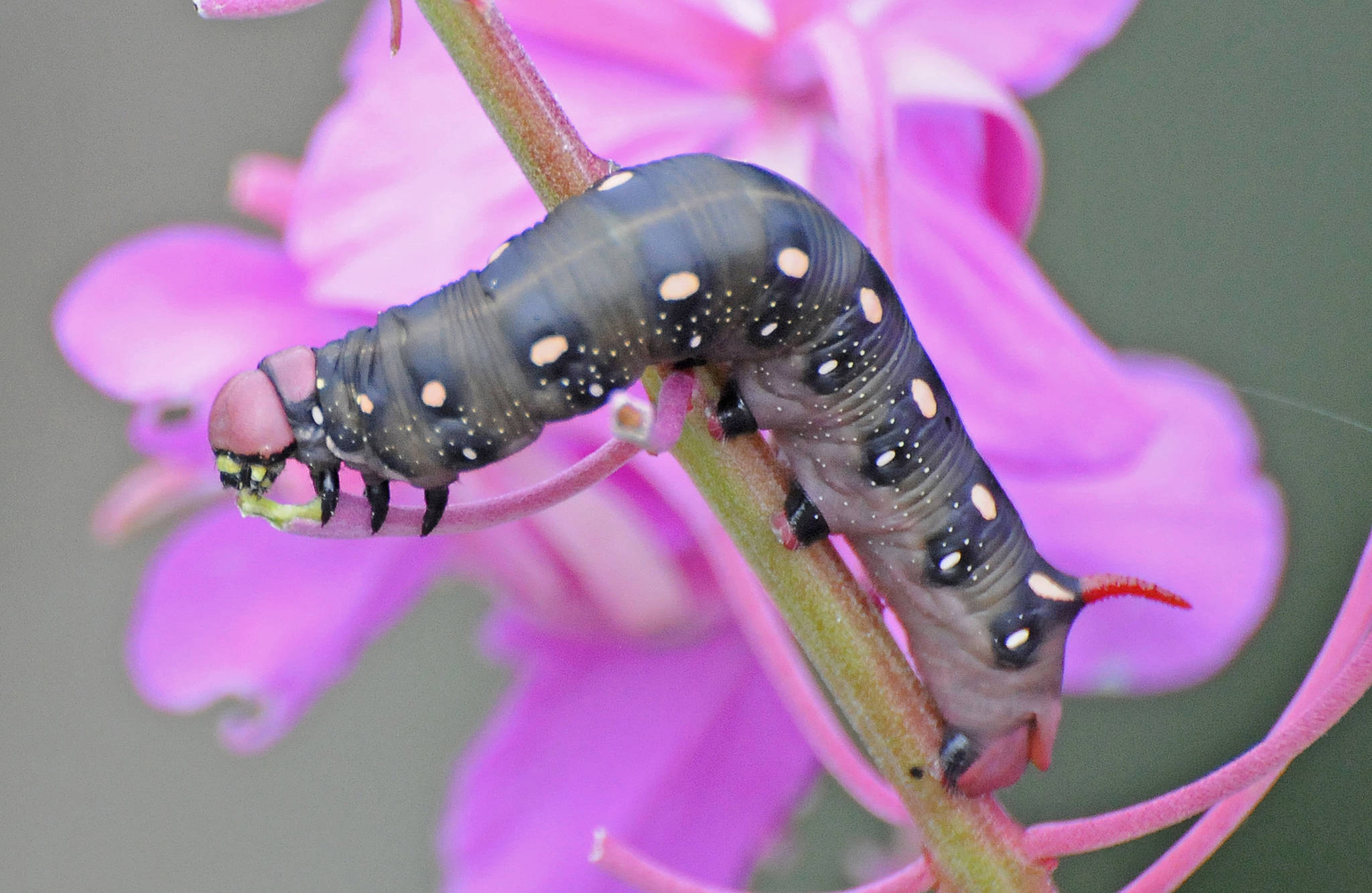
Moths and butterflies collectively belong to a big taxonomic group called Lepidoptera. That name means “scale-wing”, referring to the tiny scales that cover the wings of most of these species. The scales make the beautiful, complex color patterns that we enjoy. Butterflies are generally more colorful than moths, but many moths have elegant patterns in grays and browns, some sport bright patches of yellow, orange, or red and the big luna moth is a lovely green.
Lepidoptera are the most recently evolved large group of insects — they’ve only been around about 150 million years or so. But they have diversified a lot. Moth-like species arose first, and now moths are far more numerous than butterflies — there may be about 15,000 species of butterfly but that’s only about six percent of all lepidopterans. Because many moth species have not been identified, or even discovered, even that percentage is probably too high.
True butterflies originated much later than moths and then diversified widely about 60 million years ago. In terms of geological time, that is very recent. Much of the diversification was related to the evolution of the flowering plants and the many ways both the larval and adult lepidopterans could exploit them.
[Refreshing break from Southeast in Baja]
The first lepidopterans were leaf miners, as larvae, and that feeding habit is still prevalent, especially in moths, but many species have diverged to other feeding habits. For example, a few species make galls, and many kinds of larvae (caterpillars) feed externally on leaves. Some of the external leaf-feeders eat toxic plants and incorporate the toxins to protect themselves from predators. These species commonly have warning colorations (or sounds) that give notice to a potential predator that the caterpillar tastes bad or induces nausea; the warning colors typically are combinations of red or orange or yellow and black. Monarch butterflies, whose larvae feed on milkweeds, are a classic example. The warning coloration works so well that other, relatively harmless, species have evolved to mimic the noxious model.
Although plant-feeding of one kind or another is very common, lepidopterans have also evolved a variety of other larval feeding habits. Some are predatory or parasitic on other insects, some burrow in seeds, stems, or roots, some eat beeswax or detritus, and some eat wool. The life histories of some of these species are remarkable. Here are a few examples:
[The world would be a filthier place without these pests]
• Yucca moth females pollinate yucca flowers and simultaneously lay their eggs in the developing seeds, which serve as a larval nursery and food source. Clearly, they must not lay eggs in all the seeds of the flowers, or there wouldn’t be any new yucca plants.
• In a truly bizarre life history, certain species of caterpillars in the first stage (called an instar) of larval development follow ants to leafhoppers, which are tended by ants for the “honeydew”, and there they parasitize the leafhoppers. But they leave this host in order to molt into the second instar. Second-instar caterpillars attract ants, which collect them and taken them to the nest, where they feed on ant larvae. The caterpillars get away with this by secreting special compounds that keep the ants from attacking them.
• Some small butterflies often known as “blues” and “hairstreaks” are famous for their association with ant colonies, where they feed on ant larvae or on stuff regurgitated by the adult ants. They “pay their way”, so to speak, by secreting honeydew, rich in sugars, which the ants feed on.
I can’t leave the hawkmoths without mentioning a really weird South American species. The caterpillar looks a bit like a stick as it rests among leaves and twigs. But when it is disturbed, the thorax swells up, exposing patterns that look realistically and very alarmingly like the head of a snake, with eyes, mouth, and well-defined scales. This little “snake” even strikes at a disturber. I would love to know who the disturbers are (maybe birds?) and how they react to this mini-threat.
Adult lepidopterans typically have the jaw parts fused into a tube called a proboscis or (inaccurately) a “tongue.” This is typically used for probing into flowers for nectar (although some adults don’t feed at all). If the proboscis is long, it is coiled up close to the head when not in use. It is unfurled by blood pressure, but then it can be moved about by muscles inside the tube. That is useful when the adult is seeking nectar deep inside a flower. Some proboscides are prodigiously long. The famous example is the puzzle, noted by Darwin, of the star orchid of Madagascar, which had a nectar tube 12 inches long. Darwin predicted that a long-tongued insect must be the pollinator, but none was known at that time. Sure enough, a few decades later, someone discovered a hawk moth with a proboscis of just the right length to reach down to that deep nectar source.
Flower-feeding is common among adult butterflies. However, adults of a few lepidopterans pierce fruits with their proboscides. In southeast Asia, some of those fruit-piercers gave rise to several species that feed on blood instead. I’d like to know more about that.
• Mary F. Willson is a retired professor of ecology. “On The Trails” is a weekly column that appears every Friday. Her essays can be found online at onthetrailsjuneau.wordpress.com.
