
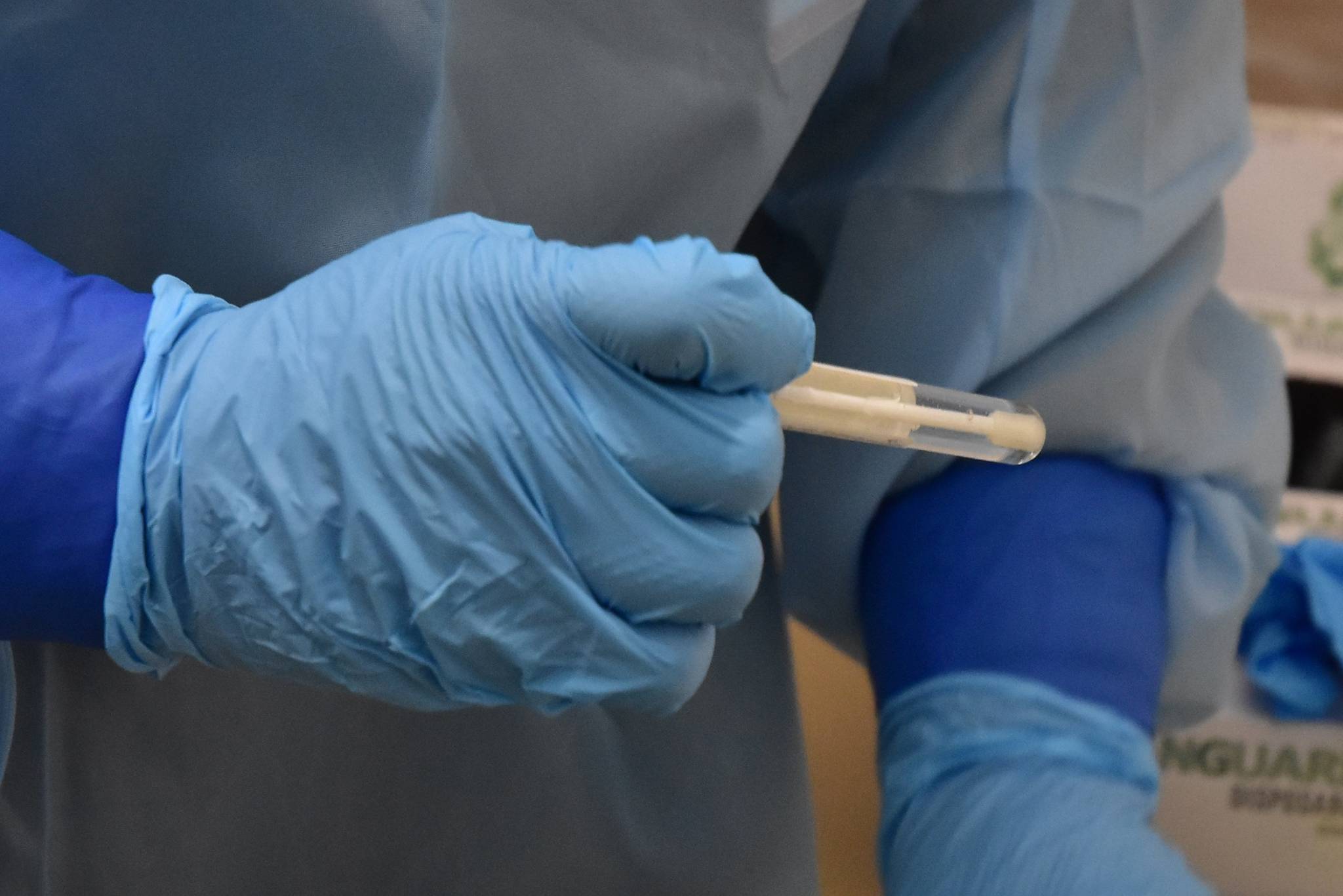
An advanced testing machine that will allow Bartlett Regional Hospital to process COVID-19 test samples will arrive in December instead of January, according to city officials.
Officials will begin working with the vendor next week regarding delivery and installation, according to the City and Borough of Juneau’s Emergency Operations Center update for Nov. 3.
Representatives from the company will have to fly into Juneau to install and run a series of diagnostic tests to ensure the machine is accurate, said Gail Moorehead, senior quality director for the hospital. Moorehead said those representatives are expected in late December and it was hoped the machine, a Roche cabas 6800, will be operational by late January but it depends on the outcome of the diagnostic tests.
The CBJ Assembly voted in Juneau to use $700,000 of CARES Act money to buy the machine and cover the costs of renovations at BRH needed for installation. Currently the state is paying for all of Juneau’s testing, but that’s scheduled to end when CARES Act money expires at the end of this year. After that, it’s not clear how the city will pay to continue to operate the machine, EOC Planning Section Chief Robert Barr previously told the Empire.
In an email Thursday, Barr said the city is hopeful there will be another round of federal funding for COVID-19 testing, but if not, there are other options the city will explore such as state and local funding, reimbursements from the Federal Emergency Management Agency and private insurance.
[Juneau a testing hub? Assembly to consider buying testing machine]
Operating at full capacity for an eight-hour shift Barr said the machine could process up to 380 test samples a day, but that number depends on staffing and supplies. The city currently averages 100-200 tests a day, Barr said.
“The system requires materials and reagents supplied by Roche to operate,” Barr said. “We are as confident as we can be that Roche will be able to supply these materials and reagents; however, it depends on testing demand worldwide.”
The machine has applications beyond the ongoing pandemic.
The Roche machines are standard testing equipment for several forms of viral transmission, said Coleman Cutchins with the Department of Health and Social Services Office of Substance Misuse & Addiction Prevention during a weekly news briefing. Other uses for the machine include testing for tuberculosis, HIV and viral respiratory illnesses.
“There is quite a bit of utility outside the world of COVID,” Cutchins said.
Cases are at an all-time high in Juneau, far above where they were in June when the city first considered purchasing the machine, according to city data, and local health officials are working to contract trace two distinct clusters in the community.
State health officials announced 296 additional cases Thursday bringing the state’s total active cases to 10,512, according to the Department of Health and Social Services, with 89 people currently hospitalized for COVID-19. In Juneau there were 14 new cases and four people hospitalized at BRH, according to CBJ data.
State and local health officials are having difficulty contact tracing all the active cases, something Chief Medical Officer Dr. Anne Zink has said is critical to managing the virus.
During DHSS’ weekly update, Zink urged Alaskans to be vigilant in observing health mitigation strategies such as social distancing, masking and limiting one’s social circle.
“It’s not just contact tracing that we need help with,” Zink said.
Contact reporter Peter Segall at psegall@juneauempire.com. Follow him on Twitter at @SegallJnoEmpire.
