
An earlier version of this article stated nearly 90% of those giving testimony favored the bill. Nearly 90% opposed the bill. The article has been updated to reflect that distinction. Also, the spelling of Apayauq Reitan’s name has been corrected.
Alaskans overwhelmingly opposed a bill restricting sex and gender references in public schools in the name of “parents rights” during a five-hour legislative hearing Thursday night. While outnumbered, backers of the bill also gave testimony creating a contrast between the sharp divide between concerns held by the legislation’s proponents and opponents despite rhetorical commonalities.
Both sides said their stances were about protecting children. Both referred to bullying, either by or against LGBTQ+ students. Some parents argued their children have no rights on such matters until they’re 18, while several youths argued parents don’t have the right to limit identity choices.
There were also areas of agreement by the opposing sides — notably thanking Gov. Mike Dunleavy for introducing the proposal in the form of House Bill 105 (and companion Senate Bill 96). The reasons, naturally, diverged into either giving parents an increase sense of control over what their children are exposed to at school and or galvanizing the LGBTQ+ community and allies into action opposing the proposal.
Dunleavy’s bill, mirroring many provisions of legislation getting widespread attention in other states, requires written permission from parents for sex education classes and for a child to be addressed by a different name or pronoun. It also requires students to use locker rooms and restrooms according to their biological sex, and school officials to notify parents about any change in a child’s physical, mental or emotional health unless there is a risk of abuse.
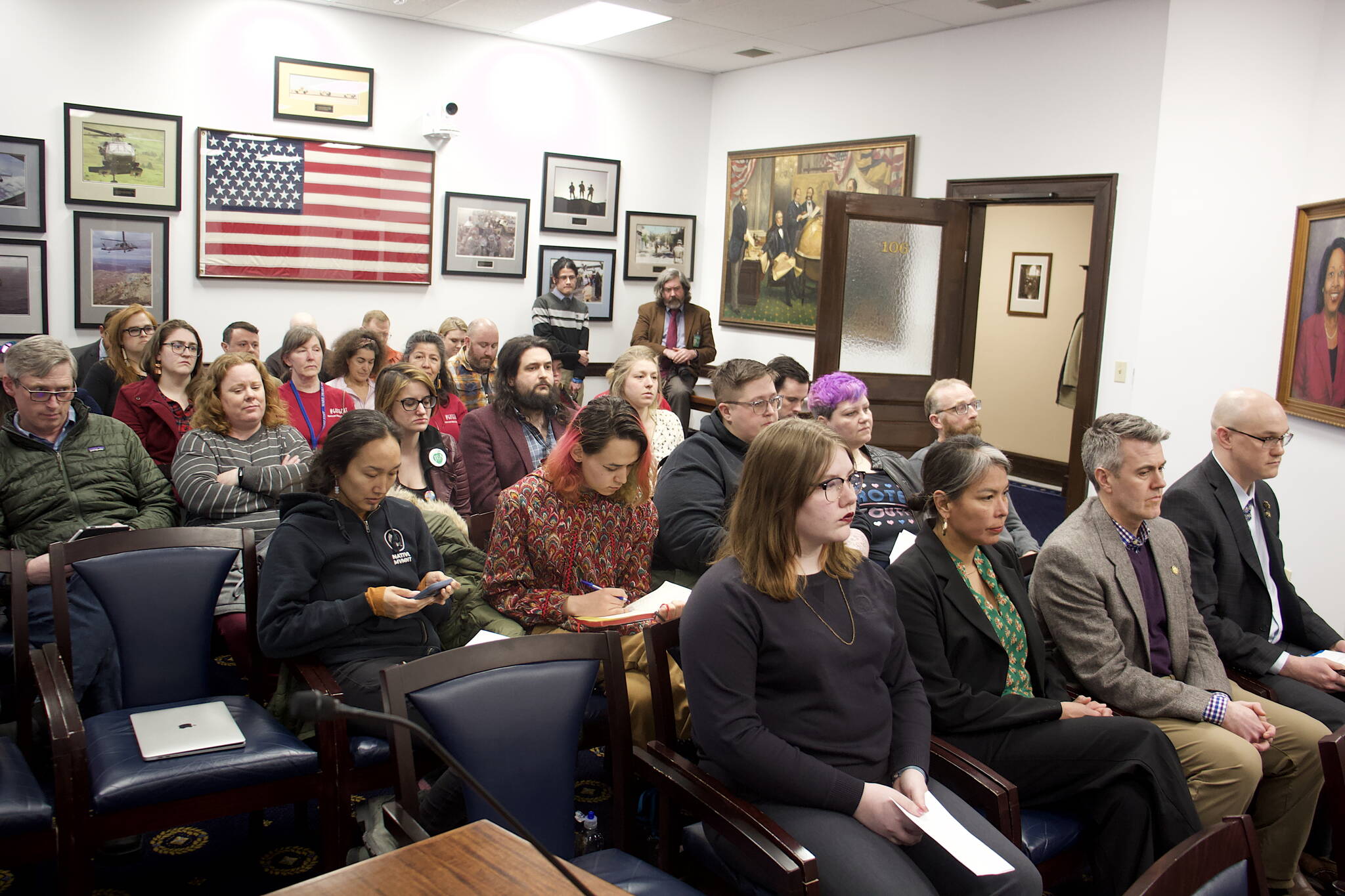
Mark Sabbatini / Juneau Empire People opposed to a bill restricting sex and gender content in schools pack a meeting room at the Alaska State Capitol during a House Education Committee meeting Thursday night. None of the people testifying in person spoke in favor of the bill.
Thursday’s hearing by the House Education Committee featured comments from roughly 125 people — including about 30 who packed into the committee room and the remainder testifying online — with nearly 90% opposing the bill. In addition, hundred of pages of written testimony were submitted and made publicly available online Friday.
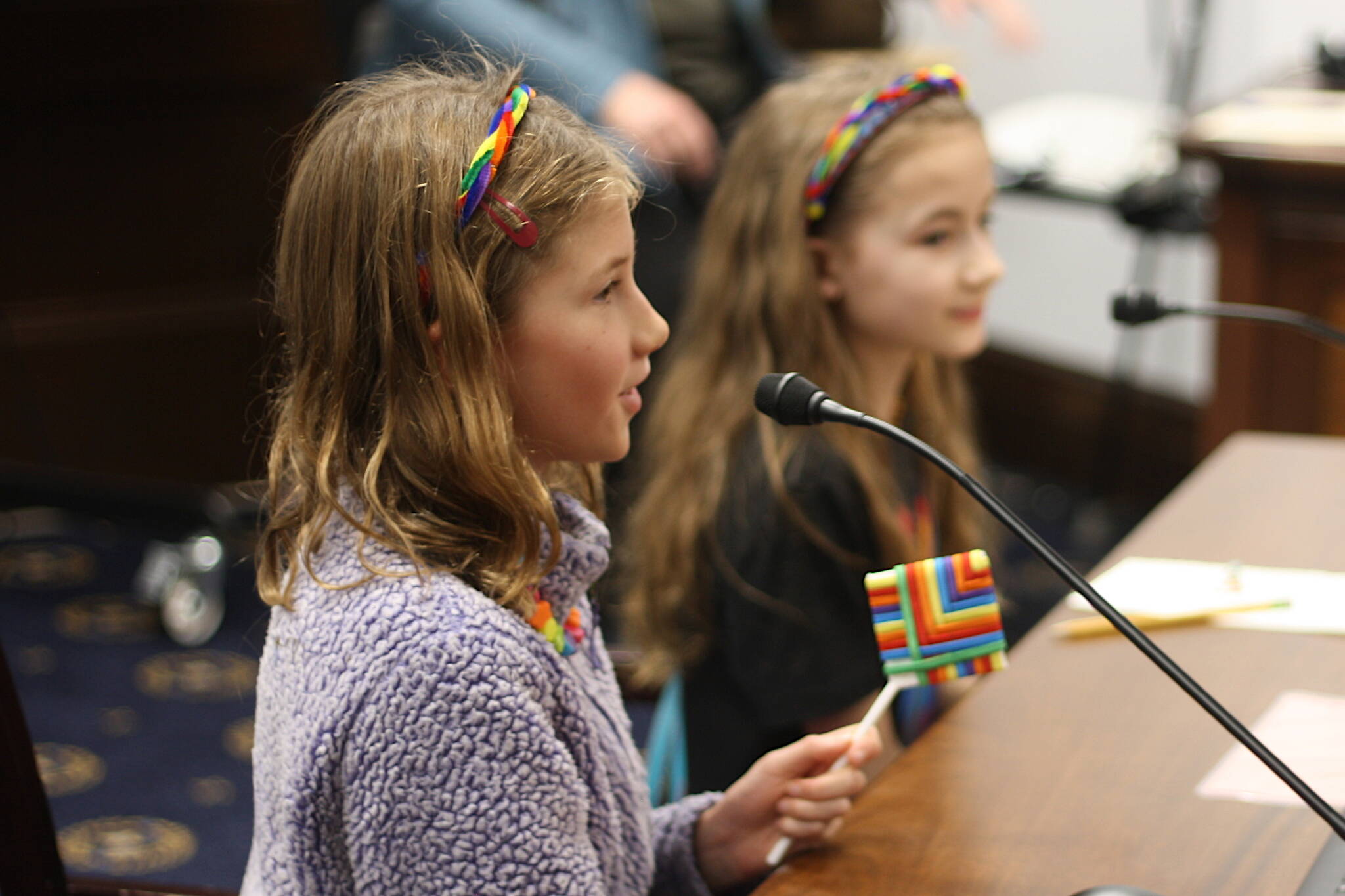
A portion of Dunleavy’s bill emphasizes younger students by banning references to sex and gender before the fourth grade, except in cases related to abuse, but the two youngest people testifying Thursday rejected the need or desire for such “protection.” Ona Eckerson, 9, and Nayeli Hood, 10, delivered their remarks while wearing rainbow-colored accessories and alternating phrases in tandem as they passed a sheet of paper between them
“We think this bill is very wrong and we have a friend who is nonbinary,” Hood said before passing the brief statement to Eckerson who added “and they deserve privacy just like everyone else. This bill should not be passed.”
With most of their two minutes of allotted time remaining Rep. Jamie Allard, an Eagle River Republican who presided over the meeting as the committee’s co-chair, encouraged them to say more if so inclined.
“I just think it’s really wrong because everyone should have their own right of who they are,” Eckerson said, this time without referring to notes. “It doesn’t matter what private part they have. It’s who they are from the heart. That’s just who they are and they should be supported for who they are.”
Hood, adding her spontaneous final comment, said “everybody deserves their right pronoun to be heard and they deserve to be recognized.”
While a large portion of the testimony focused on LGBTQ+ issues, especially involving transgender people, some opponents of the bill referred to instances that could be harmful to individuals regardless of their sexual orientation or gender.
“As a victim of sexual abuse myself at 12 I didn’t know it was abuse until I was 25 because I didn’t have the language for that,” said Brenda Taylor, a Juneau resident. “I think we need to give them information and knowledge and words and power.”
The hearing’s focus drew passionate, colorful testimony —and occasionally colorful symbols and accessories.
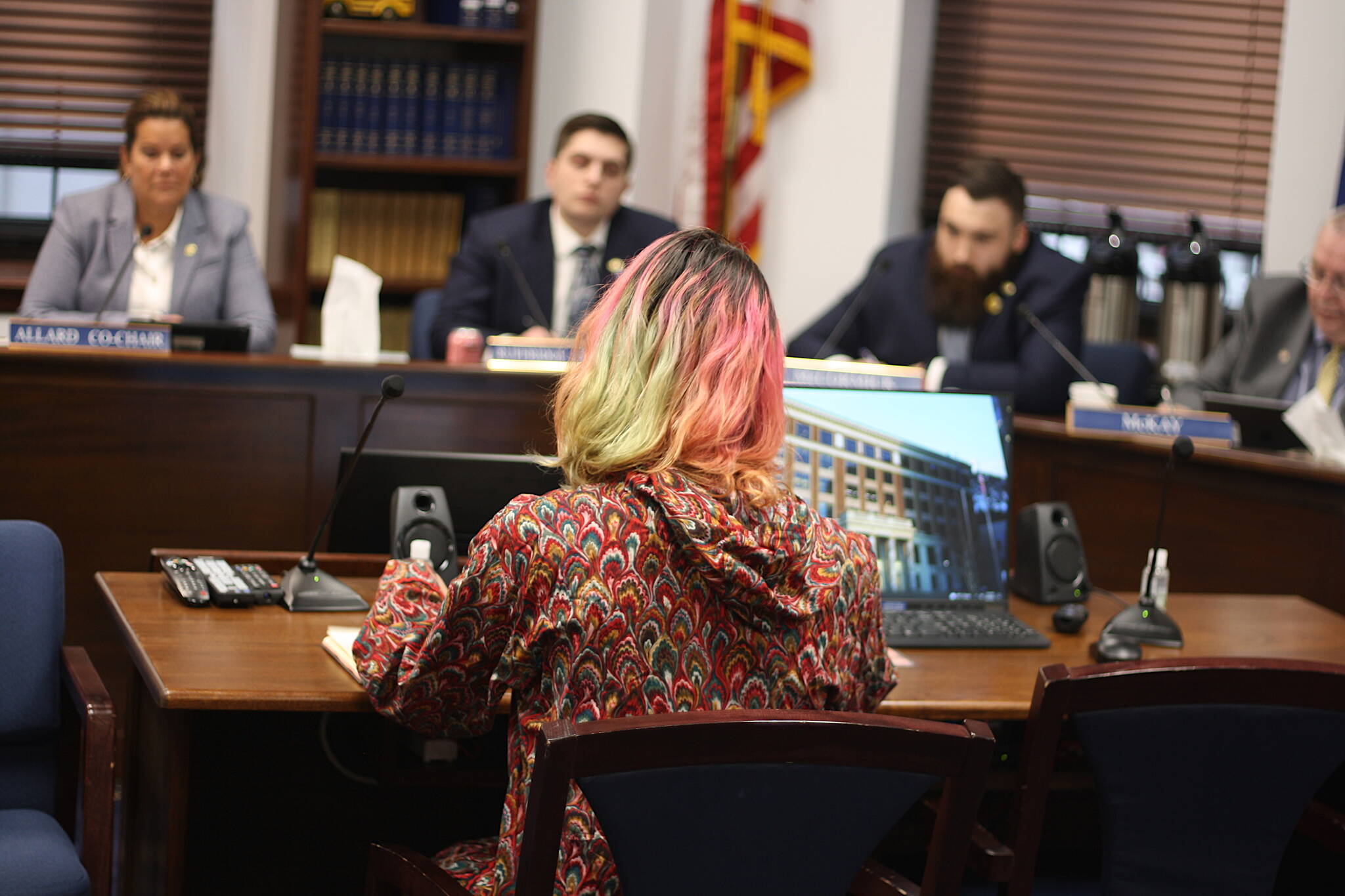
Mark Sabbatini / Juneau Empire Apayauq Reitan, the first transgender woman to participate in the Iditarod, tells the House Education Committee on Thursday why she opposes a bill restricting sex and gender content in schools.
At one point while a supporter held up a transgender flag, Apayauq Reitan with her multi-colored hair took a seat at the table in front of the committee and described growing up from a distressed child into being the first transgender woman to participate in the Iditarod. She said that at the age of 4 she knew she “was going to be a girl when I grew up,” but the perception of transgenderism she got from other people and media portrayals made her bury that part of her persona for years.
“We were presented as monsters, freaks, disgusting, deceivers, the butt of a joke or a murder victim in a crime show,” Reitan said. “We were never presented as human beings.”
While Reitan said she began the transitioning process last year and is getting affirming support from peers, she said Dunleavy’s bill will revive her experiences from earlier years.
“I’m worried about bills like this,” she said. “I’m worried about whether I can build a future in Alaska. But I am very glad that my parents have a daughter now.”
A multitude of teachers and other educators testified against the bill, stating local policies addressing LGBTQ+ students already exist without problems being expressed by youths or parents.
“We at the high school deal with this on a daily basis and it’s not an issue at all,” said Meagen Hinton, a Juneau special education teacher. “You are making it an issue. The governor is making it an issue. They don’t need other people telling them what they’re doing is wrong when what they’re doing is expressing themselves as an individual.”
But for some parents supporting the bill, the existence of such policies and their lack of knowledge about them is one of the main problems.
Rachelle Griffiths, an Anchorage resident, said she found out in January her ninth grade daughter was reading “The Handmaid’s Tale” as a school assignment which “made my child extremely uncomfortable and disturbed,” and distracted her work in other classes.
“(It’s) a book about women getting raped and used the ‘f’ word 96 times in referring to sexual intercourse,” Griffiths said, adding “I as a parent was not informed in writings or verbally about the sexually graphic nature of the book to decide if the content was appropriate for my impressionable young child to be exposed to.”
While many LGBTQ+ residents expressed concerns about bullying, dismay about being bullied by such people was expressed by Pamela Samash, a Nenana resident who said her daughter refused when “a local girl wanted to be called a boy’s name” at school.
“My Christian daughter was relentlessly harassed by the LGBTQ and their friends in the school,” Samash said in support of Dunleavy’s bill. “I finally had to homeschool her.”
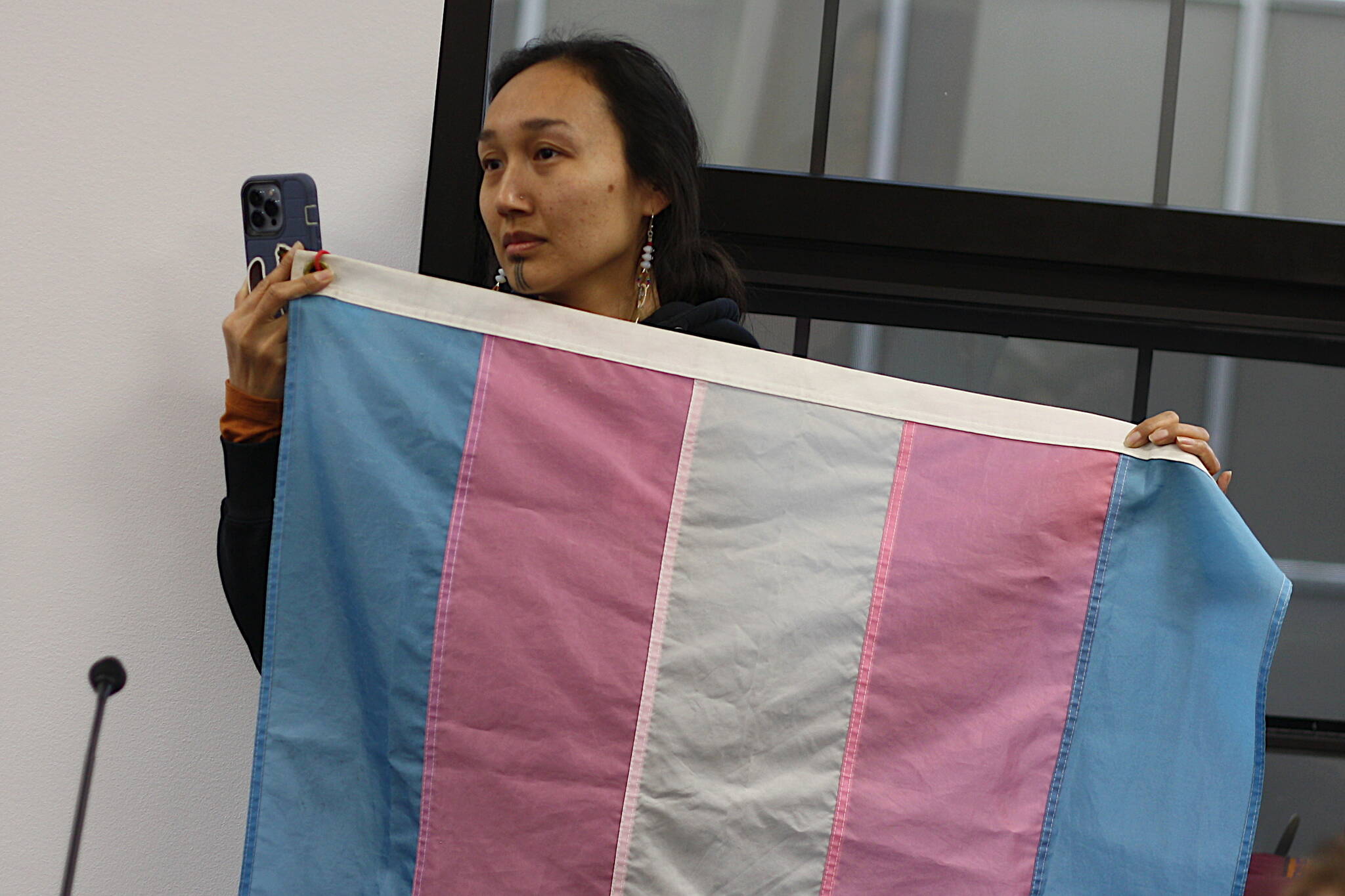
Mark Sabbatini / Juneau Empire Charlene Apok, director of gender justice and healing at Native Movement, holds up a transgender flag during public testimony on a bill limited sex and gender content in schools Thursday night at the Alaska State Capitol.
Religion was invoked by residents throughout the hearing. Juneau resident Ricky Tagaban said he grew up in a Pentecostal family where the “first thing I heard is gay people don’t exist.” He said “as a young gay person you go into survival mode,” and he ultimately encountered educators who provided guidance.
“They found kind, gentle ways to tell me there was nothing wrong with me,” he said. “This bill will criminalize these people. There’s already a finite number of people doing that work and I find it incredible we would criminalize these people.”
Practical issues with the specifics of the bill were raised by a few residents, notably about the requirement that parents be notified of and approve any reference to a student other than their birth name.
“My name is Patrick,” said Pat Race, a Juneau resident. “My teachers called me Pat. I don’t want to have to get a permission slip from my parents for that to happen.”
The bill allows parents to sue school districts for up to $15,000 for violations of the proposed law. KC Elliot, a Palmer resident who was the last person to testify, said that along with questions about the constitutionality of the bill under Alaska’s privacy clause means it could be costly to districts and the state if it becomes law.
“This is going to cause us lawsuits,” she said. “Not only that it puts an undue burden on teachers and school districts when they’re already overworked and underpaid. End this distraction and kill this bill now.”
That didn’t happen, as Allard announced several times during the meeting public testimony in writing will continue to be accepted and the bill will get further consideration by the committee. However, it’s ultimate fate appears doubtful since Senate leaders have indicated there isn’t sufficient support in the majority caucus to pass the bill.
• Contact reporter Mark Sabbatini at mark.sabbatini@juneauempire.com
