
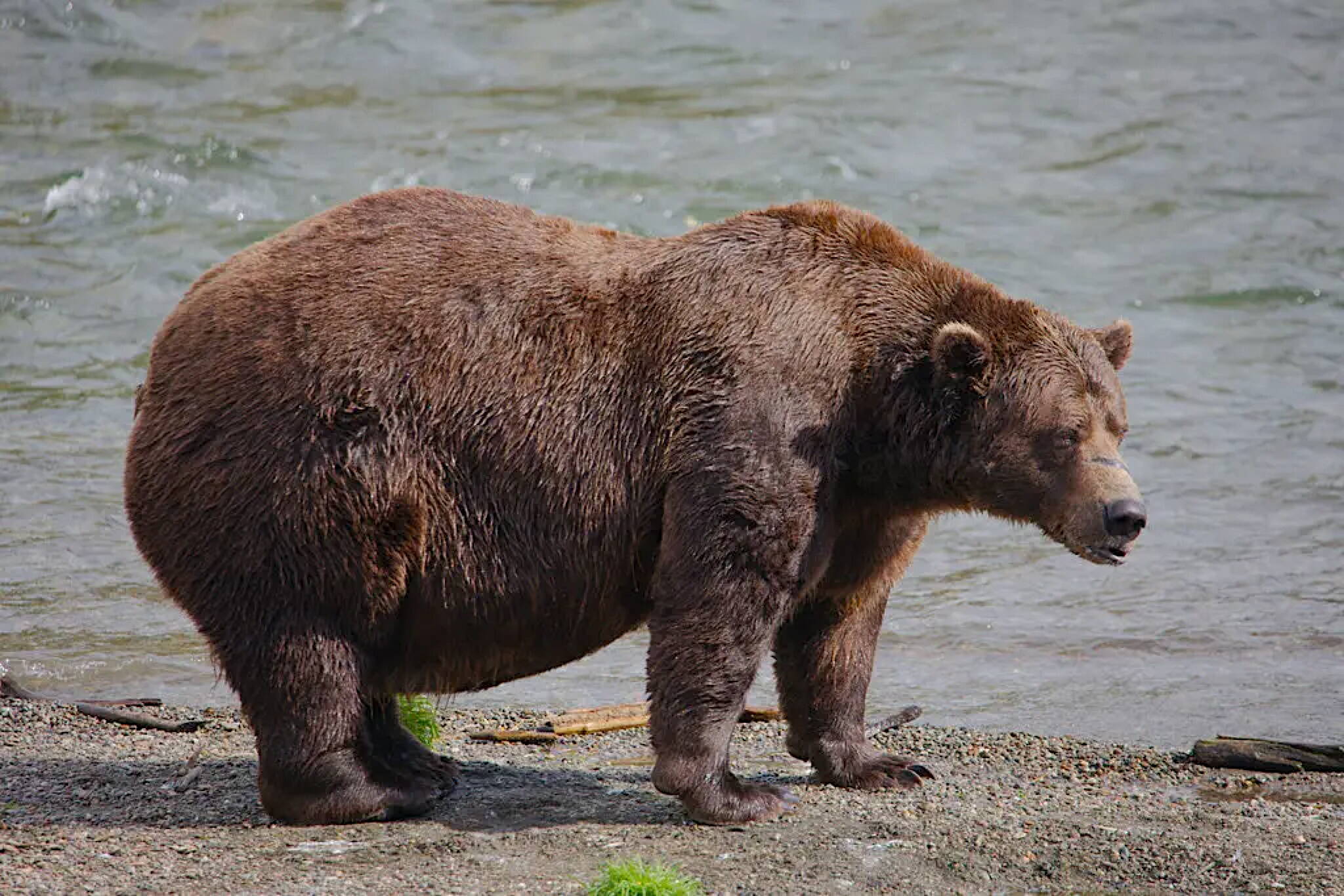
Voters have a lot to weigh: leadership qualities, policy agenda, experience. But over the past decade, one race has been defined by the amount of wild salmon that can be smashed into a mouth.
You might call them single-issue voters, but really they’re just voting for the bulkiest bear on the ballot.
Fat Bear Week, the annual contest that celebrates feeding season at Katmai National Park in Alaska, began as a one-day experiment for park rangers to engage with visitors. It has spiraled into an annual weeklong competition with a March Madness-like bracket and mentality.
It’s all thanks to a live webcam at Brooks Falls, a favorite salmon run in the park, that allows virtual visitors to observe competitors such as Grazer, Chunk, the aptly named 747 and about a dozen others feasting on the local delicacy, growing from runty to hulklike in a matter of months.
“There are very few places in the world where you can go watch wild bears and know them as individuals,” said Mike Fitz, a former park ranger who founded the contest in 2014. The contest, he said, “celebrates the success of brown bears, and it tells their stories — the challenges and the difficulties they face to get fat and survive.”
A week of celebrating hundreds of pounds of fat and muscle offers a respite from the conflict and rhetoric from other corners of the internet, Fitz said. “But beyond that, people just like looking at photos of round animals,” he added.
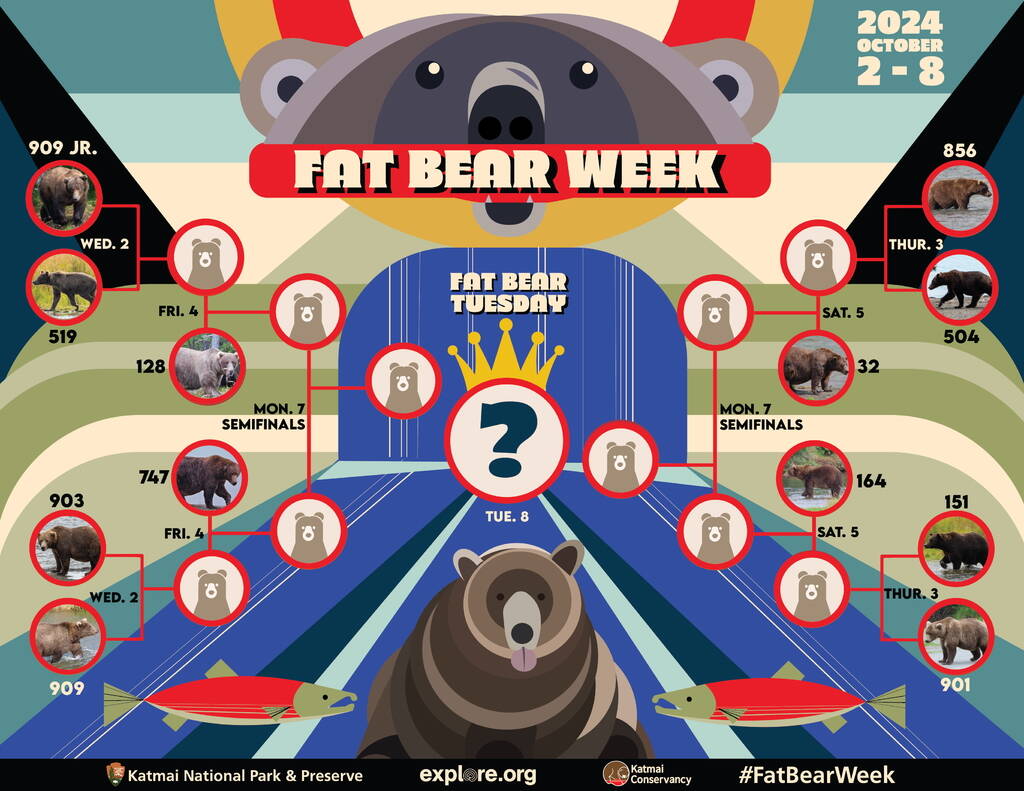
Who will be the fattest bear? (National Park Service)
Katmai’s 4 million acres are home to more than 2,200 brown bears, one of the largest populations of the species in the world. Each contest pits the biggest bears of the park against one another, asking the public to vote online for the best bear, culminating in a championship title on Fat Bear Tuesday. This year, it falls on Oct. 8.
The event has come a long way from 2014, when Fitz posted on Facebook about it and didn’t even fully describe the competition, then a one-day-only contest.
The response was so overwhelming, with millions tuning in now each year, that today there is a full social media plan with multiple people and agencies, including graphic artists, involved.
The contest has also grown into a celebration of the bears’ ecosystem — a fully functioning and intact ecosystem is becoming increasingly rare, Fitz said.
And Fat Bear Week’s success relies on the health of the bears’ environment.
More than 50 million salmon moved into freshwater at Bristol Bay this year, Fitz said.
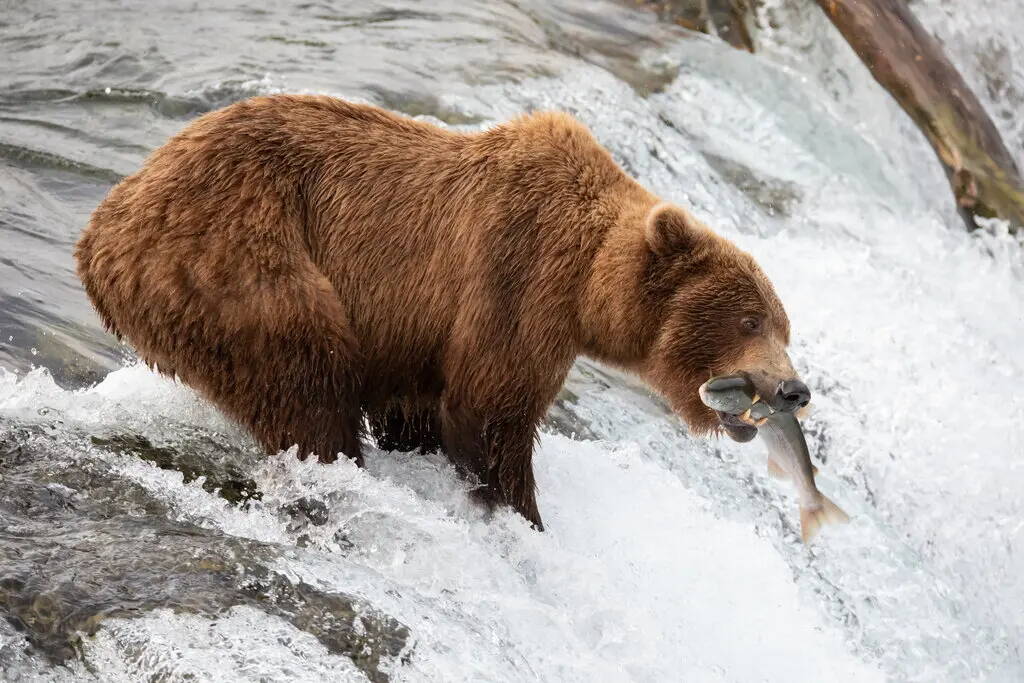
Bear 402 that was killed by another bear this week, which delayed the start of the competition. (F. Jimenez/National Park Service)
“All of this revolves around salmon,” he said. “The salmon are the reason there’s a Fat Bear Week.”
Planning for Fat Bear Week starts in early June, when park staff members begin documenting the bears’ transformation from skinny to fat before their eventual hibernation.
In the weeks leading up to the contest, organizers discuss what stories they want to highlight from over the summer.
One of those stories was a bear attack that delayed the contest this week, when a male bear, 469, killed a female bear, 402.
The attack was captured live on the park’s webcams. Park officials do not know what spurred the attack, but they believe it was predatory in nature, Fitz said. 469 would not have been eligible for voting this year, Fitz said, because he was not seen regularly around Brooks Falls this year. 402, however, was part of consideration in the bracket, he said.
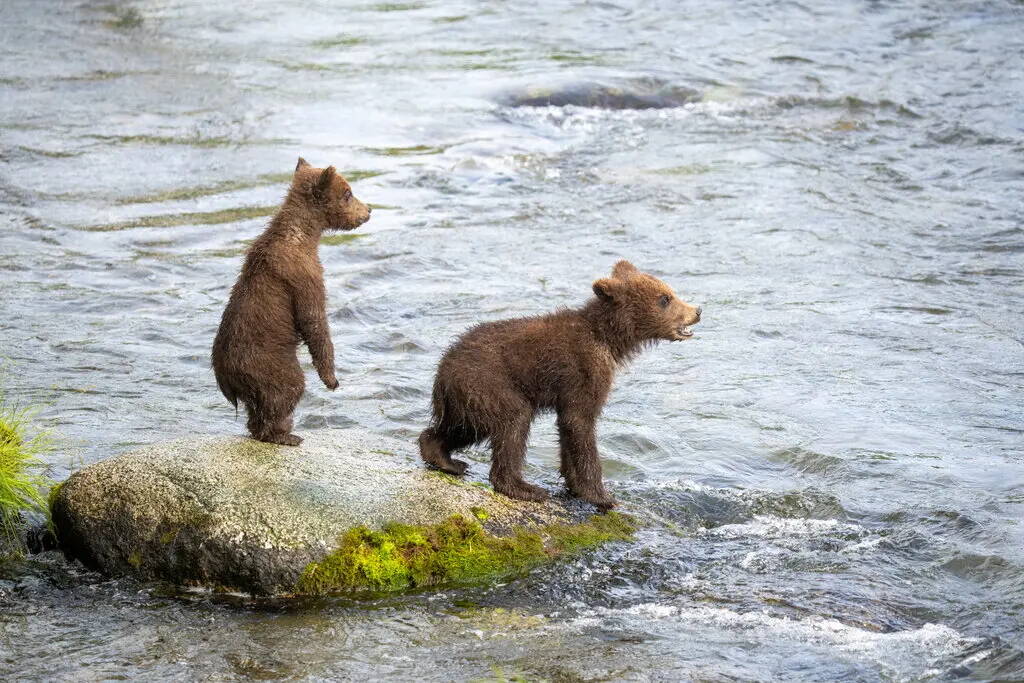
128 Spring Cub (left) competed in Fat Bear Junior, a spinoff that lets cubs vie for a chance to go up against the big guys. (K.Moore/National Park Service)
The bears can be identified by various physical characteristics, including shed patterns, ears and noses. They are not tracked with collars or chips, but an official bear monitor tracks them in the park, especially during peak summer and fall. In order to be contenders in Fat Bear Week, the bears must visit Brooks Falls in both the summer and fall.
That means a repeat champion will not be on the bracket this year for the first time in the history of the competition.
480 Otis, who won the competition four times including in the inaugural year, has not been seen on the salmon run this year. It does not necessarily mean that he did not survive the winter, said Sarah Bruce, a visual information specialist at the park. Otis may have simply wandered to another of Alaska’s many salmon runs.
“His legacy will, of course, live on,” Bruce said.
But with his absence, along with that of a few other old-timers, Fat Bear Week is anyone’s game. A new generation of bear stars between 3 and 8 years old are joining in.
“We’ve been calling them the whippersnappers,” Bruce said. “It’s nice to see a new group coming into the competition.”
• This article originally appeared in The New York Times.
