
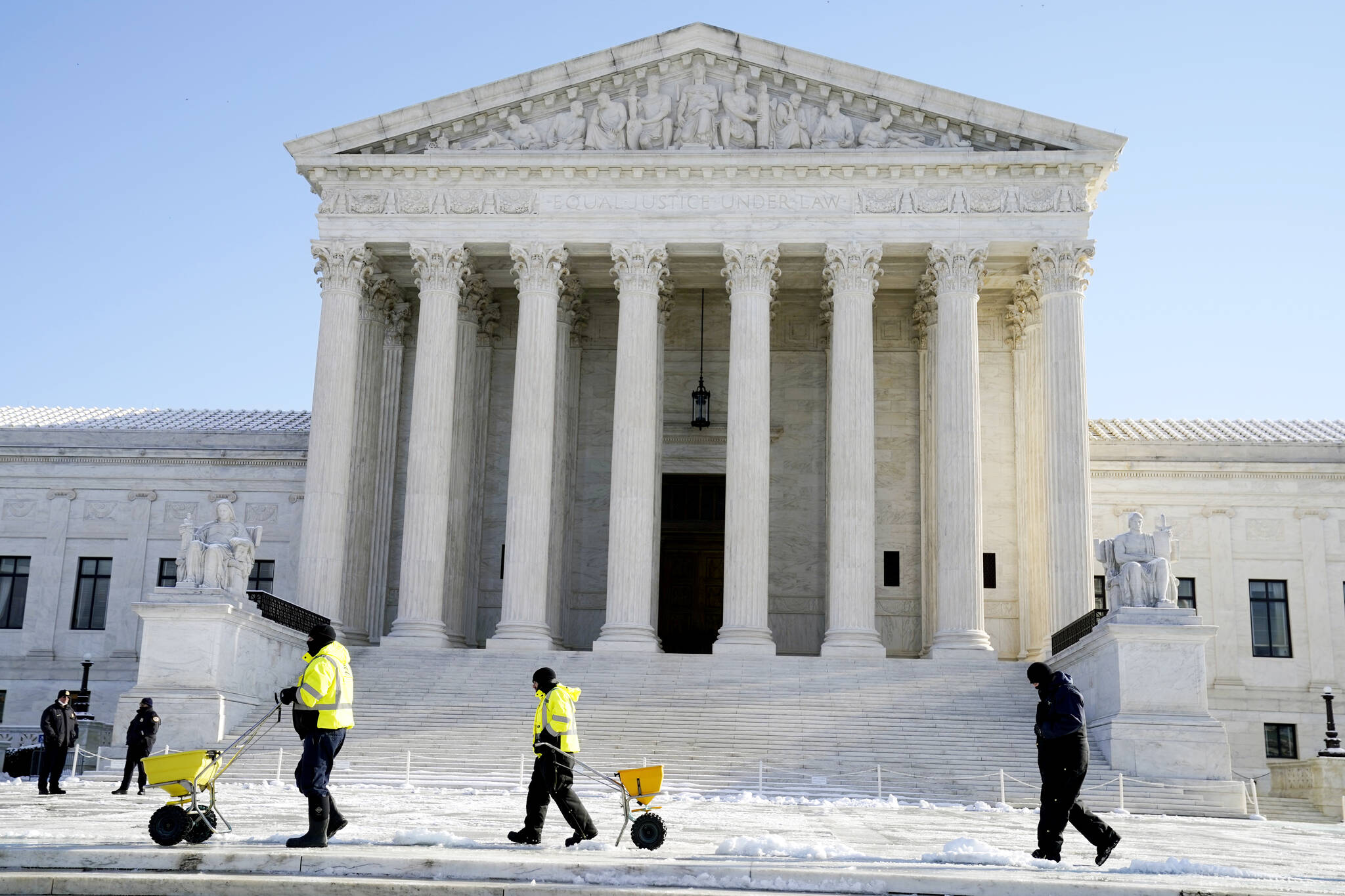
By Mark Sherman and Jessica Gresko
Associated Press
WASHINGTON — Fully vaccinated and mostly masked, the Supreme Court’s conservative majority appeared skeptical Friday of the Biden administration’s authority to impose a vaccine-or-testing requirement on the nation’s large employers. The court seemed more open to a separate vaccine mandate for most health care workers.
The arguments in the two cases come at a time of spiking coronavirus cases because of the omicron variant, and the decision Friday by seven justices to wear masks for the first time while hearing arguments reflected the new phase of the pandemic.
An eighth justice, Sonia Sotomayor, a diabetic since childhood, didn’t even appear in the courtroom, choosing to remain in her office at the court and take part remotely. Two lawyers, representing Ohio and Louisiana, argued by telephone after recent positive COVID-19 tests, state officials said.
But the COVID circumstances did not appear to outweigh the views of the court’s six conservatives that the administration overstepped its authority in its vaccine-or-testing requirement for businesses with at least 100 employees.
“This is something the federal government has never done before,” Chief Justice John Roberts said, casting doubt on the administration’s argument that a half-century-established law, the Occupational Safety and Health Act, confers such broad authority.
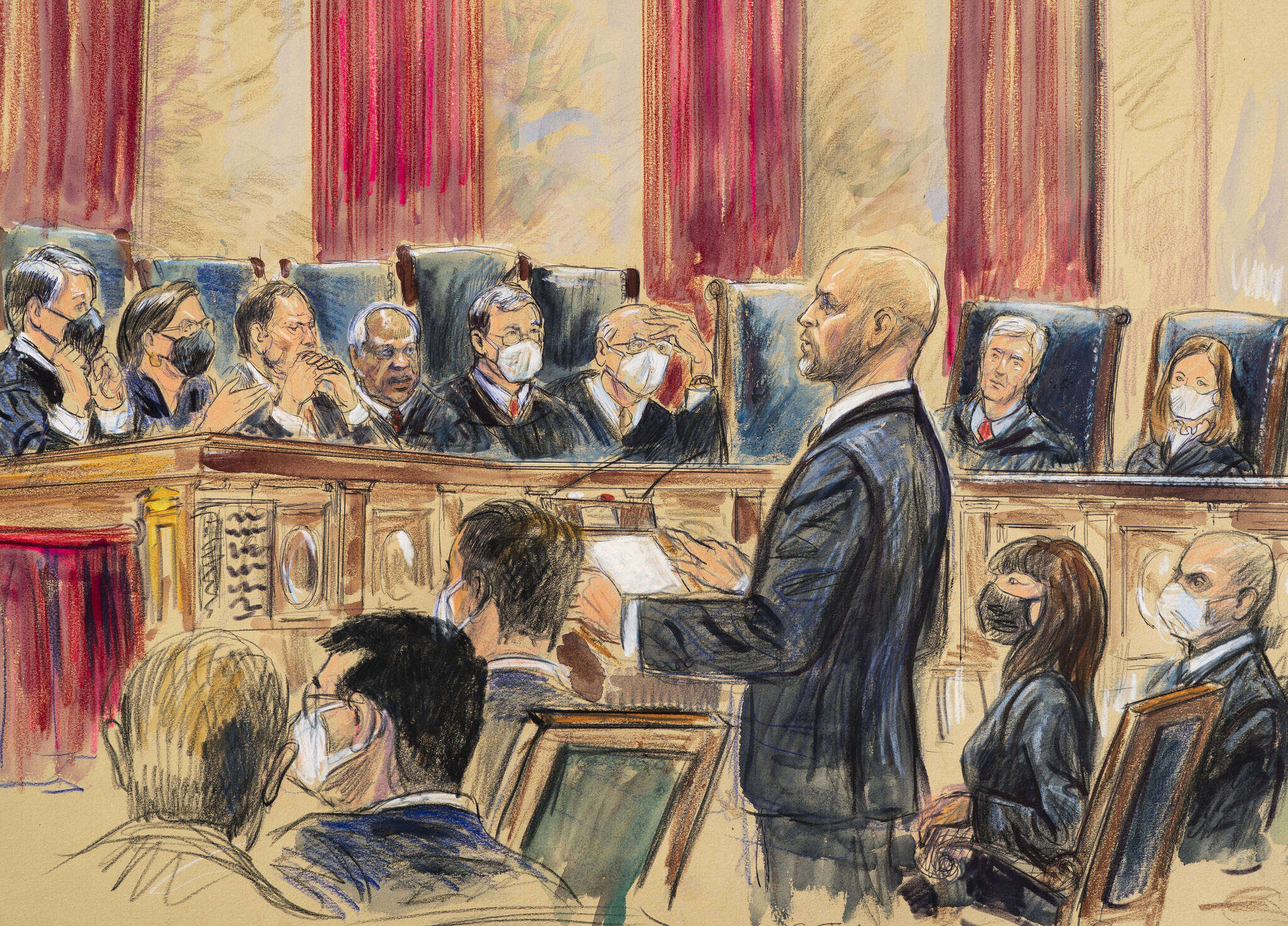
This artist sketch depicts lawyer Scott Keller standing to argue on behalf of more than two dozen business groups seeking an immediate order from the Supreme Court to halt a Biden administration order to impose a vaccine-or-testing requirement on the nation’s large employers during the COVID-19 pandemic, at the Supreme Court in Washington, Friday, Jan. 7, 2022. Solicitor General Elizabeth Prelogar, the Biden administration’s top Supreme Court lawyer, is seated at right. (Dana Verkouteren)
Roberts and Justices Brett Kavanaugh and Amy Coney Barrett probably hold the key to the outcome in both cases, as they have been more receptive to state-level vaccine requirements than the other three conservative justices. Barrett and Kavanaugh also had tough questions for Solicitor General Elizabeth Prelogar, the administration’s top Supreme Court lawyer.
[The stories that shaped our 2021]
The court’s three liberal justices suggested support for the employer rule. Justice Elena Kagan said officials have shown “quite clearly that no other policy will prevent sickness and death to anywhere like the degree that this one will.” And Justice Stephen Breyer said he found it “unbelievable” that it could be in the “public interest” to put that rule on hold. He said that on Thursday there were some 750,000 new cases in the country and that hospitals are full.
Beginning Monday, unvaccinated employees in big companies are supposed to wear masks at work, unless the court blocks enforcement. But testing requirements and potential fines for employers don’t kick in until February.
Legal challenges to the policies from Republican-led states and business groups are in their early stages, but the outcome at the high court probably will determine the fate of vaccine requirements affecting more than 80 million people.
Roberts, Kavanaugh and Barrett seemed to have fewer doubts about the health care vaccine mandate. Kavanaugh said it was a “very unusual situation” that hospitals and health care organizations affected by the regulation were “not here complaining” about the rule but instead support it. “What are we to make of that?” he asked.
The second regulation is a mandate that would apply to virtually all health care staff in the country. It covers health care providers that receive federal Medicare or Medicaid funding, potentially affecting 76,000 health care facilities as well as home health care providers. The rule has medical and religious exemptions.
Decisions by federal appeals courts in New Orleans and St. Louis have blocked the mandate in about half the states. The administration has said it is taking steps to enforce it in the rest.
“I think effectively what is at stake is whether these mandates are going to go into effect at all,” said Sean Marotta, a Washington lawyer whose clients include the American Hospital Association. The trade group is not involved in the Supreme Court cases.
Both vaccine rules would exacerbate labor shortages and be costly to businesses, lawyer Scott Keller argued Friday on behalf of more than two dozen business groups. Without an immediate order from the court, “workers will quit right away,” Keller said.
Administration lawyer Prelogar told the justices that COVID-19 “is the deadliest pandemic in American history and it poses a unique workplace danger.” OSHA has estimated that its emergency regulation will save 6,500 lives and prevent 250,000 hospitalizations over six months.
Nearly 207 million Americans, 62.3% of the population, are fully vaccinated, and more than a third of those have received booster shots, including the nine justices.
Andy Slavitt, a former adviser to the Biden administration on COVID-19, said the vaccine requirements are extremely effective for 15% to 20% of Americans “who don’t like to get a shot but they will and don’t have any strenuous objection.”
The high court is weighing in on administration vaccine policies for the first time, although the justices have turned away pleas to block state-level mandates.
A conservative majority concerned about federal overreach did bring an end to a federal moratorium on evictions put in place because of the pandemic.
Both the vaccination cases came to the court on an emergency basis, and the court took the unusual step of scheduling arguments rather than just ruling on briefs submitted by the parties. Unlike in other cases the court hears, a decision from the justices could come in weeks if not days.
Because of the pandemic the justices heard the cases in a courtroom closed to the public. Only the justices, lawyers involved in the cases, court staff and journalists were allowed inside. The public could listen live, however, a change made earlier in the pandemic when the justices heard cases via telephone for nearly 19 months.
The court has been asking arguing lawyers to have negative coronavirus test results and participate remotely if they have positive tests. Ohio Solicitor General Benjamin Flowers, who was arguing against the employer rule, had tested positive for COVID-19 after Christmas, had mild symptoms and fully recovered, but a test Sunday required by the court detected the virus, a spokeswoman said. He had been vaccinated and had a booster shot.
Louisiana Solicitor General Elizabeth Murrill, who was arguing against the health care workers rule, was also arguing remotely “based upon the court’s protocol,” state Attorney General Jeff Landry said. Landry was at the court for Friday’s arguments.
It was the first time since the court returned to in-person arguments in October that lawyers were arguing remotely.
Justice Neil Gorsuch was the only justice to remain unmasked throughout the arguments, which lasted more than 3 and 1/2 hours. He sits between Barrett and Sotomayor. The court did not explain why Sotomayor didn’t take the bench.
