
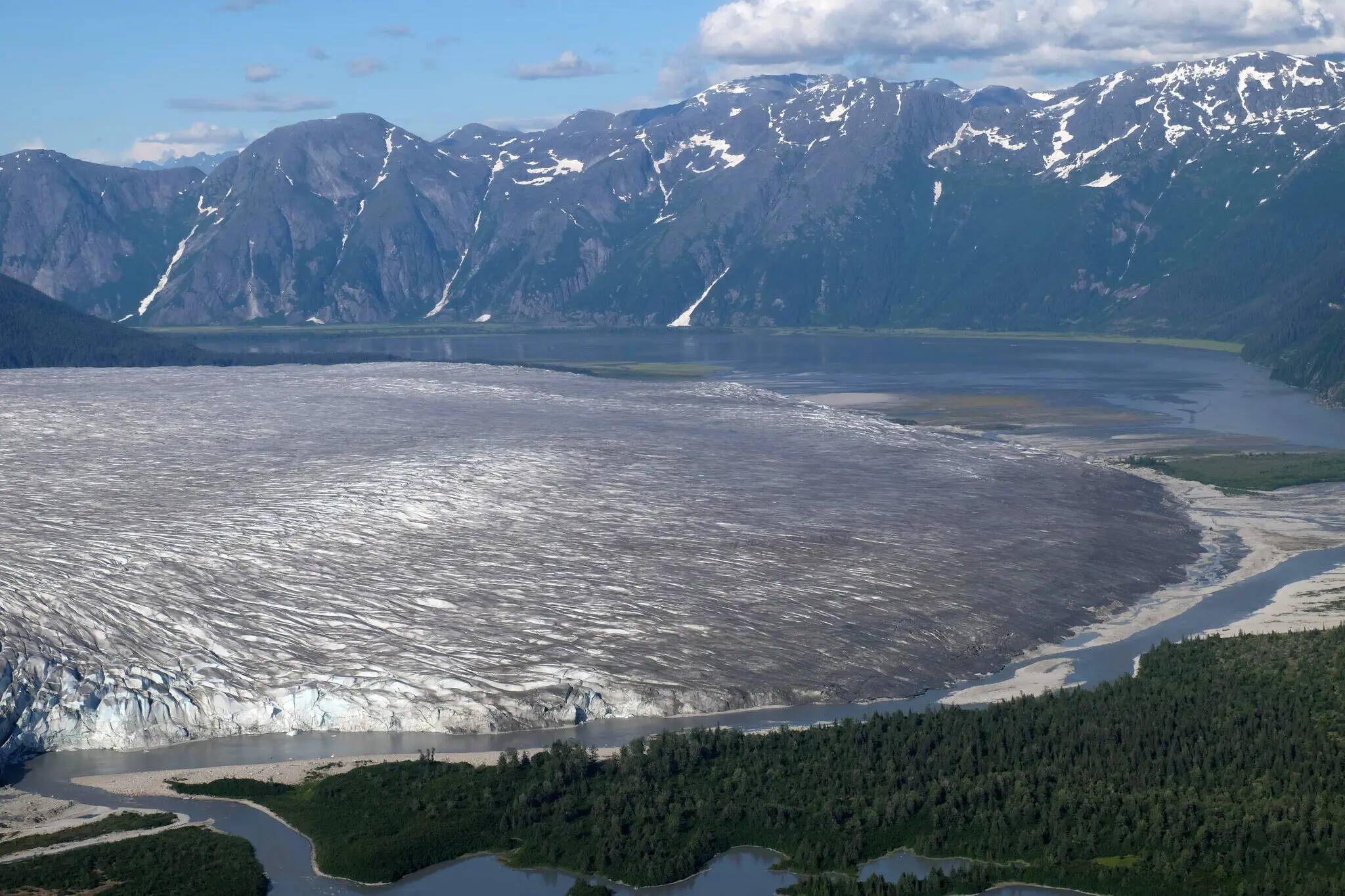
One of North America’s largest areas of interconnected glaciers is melting twice as quickly as it did before 2010, a team of scientists said Tuesday, in what they called an “incredibly worrying” sign that land ice in many places could disappear even sooner than previously thought.
The Juneau Icefield, which sprawls across the Coast Mountains of Alaska and British Columbia, lost 1.4 cubic miles of ice a year between 2010 and 2020, the researchers estimated. That’s a sharp acceleration from the decades before, and even sharper when compared with the mid-20th century or earlier, the scientists said. All told, the icefield has shed a quarter of its volume since the late 18th century, which was part of a period of glacial expansion known as the Little Ice Age.
The potentially destructive effects of such melting were seen in Juneau last August when a record release of more than more than 13 billion gallons of water from Suicide Basin above the face of the Mendenhall Glacier damaged or destroyed dozens of homes. Area researchers say multiple factors are involved in the annual jökulhlaups (glacial outburst flood) from the basin since 2011, but climate change means more such sizable releases are likely — and will involve other new basins as the glacier face retreats beyond Suicide Basin in future decades.
As societies add more and more planet-warming carbon dioxide to the atmosphere, glaciers in many areas could cross tipping points beyond which their melting speeds up rapidly, said Bethan Davies, a glaciologist at Newcastle University in England who led the new research.
“If we reduce carbon, then we have more hope of retaining these wonderful ice masses,” Dr. Davies said. “The more carbon we put in, the more we risk irreversible, complete removal of them.”
The scientists’ findings were published on Tuesday in the journal Nature Communications.
The fate of Alaska’s ice matters tremendously for the world. In no other region of the planet are melting glaciers predicted to contribute more to global sea-level rise this century.
The Juneau Icefield covers 1,500 square miles of rugged landscape north of Juneau, the state capital. The region has become warmer and rainier over the past half-century, which means a longer melt season for glaciers and less snow to replenish them.
The average annual temperature at Juneau International Airport has generally increased in the years since those measured in the study, said Nathan Compton, a meteorologist for the National Weather Service Juneau. The average temperature was 42.4 degrees in 2020, 41.7 degrees in 2021, 43 degrees in 2022 and 44 degrees in 2023. However, he said that is too short a time period to be considered a long-term climate trend.
The Juneau Icefield includes 1,050 glaciers. Or at least it did in 2019.
To reconstruct how the ice evolved in the preceding two and a half centuries, Dr. Davies and her colleagues combined decades of glacier measurements with information from satellite images, aerial photographs, maps and surveys. They looked at studies of tree rings and peat to understand the past environment. They also went out on the ice themselves to double-check what they saw from the satellites.
The changes they’ve uncovered are sweeping.
Every one of the icefield’s glaciers receded between 1770 and 2019, the scientists found. More than 100 glaciers disappeared entirely. Nearly 50 new lakes formed as glaciers melted and the water pooled.
The scientists also found that the rate at which the icefield lost volume slowed somewhat in the middle of the 20th century. It picked up after 1979, then accelerated further after 2005.
This quickening, the scientists said, might have to do with the way the whiteness of the ice — its albedo, as glaciologists call it — affects melting and vice versa. As snowfall decreases, more rocks and boulders in the ice are exposed. These dark-colored surfaces absorb more solar radiation, causing the ice around them to thin even faster. Tourism and wildfires are also depositing soot and dust on the glacier surface, which further accelerates melting.
Another factor, Dr. Davies and her colleagues said, is that as the icefield thins, more of its area lies at a lower elevation. This exposes more of its broad, flat surface to warmer air, making it thin even faster.
Scientists have been aware that glacial melt is affected by these kinds of self-enforcing feedback, said Martin Truffer, a physicist at the University of Alaska Fairbanks who wasn’t involved in the new research. By and large, though, models of glacier change still don’t include enough of these physical complexities, Dr. Davies said. “If you want to know how this icefield’s going to behave, you want to know that the physics is realistic,” she said.
Still, she added, the science is advancing quickly. Last year, researchers issued projections of how every glacier on Earth will evolve depending on what humankind does, or fails to do, about global warming.
The scientific accomplishment was significant, even if the conclusion wasn’t heartening. According to the projections, even if nations meet the Paris Agreement’s goal of limiting warming to 1.5 degrees Celsius above preindustrial conditions, roughly half of the world’s glaciers, 104,000 of them or so, could be gone by 2100.
• Juneau Empire staff contributed to this story.
