
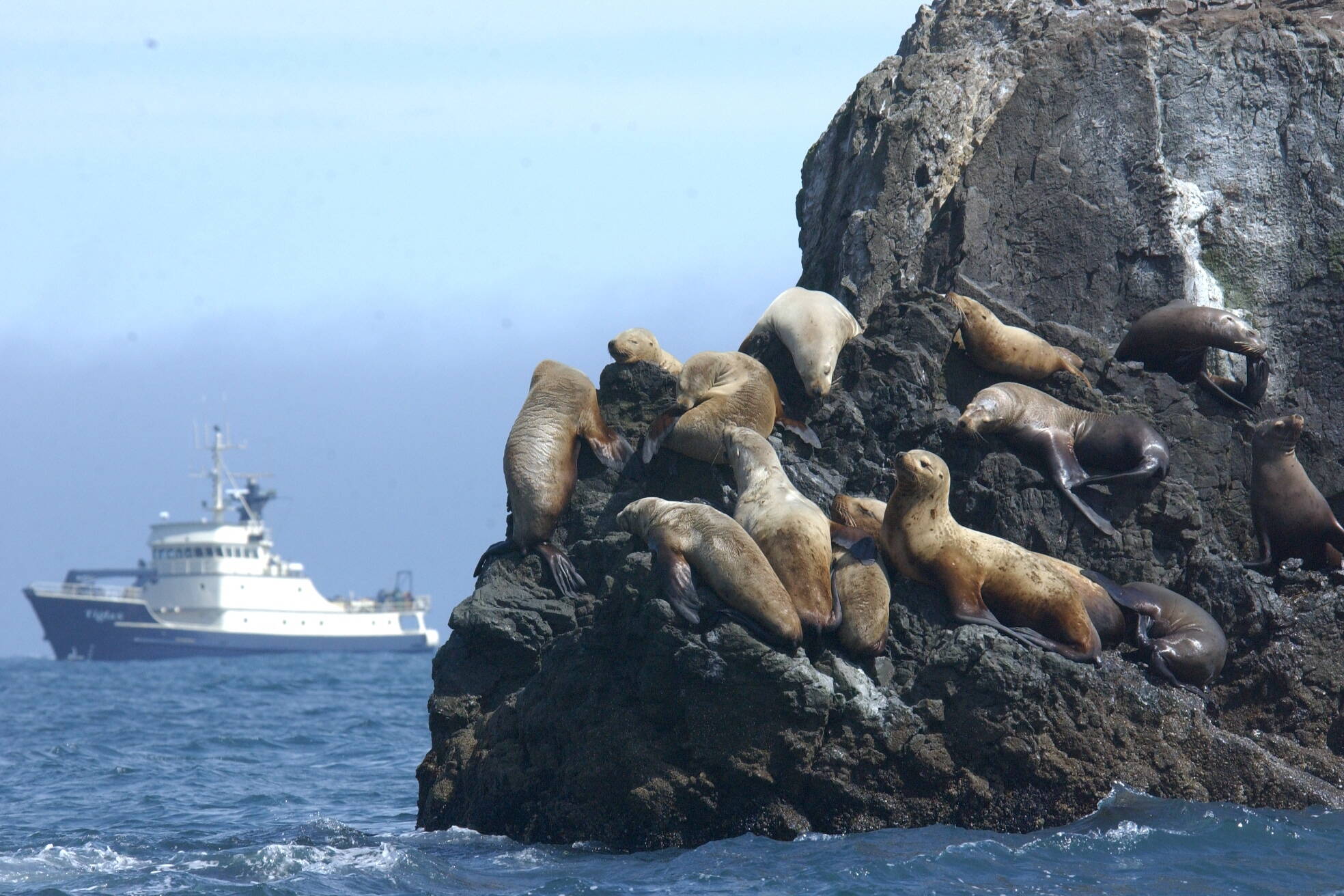
Encounters with humans from 2017 to 2021 killed hundreds of Steller sea lions and other marine mammals that swim in Alaska waters, along with dozens of Alaska whales, according to a new federal report.
Of 819 human-mammal interactions reported in the period, 710 were found to have caused death, serious injury or some other result that removed the animals from the population, said the report, released by the National Oceanic and Atmospheric Administration’s Fisheries service. The other 109 interactions were found to have resulted in injuries that were not serious, the report said.
The totals represented a slight decrease from those in the previous report, which covered the five years from 2016 to 2020. During that five-year period, 867 NOAA-managed Alaska marine mammals were documented as killed or seriously injured from encounters with people.
The report, required under the U.S. Marine Mammal Protection Act, does not include any tallies from subsistence hunts. It is also limited to the marine mammals in Alaska that NOAA manages and does not include those that the U.S. Fish and Wildlife Service manages – walruses, sea otters and polar bears.
The most common cause of deaths and injuries was entanglement or entrapment in fishing gear, marine debris or other marine gear such as anchor lines. Hooking in fishing gear was the second-leading cause of marine mammal injury or death.
Steller sea lions were the animals most frequently reported to have been affected, with 476 interactions resulting in 429 deaths or serious injuries, the report said. More than half of those cases involved animals in the western Steller sea lion population, which is classified as endangered. The western population segment ranges from Cape Suckling, just east of Prince William Sound, to the end of the Aleutian Islands.
While the vast majority of Steller sea lion cases involved gear entanglements or entrapments, 38 of the animals were found dead after being shot during the five-year period, according to the report. Sea lions are sometimes viewed as competing with people for fish, and there have been several cases in recent years of people illegally killing the protected mammals. This year, over 20 endangered Steller sea lions were found dead in the Copper River Delta area, many with gunshot wounds.
Northern fur seals were second on the list of affected marine mammals, followed by humpback whales. Marine debris was a particular risk to northern fur seals, while vessel strikes caused many of the humpback whale deaths and injuries, according to the report.
Cases ranged geographically from the Arctic Ocean, where animals like ringed seals were reported to be entangled in gear, to the waters off the U.S. West Coast, where Alaska-dwelling marine mammals sometimes are found in winter seasons.
The report does not include the recent spate of killer whale deaths from entanglements or entrapments in gear used by trawl vessels harvesting fish in the Bering Sea and Aleutian Islands area. Ten of the whales had been found ensnared in such gear this year as of September, and nine died. That is more than the total documented for the five years from 2017 to 2021, when seven killer whales were killed in fishing gear in the Bering Sea and two more Alaska killer whales were found injured in West Coast waters.
The large number of killer whale deaths this year has prompted a NOAA Fisheries investigation and plans for a lawsuit by an environmental group.
• Yereth Rosen came to Alaska in 1987 to work for the Anchorage Times. She has reported for Reuters, for the Alaska Dispatch News, for Arctic Today and for other organizations. She covers environmental issues, energy, climate change, natural resources, economic and business news, health, science and Arctic concerns. This story originally appeared at alaskabeacon.com. Alaska Beacon, an affiliate of States Newsroom, is an independent, nonpartisan news organization focused on connecting Alaskans to their state government.
