
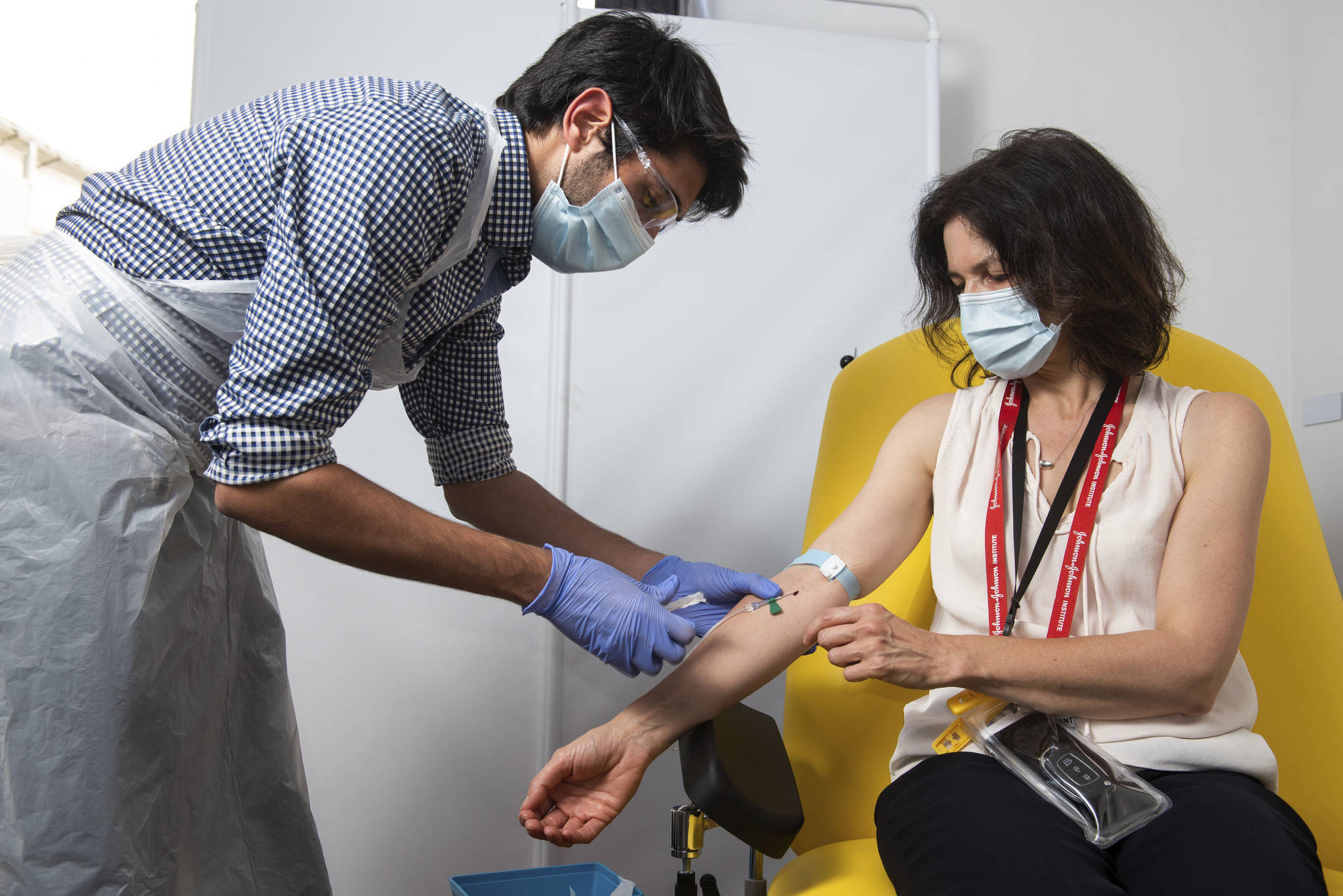
A COVID-19 vaccine is expected to arrive in Alaska early next month and could begin distribution to prioritized populations as soon as Dec. 22, said Alaska’s chief medical officer Dr. Anne Zink in a Monday news conference. Though the environment around vaccine distribution was “highly variable and rapidly changing,” Zink said that was the most recent date given by Operation Warp Speed, the federal governments’ COVID-19 vaccine program.
Speaking to reporters alongside other members of the Alaska COVID-19 Vaccine Task Force, Zink said state, local and tribal authorities worked together to draft a prioritization list and schedule for vaccine distribution for months, but the exact details of those plans depend on a lot of different information, some of which is not yet available.
Pfizer, one of the world’s largest pharmaceutical companies, submitted a request for an Emergency Use Authorization on Friday, said Tess Walker Linderman from the Alaska Department of Health and Social Services, which was the beginning of the current vaccine timeline. The Federal Drug Administration scheduled a meeting for Dec. 10, to approve the EUA, she said, and once that happens vaccines would then be quickly sent to states.
States will then need to decide which populations get the vaccine first, with vulnerable populations and health care workers likely being among the first. How the state makes that decision will depend on several different things. There are a handful of different vaccines being produced, said state epidemiologist Dr. Joe McLaughlin, and those vaccines affect populations differently. One of the issues for the state is that without that information it’s difficult to know how best to use a certain vaccine.
“As the science continues to progress we might see differential effects,” McLaughlin said. “That’s all information that is forthcoming, but that will also weigh into our decision-making process.”
The federal Centers for Disease Control and Prevention has a vaccine advisory committee that will issue recommendations on how best to use Pfizer’s vaccine following the anticipated approval of the EUA in December, at which point the state would issue its own refined recommendations. Zink described the layers of recommendations like nesting-dolls, where the state’s recommendations would be based on federal ones, and local guidelines based on the state’s recommendations.
Zink said local authorities will have a fair amount a control over their own distribution plans as local health agencies will need flexibility in how they distribute the vaccine.
[Over 1,000 vaccinated against flu over weekend]
The general population isn’t likely to start receiving vaccines until spring of next year, McLaughlin said, and the first vaccines will likely go to front line health care workers and vulnerable populations. Vaccines currently in development have only been tested on adults, he said, and a vaccine for children and pregnant women would likely come later.
In October, the City and Borough of Juneau held two flu vaccine clinics over a weekend and was able to inoculate more than 1,300 residents in an effort meant to double as a practice run for a potential COVID-19 vaccine. That effort was a collaboration between city and state health authorities with significant support from Juneau’s private health sector, Sarah Hargrave, southeast regional nurse manager for Alaska Division of Public Health told the Empire in October. It was considered a success.
In an email, CBJ Emergency Operations Center Planning Section Chief Robert Barr said the city would follow the state’s forthcoming prioritization guidelines.
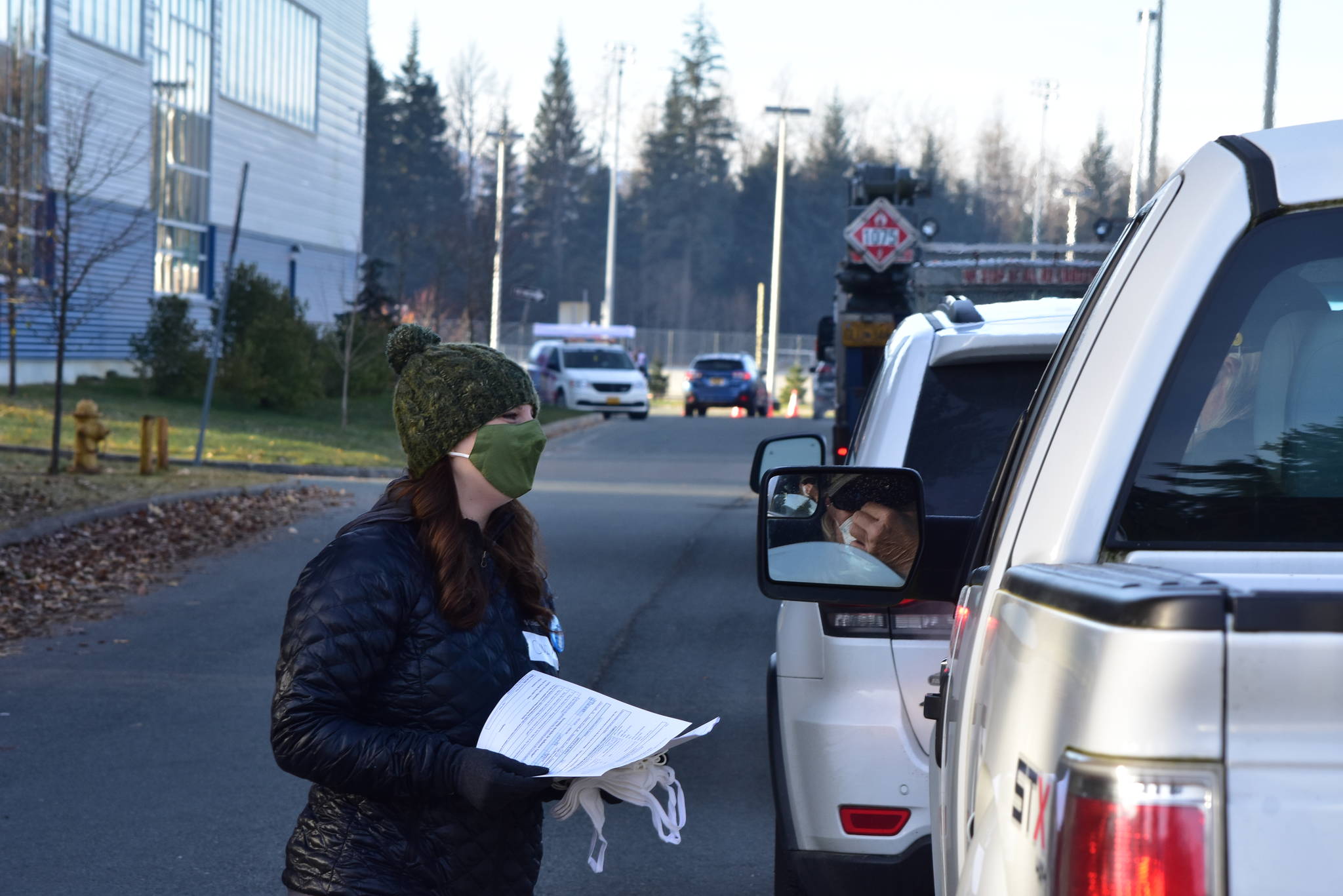
Cindy Carte, a volunteer worker from Bartlett Regional Hospital, hands out paperwork to Juneau residents waiting in line for a drive-thru flu shot clinic at Thunder Mountain High School on Saturday, Oct. 24, 2020. State and city health officials said the October vaccine clinic doubled as a practice run for an eventual coronavirus vaccine distribution. (Peter Segall / Juneau Empire)
The state of Alaska already had vaccine purchase and distribution programs in place with roughly 360 medical providers enrolled, the Division of Public Health said in September.
Throughout the Monday meeting, health officials repeatedly emphasized there are many factors at play affecting when and where a vaccine will be accessible.
So far, only Pfizer has submitted its application for an EUA, Walker Linderman said, but Moderna is also developing a vaccine that may be considered at the FDA’s Dec. 10, meeting if that company submits its application in time.
There were logistical factors, such as the temperature at which a vaccine must be stored, that complicate predicting a timeline, McLaughlin said. Pfizer’s vaccine needs to be stored at extremely cold temperatures and there are currently not many freezers in the state that can meet that demand, he said.
State health officials have been working closely with tribal health authorities such as the Alaska Native Tribal Health Consortium and Alaska Native Health Board to ensure vaccines are equally distributed across the state, and vulnerable communities are prioritized, according to Dr. Bob Onders, with ANTHC
“Alaska Native people are already showing disproportional effects,” Onders said. “This is not dissimilar from past epidemics, Alaska Native people know this from past pandemics and there may be undue burden on rural Alaska.”
Alaska Native and Pacific Islanders have been disproportionately affected by COVID-19 in Alaska, Zink said, and conversations about racial disparities in health care and have been front and center in distribution conversations at both the state and federal level.
“This is a highly talked about conversation,” Zink said. “We want to make sure there is equal access to the vaccine. It’s really important to us that we are thinking widely and broadly about vaccine distribution.”
Onders and Verné Boerner at ANHB both said DHSS had been a close and collaborative partner throughout the pandemic and Boerner said the state had treated tribal health authorities as the sovereign entities they are.
DHSS would soon be starting an information campaign to raise awareness about the vaccine and try to reassure those who may be hesitant about receiving one.
Even though a vaccine is on its way, the amount of COVID-19 in a community affected how quickly health officials would be able to respond once the medicine was available, Zink said. Health care precautions such as social distancing and masking were still important to decrease the spread of the virus in the community, she said.
“There are different reasons why people might be vaccine-hesitant,” Zink said. “We do have a communications team to see how can we change vaccine hesitancy to vaccine confidence.”
DHSS set up a webpage, covidvax.alaska.gov, with additional information on the status of vaccine distribution and informational materials available for use by the public, including private businesses.
• Contact reporter Peter Segall at psegall@juneauempire.com. Follow him on Twitter at @SegallJnuEmpire.
