
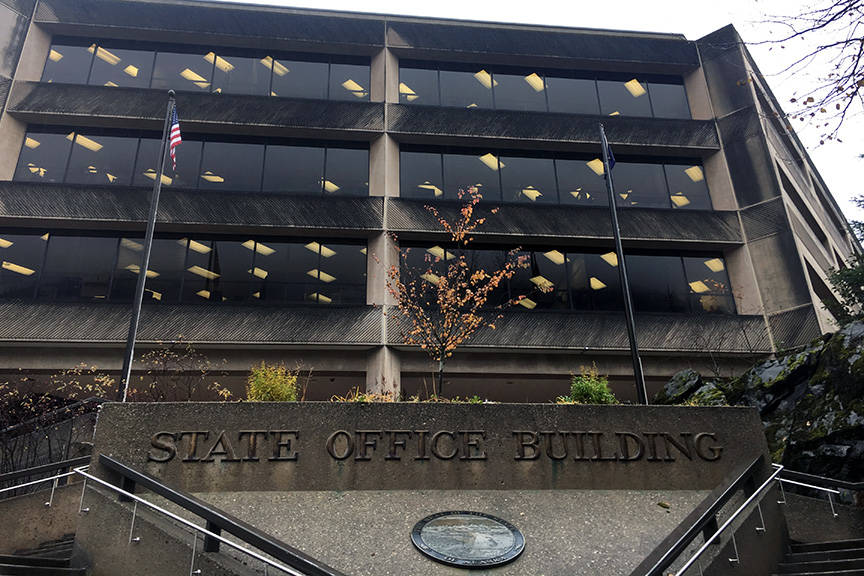
Southeast Alaska lost roughly 300 jobs last year, most of them in state government, according to data released Monday by the Department of Labor and Workforce Development (DOLWD).
The region lost about 200 jobs in state government, and the seafood industry, timber and construction all saw a net loss of jobs in Southeast in the past year, the data show.
But while those jobs were lost, there were other areas of growth, said state economist Karinne Wiebold.
“I can say that not all industries in Southeast are losing jobs,” Wiebold said in an interview with the Empire Tuesday. “There was a net negative, but there’s a lot going on in between.”
The tourism industry gained the most, adding 265 jobs in 2018, according to Southeast Conference’s annual Southeast by the Numbers report, with wages gains of 8 percent. Cruise ship passenger arrivals have been steadily increasing since 2010 with a projected 1.4 million arrivals in 2020.
The health care industry also saw growth with a 3 percent gain in jobs. Health care jobs have also seen a 24 percent increase in wages over the past three years.
Despite the loss of jobs in state government, the Juneau area still has some of the lowest unemployment in the state at 4 percent. The entire Southeast region has an average unemployment at 4.8 percent.
Those 200 lost state jobs are for the Southeast region, not just for Juneau. In Alaska’s capital city, the loss of government jobs has been an eight-year trend that seems to be coming to an end, according to Brian Holst, executive director of the Juneau Economic Development Council.
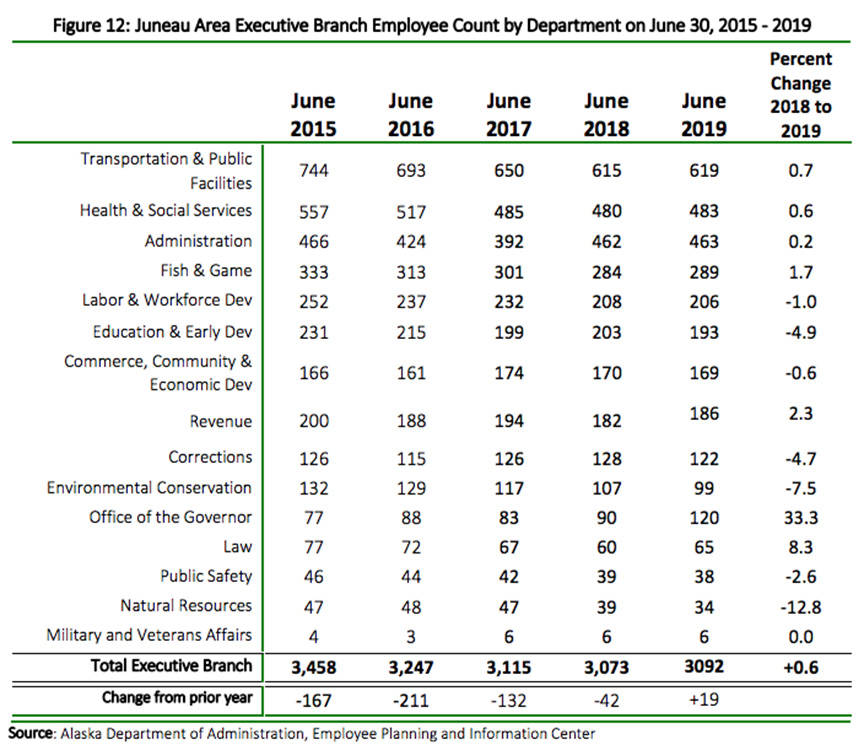
Table showing Juneau area executive branch employment by department from 2015 to 2019. From the Juneau Economic Development Council’s Economic Indicators and Outlook report for 2019. (Image courtesy JEDC)
“That’s not a huge change,” Holst said in a phone interview with the Empire Tuesday. “What we’re seeing in the latest data is that the losses have essentially stopped.”
Holst said that data reviewed by JEDC shows basically no change in administrative branch jobs in Juneau from June 2018 to June 2019.
“Our read of the data is that the loss of state government jobs appears to have leveled off,” Holst said.
Holst said that it was difficult to pin down where the numbers in the state report come from, and that a no job loss or growth in state government wasn’t necessarily a positive or a negative. Staff at DOLWD said they were not able to provide which departments those job losses came from Tuesday due to a staffing issue, but would give that information at a later date.
Southeast had lost jobs in government, but gains had been made in mining and tourism, Holst said.
“Growth for Juneau is relatively flat,” he said. “The private sector has been strengthening, and the two basically cancel each other out. We’re not seeing much of a pronounced change.”
Cost of Living
While growth in Southeast might be flat, the cost of living isn’t. According to state data released in July, prices in Alaska rose 3 percent in 2018. Based on preliminary data from the first half of the year, 2019 looks like it’s a repeat of last year’s increases.
What drives that increase in cost varies from year to year, according to Neal Fried, the state economist for DOLWD who compiled the report. The biggest drivers for increases in 2018 were medical and energy costs.
“While medical has been consistently the highest over time, energy is the most volatile,” Fried said. Energy prices, generally tied to some kind of fuel, are the most volatile because the value of those commodities are always in flux, Fried said.
The biggest cost for consumers, Fried said, was housing. While Juneau doesn’t have the highest rent in the state — Kodiak does — median rent in the city is $1,167. Juneau does, however, have the highest price for a two-bedroom single family home at $385,000. The statewide median is $318,000.
Alaska is also fourth in the nation in terms of monthly health insurance costs, with an average of $696 compared to the national average of $427.
One trend Fried found interesting was that Alaska’s cost of living was becoming more in line with other parts of the country. Not because Alaska’s cost of living is getting cheaper, but because the rest of the nation is getting more expensive.
“Alaska was typically a big outlier,” Fried said. “For a long time, there were only a few places that were higher (in terms of cost of living) than Anchorage.”
But as far back as 2015, Seattle exceeded Anchorage in terms of cost of living. Based on data from 2019, Juneau ranked 17th in terms of cost of living compared to other U.S. cities while Alaska is the seventh most expensive state to live.
The average cost of groceries in Juneau in December 2018 was $215 a week, eighth most expensive in the state, while the national average was $149.
Alaska’s costs for construction remain significantly higher than the rest of the country, second only to Hawaii. From a base average of 1.00, Alaska’s construction costs in 2018 were 2.13, the next highest state was California with 1.22.
Rising costs in the rest of the nation could be beneficial for Alaska, Fried said, in that investors might not considered its cost to be too burdensome for investment.
“It’s not quite the barrier that it might have been maybe 10 years ago,” he said. “But I think in some cases we look better, especially to investors that are coming from elsewhere. There’s less of a psychological barrier.”
The good news for Juneau is that per capita income in the city is higher than elsewhere in the state and the nation. According to JEDC’s data analyzed from the Bureau of Economic Analysis, Juneau’s income just over $66,000 as of 2017, the latest data available. Per capita income statewide was more than $57,000 while in the nation it was more than $51,000.
• Contact reporter Peter Segall at 523-2228 or psegall@juneauempire.com.
