
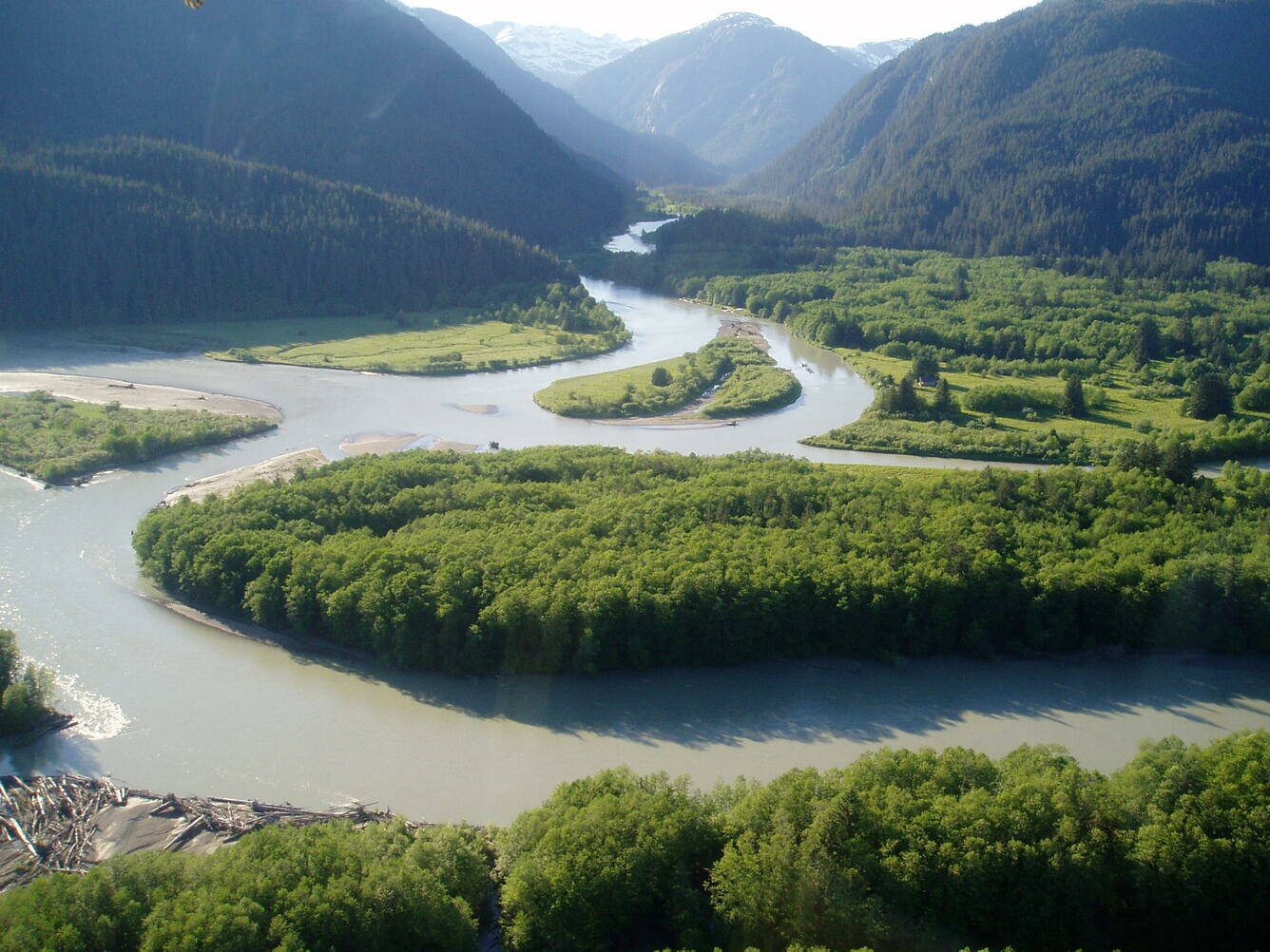
A group of Southeast Alaska tribes is asking Canada to recognize their right to have a voice in how transboundary lands and waters are treated. They’re asking to be recognized as Participating Indigenous Nations in Canada’s review process for resource development. Under Section 35 of Canada’s Constitution, the government is required to consult with Indigenous peoples on projects impacting their ancestral lands.
At issue is an open pit gold mine in the headwaters of the Unuk River, which empties into the Pacific Ocean. Eskay Creek is one of several proposed and operating mines located on or near major rivers that cross the Canadian-U.S. border in Southeast Alaska. Canadian recognition would give the Alaska tribes rights to be consulted on the Eskay Creek and other mining projects.
The seven tribes are members of the Southeast Alaska Indigenous Transboundary Commission (SEITC). Its Executive Director Guy Archibald said the Canadian Supreme Court in R. v. Desautel in 2021 considered whether Aboriginal people located outside Canada can assert Aboriginal rights under the Canadian Constitution. “The court found that those rights extend to people that are no longer residents in Canada who have traditional ties to territory that’s within Canada,” Archibald said.
“So Canada has to respect the territories as they were at the time of European contact. And at the time of European contact (in 1741), the entire Unuk watershed was a recognized territory of the Tèiḵwèidi clan. And seven of our tribes are the successors of the Tèiḵwèidi. There’s a direct line between the clan and the federally recognized tribes,” he said.
“If SEITC succeeds, it would be the first time in history that a US-based tribe is granted Participating Indigenous Nation status in Canada,” said Earthjustice’s Public Affairs and Communications Strategist Timna Axel in an email.
Also in the tribes’ favor, she said the United Nations Inter-American Commission on Human Rights “recently recognized that Canada’s persistent refusal to consult with Alaska Native tribes on large-scale mining development along the transboundary watersheds could violate international human rights.”
Louie Wagner Jr., who is Tsimshian and Tlingit, told the commission on Sept. 26, 2018 his family has been the hereditary steward of the river for thousands of years.
“As caretakers, our family’s crest can be seen marked on painted pictoglyphs at the mouth of the Unuk River, as well as at points upstream. The crest has been tested and is thousands of years old. It depicts a sun with rays; the bottom edge was rubbed off by ice, with the grooves still evident,” Wagner said.
The tribes are being represented in the effort by Earthjustice, a nonprofit environmental law organization.
Earthjustice said in a statement that gold mining in Northwest Canada is “recklessly under regulated,” and “threatens to disrupt these vulnerable watersheds and leach copper, selenium and other toxins downstream across the border.”
The mining has the “possibility of erasing salmon runs, eulachon (fish) runs, erasing the wildlife that is usually flocked and thriving on that river and our culture and our traditions of harvesting, sharing and celebrating,” said Lee Wagner, who is Tlingit, Haida and Tsimshian, and the assistant executive director of the commission. She’s also an honorary caretaker of the Unuk River by means of her father Louie Wagner Jr.
“We are talking about poisoning our rivers to help mining companies turn a profit,” said Commission Vice-President Rob Sanderson Jr., Haida., in a prepared statement. “We have relied on and stewarded these rivers for millennia. Canada has no right to endanger our way of life for generations to come.”
“There’s just no way to predict all the potential disasters and long-term harms of the Eskay Creek Mine,” said Earthjustice Senior Attorney Ramin Pejan in a prepared statement. “Tribes in Southeast Alaska downstream from the mine rightly fear this could jeopardize their food security and exacerbate the global biodiversity crisis. British Columbia regulators simply must engage in deep consultation and negotiate a consent-based agreement with these tribes before rushing forward.”
The seven tribes behind the petition are the Ketchikan Indian Community, the Organized Village of Saxman, the Petersburg Indian Association, Craig Tribal Cooperative Association, the Organized Village of Kasaan, Klawock Cooperative Association, and the Hydaburg Indian Association. They sent their petition for recognition to the head of the Environmental Assessment Office of British Columbia, Canada, on Jan. 30.
This article was originally published by ICT, an independent, nonprofit, multimedia news enterprise. ICT covers Indigenous peoples. Alaska Beacon, an affiliate of States Newsroom, is an independent, nonpartisan news organization focused on connecting Alaskans to their state government.
