
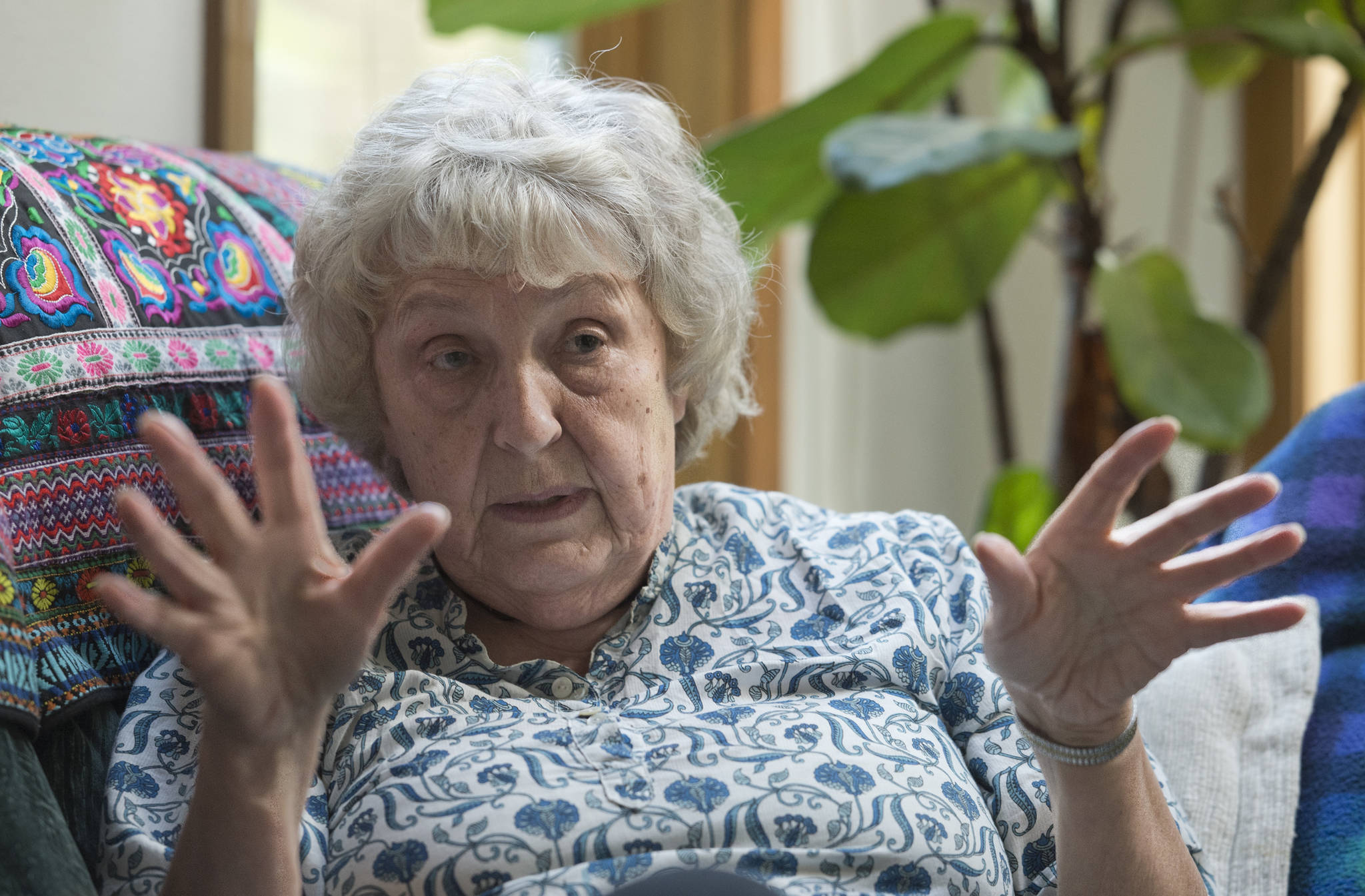
While recounting moments in her life, Dixie Belcher does not start off as you might expect.
“I think we all have our own path and my path happened to be quite nuts,” Belcher laughs. “I’m writing a biography and it’s called ‘By Accident: The Story of an Unplanned Life.’”
On May 4th, 2017, Belcher became one of 11 women inducted into the Alaska Women’s Hall of Fame.
Belcher was born in Juneau on May 20, 1940 and attended Juneau High School where she was to meet and become lifelong friends with Karleen Grummett, the woman who nominated Belcher for the Alaska Women’s Hall of Fame. Grummett saw this nomination as a way to eulogize Belcher while both women are still alive.
[Video: Dixie Belcher talks about her life experiences]
“I looked over her life — I’m 75 and she’s soon to be 77 — and when you take in the total of somebody’s life, she’s done so much,” Grummett said.
Dixie graduated from Northwestern University in the early ’60s with a sociology degree and music minor. She returned to Juneau with her husband Fred and both held jobs with the State. In 1971, Fred was killed in a helicopter crash while on assignment, leaving Dixie responsible for the well-being of their two young daughters.
After her husband’s death, Dixie did not sit still. Her commitment to social justice initiatives led her to create organizations that did not exist in Juneau, such as Juneau Hospice. She even went as far as to bring Dr. Elisabeth Kübler-Ross, author of “On Death and Dying,” to Southeast in 1979 so that cancer care and end-of-life issues would gain more attention.
In a generation where career success was defined by working a job 30 years or more, Dixie managed to form, write music for and direct the Juneau St. Paul Singers; create the Alaska Wilderness Experience group for teens to learn about their environment; organize 40 Goodwill Ambassadors to advocate throughout Alaska to keep the capitol in Juneau; and use her love of music to create Performing Artists for Peace — a group comprised of 67 performers from statewide arts organizations such as the Tanqik Theatre in Chevak, the Juneau Folksingers and Dancers, the Nunamta Dancers from Bethel, the Savoonga Comedy Players, the Anchorage Gospel Choir and the Yukon Fiddle Band of Fairbanks.
Through music, the Performing Artists for Peace led the movement to open the border between Russia and Alaska, Dixie’s biggest and most dangerous contribution yet. Despite bomb threats and disputes between Russia and the United States in the ’80s, Dixie and her group crossed 11 time zones and traveled 7,800 miles to sing multilingual songs of peace and kindness before thousands of Soviets who applauded the group.
“I was working with Gennadi Gerasimov, the spokesperson for Gorbachev and the spokesperson for the Soviet Union,” Belcher said. “We eventually got an award from the Russian Peace Committee for opening the border and Gennadi said when we got [the award], ‘While the rest of the world was focusing on Moscow and Washington, Dixie and I ran around and opened the back door.’”
The results of opening this back door were two-fold. It raised attention to the “Ice Wall” that had separated Siberian and Alaskan Yup’ik relatives for 40 years while improving overall relations between Russia and the United States.
Just two years after those life-changing concerts in Russia, the Bering Strait opened with Alaska Airlines’ Friendship Flight to Provideniya and a sailboat voyage of Alaska Eskimos to Novoye Chaplino. At last the “Ice Wall” had melted, spurring the reunion of Siberian and Alaskan Yup’ik relatives for the first time since separation.
Belcher turned 77 on Saturday, May 20, and still advises others to follow their passions.
“Find what you love to do, and go do it,” Belcher said. “It is overwhelming. Gandhi said, ‘Nobody can do everything, but we all can do our part.’”
• Ray Friedlander is a freelance writer based out of Douglas.
