
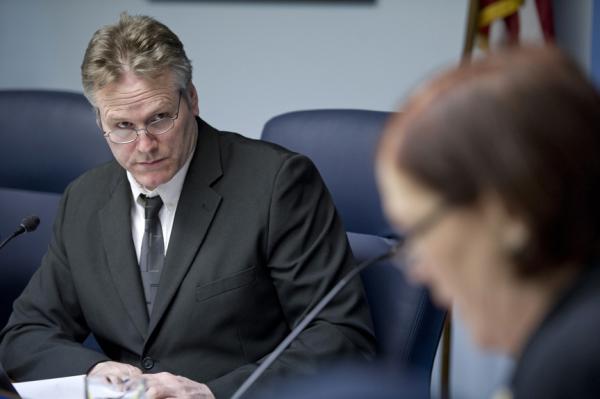
Sen. Mike Dunleavy, R-Wasilla, believes he’s found a way Alaska can erase its multibillion-dollar deficit and guarantee big Permanent Fund dividends — without tax increases.
On Tuesday, Dunleavy — a member of the powerful Senate Finance Committee — unveiled a budget plan calling for $1.1 billion in additional cuts to the state budget. Those cuts would be spread across four years and would address about 40 percent of the state’s $2.65 billion annual deficit.
The remaining 60 percent of the deficit would be covered by a portion of the Alaska Permanent Fund’s investment earnings.
“It does not require new taxes; it does not require the taking or manipulation of the dividend,” Dunleavy said by phone Wednesday.
There are now effectively four proposals for balancing the state’s deficit: one from Gov. Bill Walker, one from Dunleavy, one proposed (in outline) by the Republican-led Senate Majority, and one expected from the coalition House Majority.
Under Dunleavy’s plan, the Permanent Fund’s earnings would be split 50/50; half for dividends, half for government services.
“We allow the dividend to be calculated as it always has been,” he said.
Dunleavy said his principal goals with the plan are to balance the budget, leave the dividend unchanged, and avoid taxes on the private economy.
“You really don’t want to take money out of the private economy as it’s shedding jobs,” he said.
Dunleavy’s plan — as do others circulating in the Legislature — relies on projections by the Permanent Fund Corporation about future earnings and Alaska Department of Revenue forecasts about future oil prices.
The biggest obstacle to Dunleavy’s plan is the cut. The governor’s proposed budget for fiscal year 2018 includes $4.33 billion in unrestricted general fund spending, things that aren’t paid for with fees, federal money or program-specific money.
That figure is already 28.8 percent smaller than it was in fiscal year 2015, when the big cost-cutting started. Dunleavy’s cuts would drop that figure to $3.23 billion, or barely more than 50 percent of the FY15 figure.
“There’s no doubt about it — that’s going to be the sticking point,” Dunleavy said of the cuts.
Rep. Andy Josephson, D-Anchorage and a member of the House Majority, agreed with Dunleavy’s assessment.
“If he said it’s going to be darn hard to do, he’s right about that,” Josephson said. “While there are additional surgical cuts that could be made, I don’t think there’s a whole lot of additional cutting that could be made” without significantly affecting services.
In the extent of its cuts, Dunleavy’s proposal is deeper even than that of his fellow Senate Majority members, who said in a statement last week that they intend to propose $750 million in cuts spread over three years.
Asked whether Dunleavy’s proposal represents a change from that plan, Senate President Pete Kelly, R-Fairbanks, said by email that “The caucus hasn’t taken a position on it yet, one way or another” and “We look forward to looking at Mike’s plan as it works its way through the process.”
Dunleavy said he believes his plan is “in many respects, very similar — if not the same” as the previously announced Senate Majority outline.
Both plans involve significant budget cuts, both plans involve spending the earnings of the Permanent Fund, both plans involve preserving a significant dividend, and both plans call for a firm spending cap to keep expenses low in future years.
Even Josephson said some elements of Dunleavy’s proposal appear to be a foregone conclusion — in particular, the use of Permanent Fund earnings.
“That part of Sen. Dunleavy’s plan, I broadly agree with it,” Josephson said.
While the two men might disagree about the details of using those earnings, “it’s the low-hanging fruit” for balancing the budget, Josephson said, because it doesn’t directly affect dividends or impose new taxes.
Josephson and Dunleavy also agree on another important aspect of the budget: “He’s also right that something must happen this year,” Josephson said. “He’s absolutely right about that.”
The 30th Alaska Legislature convenes Tuesday.
