
The Alaska Senate has proposed slashing the state’s public education system, university system, department of transportation, and health care.
The Senate Finance Committee on Monday approved a plan — which was opposed by the House — that cuts $211 million from the state’s operating budget in order to balance the state’s $2.8 billion annual budget deficit.
Sen. Mike Dunleavy, R-Wasilla, a member of the Senate’s Republican-led majority, said his constituents would rather have more spending cuts to balance the budget, rather than implementing an income tax or dipping into the earnings of the Permanent Fund.
“I’ve got numerous calls from constituents saying they want more,” Dunleavy said.
The Legislature has already cut Alaska’s budget 44 percent since 2012.
The new proposed cuts, which will face a vote of the full Senate later this week, will affect nearly every Alaskan who attends a public school or rides a ferry.
It proposes a $50 million cut to the Alaska Department of Health and Social Services, almost $22 million from the University of Alaska, and millions from the Department of Transportation. The Alaska Marine Highway, for example, would be required to come up with $40 million more per year from fares and other revenue.
But the Senate’s biggest proposed cuts were to education. Right now, the state’s education budget is $1.62 billion. This bill lowers that to $1.57 billion.
The Senate is proposing to reduce per-student funding by about $265 per student, staffers said. In Juneau, where the school district estimates just under 5,000 students in the 2017-2018 year, that would result in an immediate cut of about $1.3 million. (That figure does not include possible reductions in the cap on local funding which might come because the cap is based upon the amount the state contributes.)
The Legislative Finance Division of the Legislature was analyzing the impact on a per-district level, and figures were not immediately available Monday.
Three bills were introduced by the Senate Majority Monday to cut education costs. The first would eliminate the state’s $17 million-per-year scholarship program for high-performing students. The second would suspend Alaska’s requirement for regular curriculum reviews. The third would encourage — with money saved from the elimination of scholarships — school districts to improve virtual education programs. Virtual education, the so-called “teacher in a box,” allows teachers to present lessons through videoconferencing.
“The Senate has put out, I believe, quite a few bills that I feel will help us save billions of dollars over the long run,” said Sen. Anna MacKinnon, R-Anchorage and co-chairwoman of the Senate Finance Committee.
In a statement issued shortly after the budget bill moving out of the committee, House Majority Leader Chris Tuck, D-Anchorage, said the House’s coalition majority is opposed to such steep education cuts.
“Our coalition has made public education a priority and we will not sacrifice the future of our children for some short-term savings,” he said in a prepared statement.
The House’s rejection of the Senate’s proposed budget would send the state’s annual spending plan to a conference committee to iron out the differences.
In that case, the House budget would act as an upper bumper and the Senate’s as a lower bumper, with the eventual compromise somewhere in between.
Before that, the budget faces a floor vote in the Senate, where the five-person Senate minority will try to amend the proposal.
“I don’t like what happened today in committee,” said Sen. Dennis Egan, D-Juneau. “I’m really concerned about education. I’m concerned about the Alaska Marine Highway System — still — and I like our idea of an income tax. We’ll have some amendments.”
The Senate’s budget must be reconciled with the separate version passed by the House, and negotiations are expected to continue through the weeks (and possibly months) ahead as lawmakers debate not only how much to spend, but how to pay for that spending.
“We as a state are continuing to struggle with the fact that we are living beyond our means today,” said Sen. Lyman Hoffman, D-Bethel and the finance co-chairman in charge of the budget.
“We have stepped down significantly in four years, and we continue to do so,” said Senate Majority Leader Peter Micciche, R-Soldotna.
Correction: The first version of this story incorrectly referred to the five-person Senate Minority as the Senate Majority.
• Contact reporter James Brooks at james.k.brooks@juneauempire.com or call 419-7732.
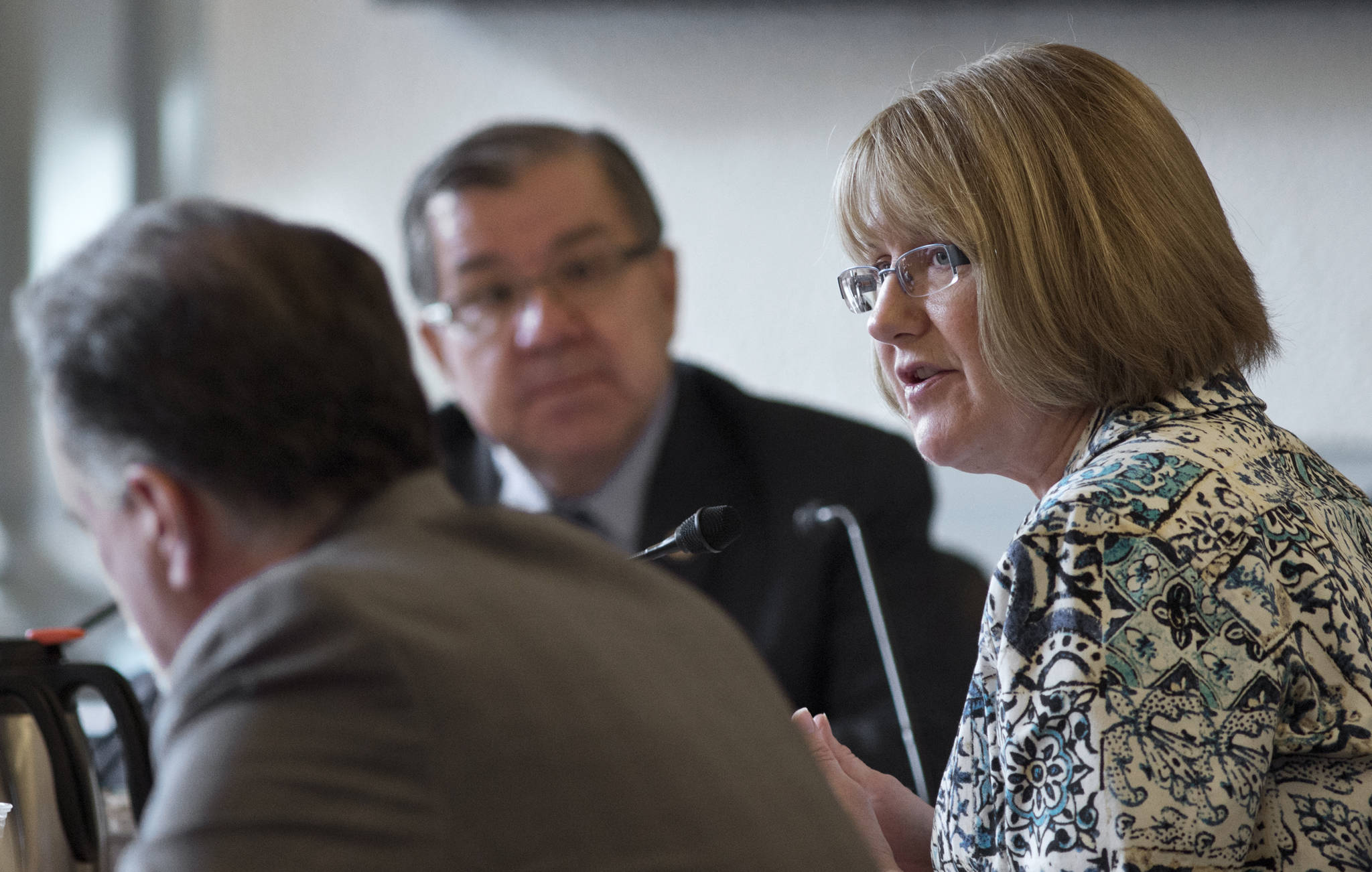
Senate Finance Committee co-chair Sen. Anna MacKinnon, R-Eagle River, asks a question during work on the operation budget bill as co-chair Sen. Lyman Hoffman, D-Bethel, watches at the Capitol on Monday, April 3, 2017. (Michael Penn | Juneau Empire)
