
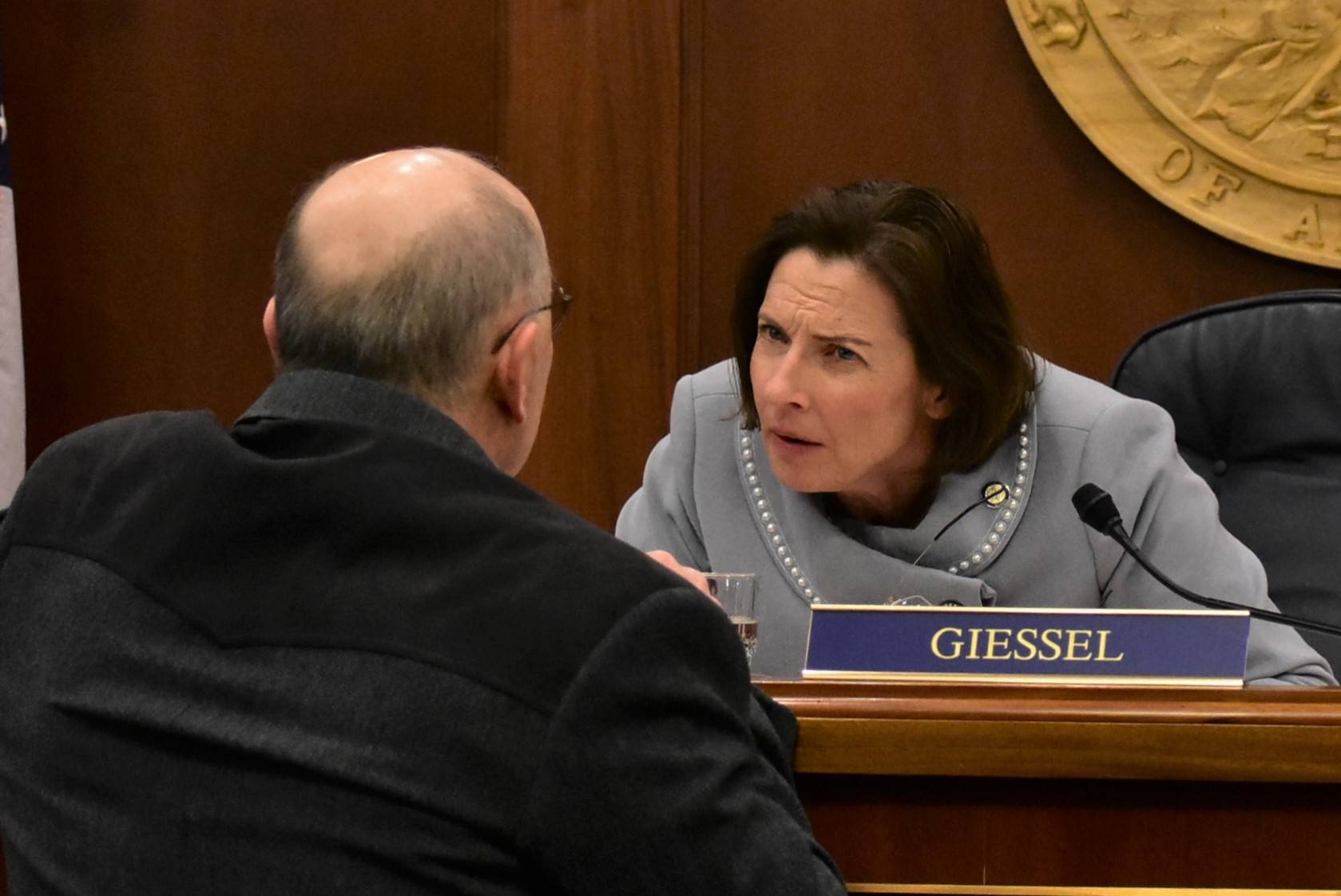
The Senate passed a state budget bill with $12.6 billion in funding after several hours of debate on the floor Monday.
Contained in the budget was $75 million in emergency funding for the COVID-19 crisis and unlimited federal receipt authority for Gov. Mike Dunleavy to accept funds from the federal government.
Senators also voted for a $1,000 emergency relief payment to Alaskans who qualified for the 2019 Permanent Fund Dividend to be sent out in the coming weeks.
Sen. Mike Shower, R-Wasilla, who introduced the amendment, had earlier tried to add an amendment allocating a $1,300 supplemental PFD, but that motion narrowly failed, 10-9.
Shower argued that by mandating the closure of businesses the state owed a responsibility to Alaskans to help ease their financial strain.
“We are killing (people’s) livelihood,” Shower said. “People need help right now, and we can’t wait for help from the federal government.”
The U.S. Congress is currently weighing making cash payments to Americans but supporters of Shower’s amendment, including some Democrats, argued there wasn’t time to wait.
Opponents, including Senate Finance Co-Chairs Sens. Natasha Von Imhof, R-Anchorage and Bert Stedman, R-Sitka, said while they agreed Alaskans were in need, PFDs would be sent to every Alaskan, even those who aren’t in financial need.
Sen. Jesse Kiehl, D-Juneau, cited many of the essential services provided by the state such as police and public health care. It made more sense, he said, to keep that money where it could be most effective, such as funding health services to combat the COVID-19 outbreak.
“It’s the difference between a ripple in the water and a wave,” he said.
Though Shower’s initial amendment failed, his second attempt which allocated only $1,000 passed 12-7.
Shower and Sen. Lora Reinbold, R-Eagle River, attempted to add several amendments Monday, with most of them failing save for Shower’s payment amendment.
Reinbold proposed adding in a full statutory PFD of $3,000 — the bill which passed the Senate allocated $1,000 for 2020’s PFD — and tried to add intent language which would “extend the benefits” of the U.S. Supreme Courts decision in Janus v AFSCME.
Last year Attorney General Kevin Clarkson issued an opinion the state was not in compliance with that decision, which says public employee unions can no longer automatically collect union dues. That opinion was challenged by the unions in the state and the matter is still in the courts. Citing the ongoing court case that amendment failed 15-4.
When the budget came before the Senate Monday morning it allocated roughly $11.8 billion, but with additional amendments, it rose to nearly $12 billion. Shower’s $1,000 relief check amendment added $680 million to the state’s budget.
The bill still needs to be passed by the House, which has yet to pass the FY2020 supplemental budget sent to them by the Senate last week.
That bill contained additional funding for COVID-19 relief as well as language for the “reverse sweep,” an action to reverse an accounting mechanism that empties state accounts at the end of each fiscal year. Normally those accounts are automatically restored by an act of the Legislature, but in the past few years, the approval of the reverse sweep has been used as a bargaining chip by the House Minority for leverage over the majority.
[Without changes, GOP lawmakers see little reason to vote for supplemental budget]
Members of House Majority have said they will try to rescind the vote against the supplemental budget and try again, hoping the sense of urgency provided by the COVID-19 pandemic will motivate members to pass the bill.
Asked what happens if the House fails to do that, Stedman told reporters following Monday’s floor session, “they might want to consider that.”
“If they don’t get (the supplemental budget) across the finish line, then those funds would be swept,” Stedman said. “My concern is we’ll have a lot of federal money coming in that’ll be sitting in those accounts, and it’ll restrict the flexibility that the governor has to even respond.”
After the vote on the budget, that Senate passed a resolution that would allow the Legislature to take a recess of more than three days if they can pass a budget. Some lawmakers are hoping to pass a budget and reconvene later in the year when the crisis has hopefully abated. Stedman said he hoped the Legislature could finish its business by the end of the week.
Both bodies were holding sessions into the evening Monday.
• Contact reporter Peter Segall at 523-2228 or psegall@juneauempire.com.
Information on the coronavirus is available from websites for the City and Borough of Juneau, the State of Alaska at coronavirus.alaska.gov and the Centers for Disease Control and Prevention. People with flu-like symptoms are encouraged to contact their health care provider.
